Kundur dinosaur locality
Arkhara District, Amur Region, Russia
Udurchukan Formation
regional marker
Pronunciation: oh-LOR-oh-TY-tan ar-har-EN-sis
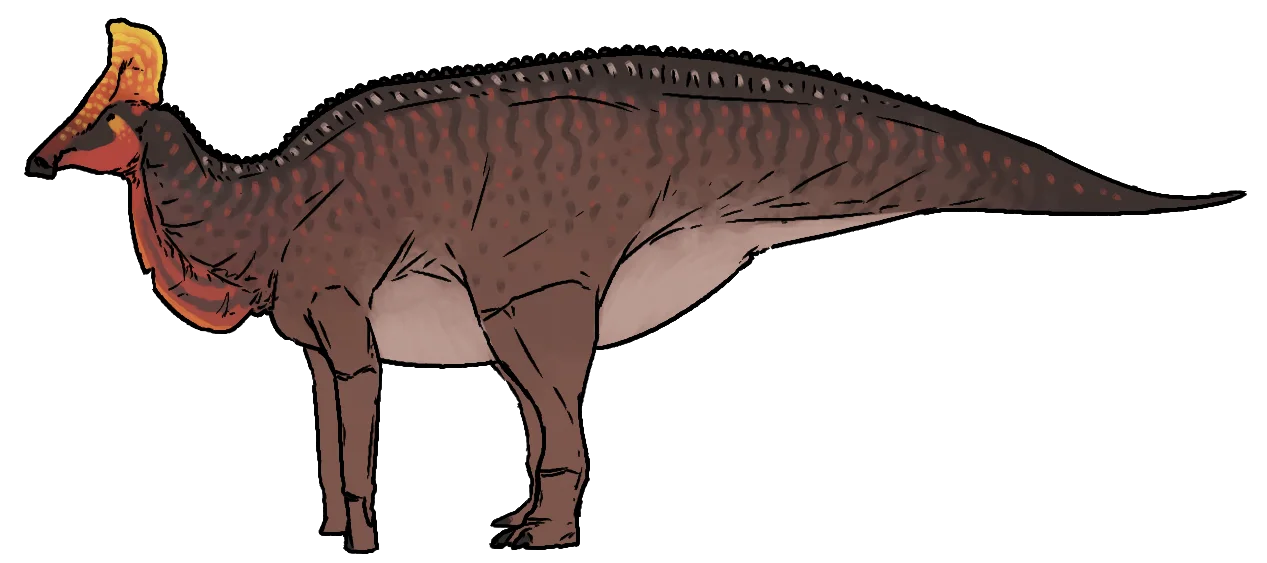
An exceptionally complete hollow-crested hadrosaur from Far Eastern Russia, recognised by its tall helmet-like crest and unusually long neck.
Last updated 23 July 2026
Field guide
Olorotitan arharensis was a lambeosaurine hadrosaur that lived near the end of the Cretaceous in what is now the Amur Region of Russia. Its holotype is a nearly complete, articulated skeleton and is among the best-preserved lambeosaurines found outside North America. Olorotitan combined the dental batteries and deep beak of other duck-billed dinosaurs with a distinctive hollow crest. Detailed redescription confirmed many unusual proportions, while also showing that deformation and restoration complicate some features of the mounted skeleton.
Its fossils occur between approximately 70.1 and 66 million years ago. Values shown here are approximate and reflect the current curated seed dataset.
Form and function
The skull carried a large, hollow crest whose back edge rose well above the braincase. Internal nasal passages passed through the crest, but their precise acoustic and display functions cannot be observed directly. Olorotitan had eighteen neck vertebrae, more than most hadrosaurids, creating an unusually elongated neck. The sacrum contained at least fifteen vertebrae, and the deep tail was stiffened by a lattice of ossified tendons. Its jaws bore densely packed replacement teeth forming dental batteries for processing vegetation.
Evolutionary position
This simplified classification path shows one placement from Dinosauria to this species. Each step is clickable, and other analyses may support alternative relationships.
Open interactive positionScale
Simplified length comparison using preferred dataset estimates; body shape and posture are not represented.
Scientific record
The holotype AEHM 2/845 was excavated at Kundur in the Arkhara District by Russian and Belgian teams between 1999 and 2001. Pascal Godefroit, Yuri Bolotsky and Vladimir Alifanov named Olorotitan arharensis in 2003, and Godefroit, Yuri Bolotsky and Ivan Bolotsky published a comprehensive osteological redescription in 2012. The genus name combines Latin olor, swan, with Greek titan, while the species name refers to Arkhara.
Naming authors: Pascal Godefroit, Yuri L. Bolotsky, Vladimir Alifanov.
Palaeoenvironment
The Udurchukan Formation at Kundur records a river and floodplain system in Far Eastern Russia during the Maastrichtian. The locality preserves a mixed dinosaur assemblage including hadrosaurids, theropods, turtles and crocodile-line reptiles. Olorotitan lived at high northern latitude, but the exact seasonal vegetation and climate it experienced remain reconstructed from regional geology rather than the skeleton alone.
Olorotitan could probably alternate between quadrupedal walking and bipedal movement, as inferred for other hadrosaurids. Its crest was connected to the nasal airway and may have supported visual recognition, sound production or both. Those roles are biomechanically plausible but cannot identify a particular call, colour pattern, social structure or mating display.
Worth knowing
Fossil distribution
Arkhara District, Amur Region, Russia
Udurchukan Formation
regional marker
Markers are deliberately approximate. They identify published fossil areas without exposing sensitive excavation coordinates.
Open interactive mapFossil specimen record
Blagoveshchensk, Russia
Repository of the nearly complete articulated holotype from Kundur. The scientific papers establish its collection, but continuous public display is not confirmed.
A research repository is not necessarily a public exhibit. Loan and display status can change, so check with the institution before visiting.
Media record
Evidence
Pascal Godefroit, Yuri L. Bolotsky, Vladimir Alifanov · Comptes Rendus Palevol 2(2), 143–151 · 2003
Open sourcePascal Godefroit, Yuri L. Bolotsky, Ivan Y. Bolotsky · Acta Palaeontologica Polonica 57(3), 527–560 · 2012
Open source