Gadoufaoua fossil region
Ténéré Desert, Agadez Region, Niger
Elrhaz Formation
regional marker
Pronunciation: oo-RAN-oh-SORE-us nye-JEER-ee-EN-sis
A large, deep-bodied iguanodontian from Niger with a broad beak, thumb spikes and a spectacular row of elongated vertebral spines.
Last updated 16 July 2026
Field guide
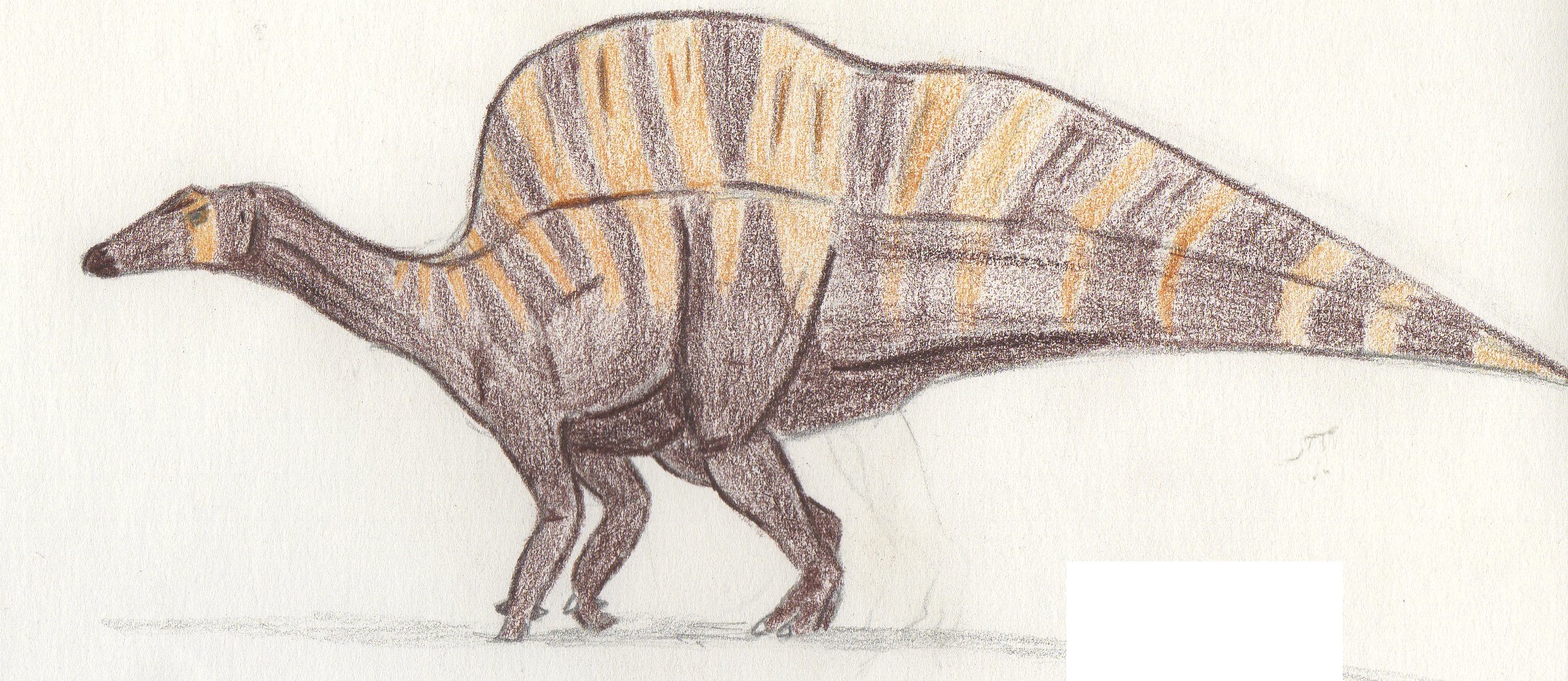
Ouranosaurus nigeriensis was a distinctive iguanodontian herbivore from the Elrhaz Formation of Niger. Two unusually complete skeletons reveal a deep torso, powerful forelimbs, a broad duck-like beak and tall neural spines over the back and front of the tail. Those spines certainly supported expanded soft tissue, but fossils do not show whether the living outline was a thin display sail, a thick muscular and fatty ridge, or something between them. Ouranosaurus sits close to the evolutionary grade that produced duck-billed dinosaurs without itself being a true hadrosaurid.
Its fossils occur between approximately 125 and 112 million years ago. Values shown here are approximate and reflect the current curated seed dataset.
Form and function
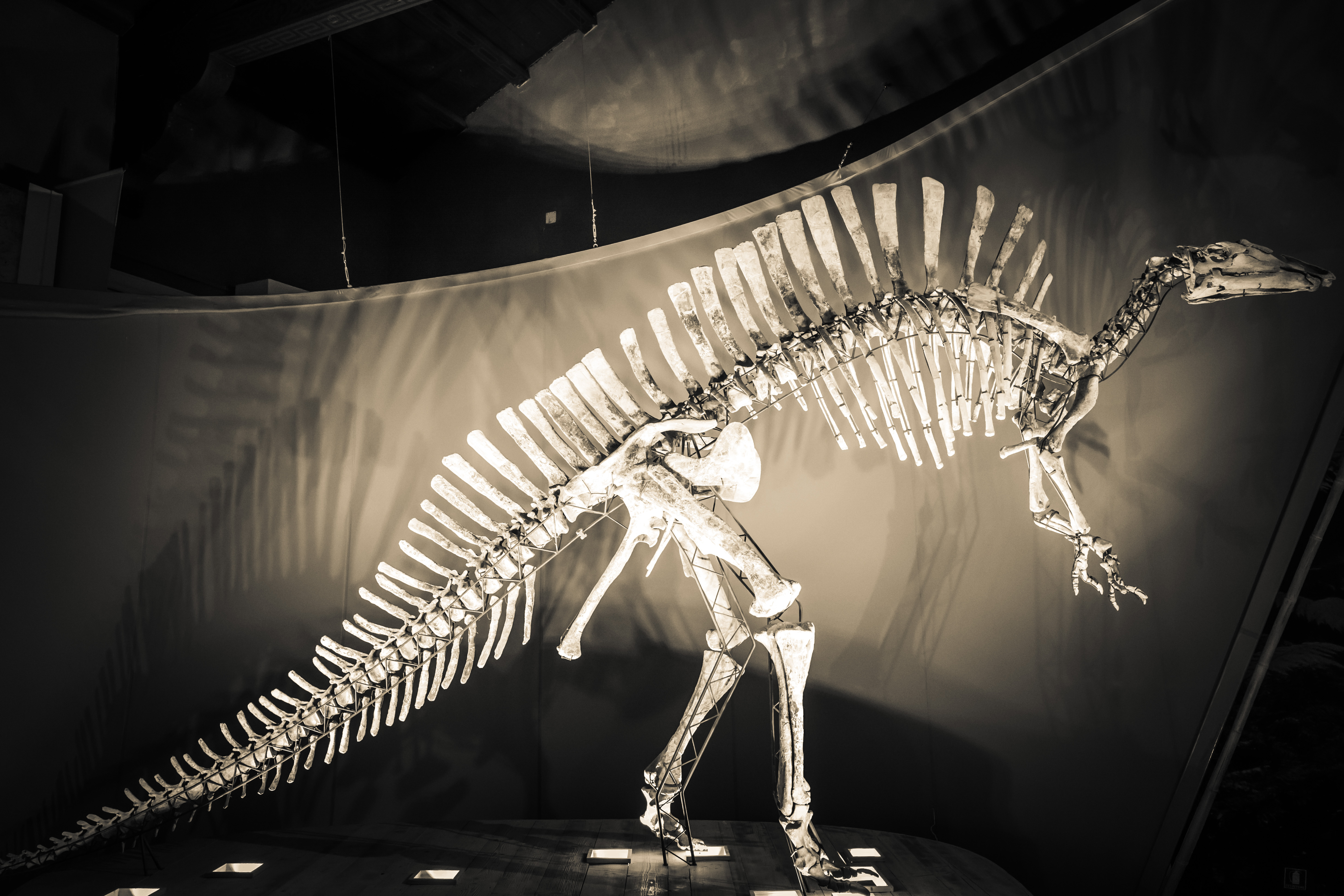
The skull was low and broad at the muzzle, with a keratin-covered beak at the front and dense batteries of leaf-shaped cheek teeth farther back. Each hand had a conical thumb spike, three central weight-bearing digits and a mobile outer finger. Robust arms show that it could stand and walk on all fours, while the hind limbs and balancing tail also permitted bipedal movement. Neural spines over the trunk reached many times the height of their centra and continued onto the tail. Their thickened bases and ligament scars confirm substantial soft-tissue support but do not preserve its external shape.
Evolutionary position
This simplified classification path shows one placement from Dinosauria to this species. Each step is clickable, and other analyses may support alternative relationships.
Open interactive positionScale
Simplified length comparison using preferred dataset estimates; body shape and posture are not represented.
Scientific record
Philippe Taquet's French expedition found the first major skeleton, GDF 300, at Gadoufaoua in 1965. Taquet introduced the name informally before publishing the formal monographic description in 1976. A later French-Italian expedition recovered another nearly complete skeleton that became the celebrated Venice mount, now catalogued MSNVE 3714. Detailed re-examination in 2017 showed that this mount incorporates the original paratype GDF 381 and clarified which bones are genuine, reconstructed or from more than one individual. The species name refers to Niger, while Ourane is a Tuareg-derived word translated as brave or courageous.
Discovery credit: Philippe Taquet, French Gadoufaoua expedition.
Naming authors: Philippe Taquet.
Palaeoenvironment
Gadoufaoua lay on a low-relief Early Cretaceous floodplain crossed by rivers and dotted with lakes and wetlands. The Elrhaz Formation preserves abundant fish, turtles, crocodile-line reptiles and dinosaurs, including the predator Suchomimus and the giant crocodyliform Sarcosuchus. Vegetation and water were likely concentrated around channels during dry intervals. Fossils accumulated across time and space, so the formation's famous animals should not all be imagined in one permanent gathering.
Ouranosaurus could crop vegetation on four limbs and rear or move bipedally when useful. Its cheek teeth processed tough plant matter, while the deep trunk accommodated a large digestive system. The tall-spined back has inspired hypotheses involving display, temperature control, fat storage and support of a thick ridge. Bone alone cannot yet distinguish these soft-tissue models, and there is no preserved colour pattern, mating display or thermoregulatory measurement. Thumb spikes were potential defensive or foraging tools, but their exact use is not directly recorded.
Worth knowing
Fossil distribution
Ténéré Desert, Agadez Region, Niger
Elrhaz Formation
regional marker
Markers are deliberately approximate. They identify published fossil areas without exposing sensitive excavation coordinates.
Open interactive mapFossil specimen record
Niamey, Niger
Repository associated with the original nearly complete holotype after study in France. Public-display arrangements may change, so this historical repository entry should be checked with the museum before travel.
Venice, Italy
Nearly complete mounted skeleton incorporating the paratype GDF 381, with reconstructed and composite portions documented by the 2017 revision. The museum's current guide lists it in the Niger expedition galleries.
A research repository is not necessarily a public exhibit. Loan and display status can change, so check with the institution before visiting.
Media record
Evidence
Philippe Taquet · Cahiers de Paléontologie · 1976
Open sourceFilippo Bertozzo, Fabio Marco Dalla Vecchia, Matteo Fabbri · PeerJ 5, e3403 · 2017
Open sourceNatural History Museum of Venice Giancarlo Ligabue
Open source