Dinosaur Provincial Park region
Alberta, Canada
Dinosaur Park Formation
regional marker
Pronunciation: PAIR-ah-sore-OL-oh-fus WALK-er-eye
A rare Canadian hadrosaur with a long, backward-projecting tubular crest. Its exceptionally important holotype preserves a complete skull and a partial skeleton, including healed injuries that the animal survived.
Last updated 13 July 2026
Field guide
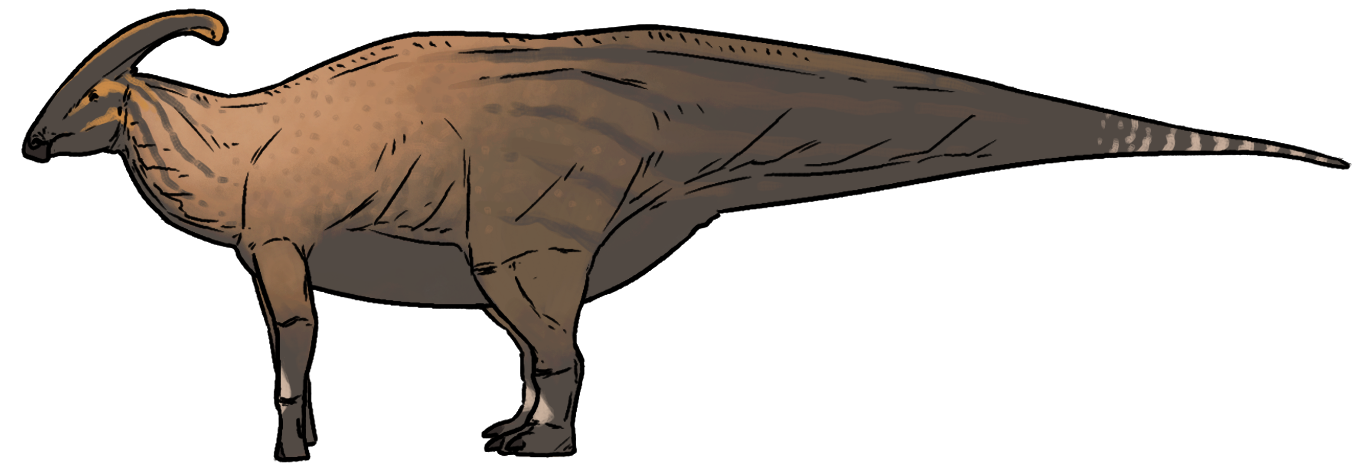
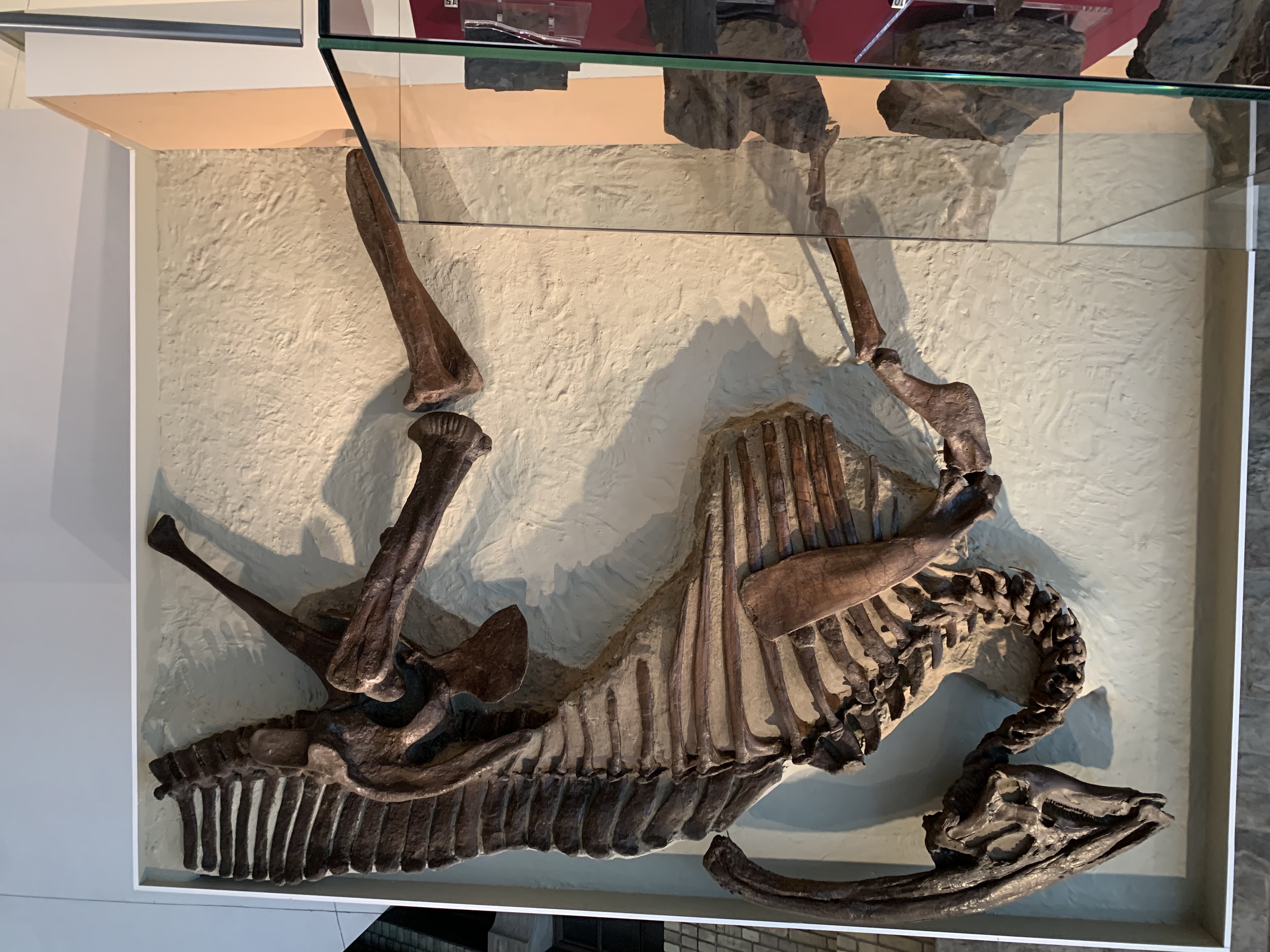
Parasaurolophus walkeri was a large lambeosaurine hadrosaur from the Campanian Dinosaur Park Formation of Alberta. Its crest contained elongated nasal passages that looped from the nostrils to the tip of the crest and back into the skull. The crest probably combined visual display with sound resonance, although no fossil can reveal an exact call. Almost everything diagnostic about this species rests on ROM 768, a skull and partial skeleton that remains one of the most recognisable dinosaur fossils in the Royal Ontario Museum.
Its fossils occur between approximately 77 and 76 million years ago. Values shown here are approximate and reflect the current curated seed dataset.
Form and function
ROM 768 preserves the complete skull and much of the trunk and limbs, but most of the tail and the hind limbs below the knees are missing. The long crest is built mainly from the premaxillae and nasals and carries paired air passages through most of its length. A broad, toothless beak cropped plants, while tightly packed dental batteries continually replaced worn teeth. The forelimbs could support the body during ordinary walking and feeding, while the more powerful hind limbs also permitted bipedal movement.
Evolutionary position
This simplified classification path shows one placement from Dinosauria to this species. Each step is clickable, and other analyses may support alternative relationships.
Open interactive positionScale
Simplified length comparison using preferred dataset estimates; body shape and posture are not represented.
Scientific record
A University of Toronto field party found ROM 768 near Sand Creek along Alberta's Red Deer River in 1920. William Arthur Parks described the animal in 1922, choosing Parasaurolophus—'near Saurolophus' or 'near-crested lizard'—for its resemblance to the shorter-crested Saurolophus. The species name walkeri honours Sir Byron Edmund Walker, a major supporter and chair of the Royal Ontario Museum's board. Later study showed that the type skeleton records several healed injuries, including damaged ribs and unusual vertebral bone growth.
Discovery credit: University of Toronto field party.
Naming authors: William Arthur Parks.
Palaeoenvironment
P. walkeri lived on warm, humid coastal lowlands crossed by rivers and floodplains west of the Western Interior Seaway. The Dinosaur Park Formation supported conifers, flowering plants, ferns and dense waterside vegetation. Corythosaurus, Lambeosaurus, ceratopsids, ankylosaurs and predators such as Gorgosaurus and Daspletosaurus occupied the same broad ecosystem, although not every species occurred at exactly the same place and time.
Parasaurolophus used its beak and dental batteries to crop and process fibrous plants. Computer and physical models show that the crest could resonate at low frequencies in adults, and a juvenile specimen of the genus indicates that resonance changed as the crest grew. This supports an acoustic signalling role alongside visual display, but it does not reproduce the animal's actual voice. Hadrosaurs sometimes formed groups, yet the rarity of P. walkeri provides no direct basis for assigning it a particular herd structure. Healed damage in ROM 768 shows that this individual survived substantial trauma.
Worth knowing
Fossil distribution
Alberta, Canada
Dinosaur Park Formation
regional marker
Markers are deliberately approximate. They identify published fossil areas without exposing sensitive excavation coordinates.
Open interactive mapFossil specimen record
Toronto, Canada
Original, slab-mounted holotype ROM 768: a complete skull with a partial associated skeleton collected in Alberta in 1920. Most of the tail and the hind limbs below the knees are absent. The ROM's 2026 visitor guide confirms the specimen is on Level 2 and describes it as the best-known specimen of the genus.
A research repository is not necessarily a public exhibit. Loan and display status can change, so check with the institution before visiting.
Media record
Evidence
William Arthur Parks · University of Toronto Studies, Geological Series 13 · 1922
Open sourceDavid B. Weishampel · Paleobiology · 1981
Open sourceAndrew A. Farke, Derek J. Chok, Annisa Herrero and 2 coauthors · PeerJ · 2013
Open sourceFilippo Bertozzo, Fabio Manucci, Matthew Dempsey and 4 coauthors · Journal of Anatomy · 2021
Open sourceRoyal Ontario Museum · 2026
Open source