Rahioli–Temple Hill fossil region
Kheda District, Gujarat, India
Lameta Formation
regional marker
Pronunciation: RAH-jah-SORE-us nar-mah-DEN-sis
A stoutly built Indian abelisaurid known from an associated partial skeleton with a thickened skull roof and distinctive low median horn.
Last updated 25 July 2026
Field guide
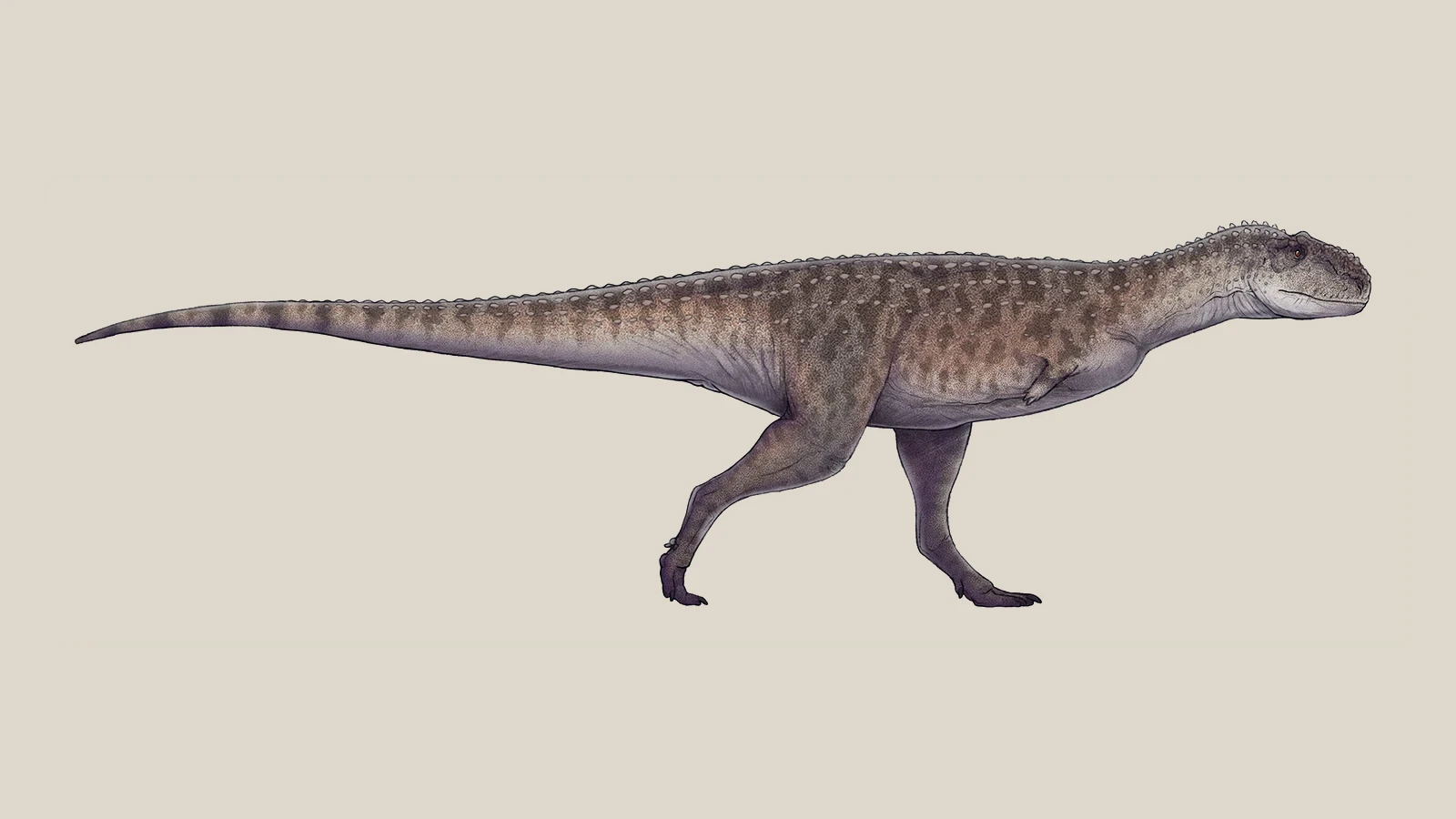
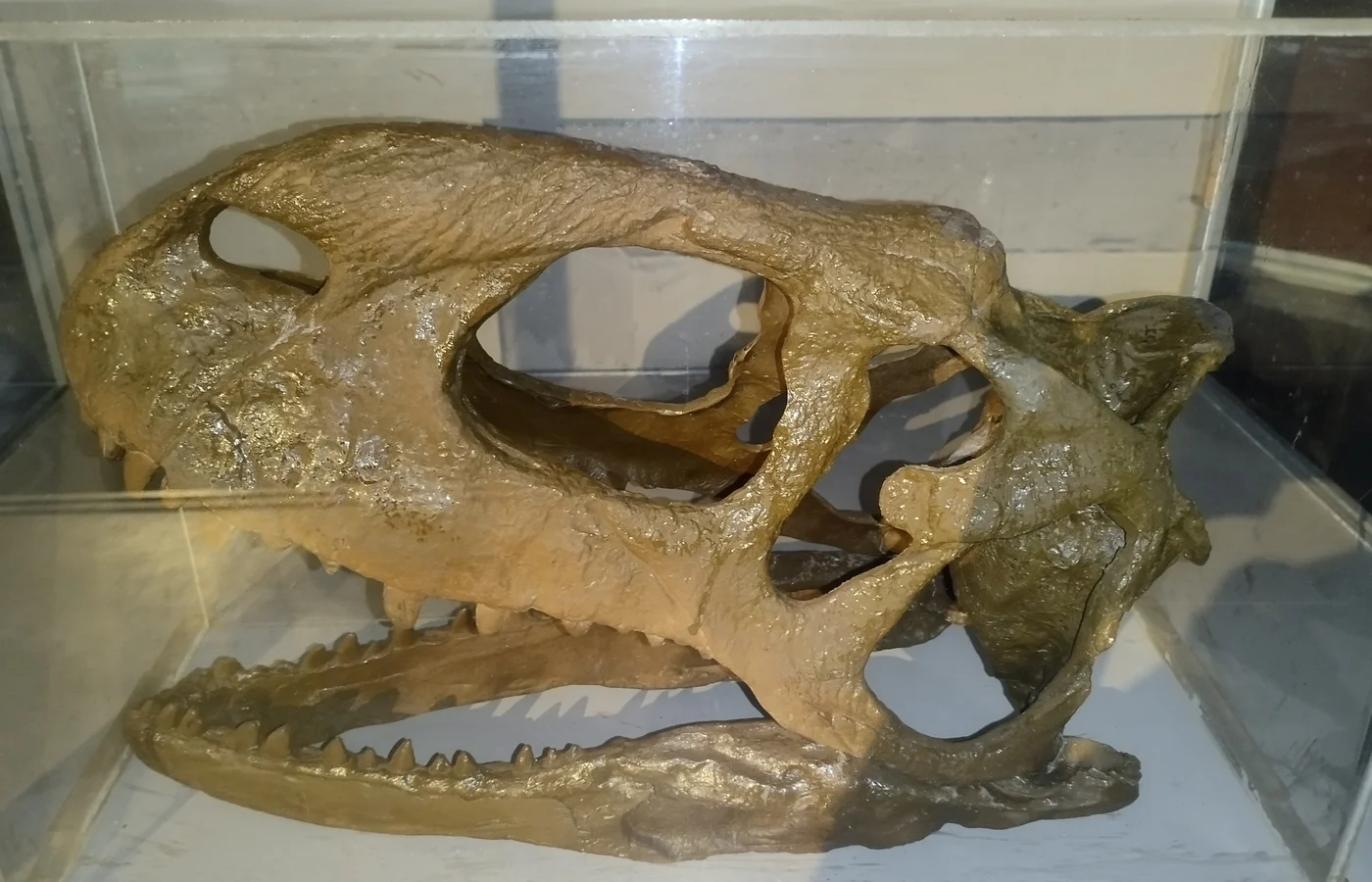
Rajasaurus narmadensis was a large abelisaurid predator from the latest Cretaceous Lameta Formation of western India. Unlike many Indian theropods named from isolated bones, it is represented by associated cranial and postcranial remains from one individual. The preserved braincase and skull-roof bones carry a unique low, rounded protuberance where the nasal and frontal bones meet. Vertebrae, pelvic bones and parts of the hind limbs show that it was a robust animal, but most of the face, arms, feet and tail are unknown and must be reconstructed from related abelisaurids.
Its fossils occur between approximately 70 and 66 million years ago. Values shown here are approximate and reflect the current curated seed dataset.
Form and function
The skull roof was thick and bore a single low median horn or boss above the eyes. Exceptionally long openings on the top of the braincase and details of the neck vertebrae distinguish Rajasaurus from other abelisaurids. The ilium was powerfully built and the preserved femoral, tibial and metatarsal elements indicate stout hind limbs. Its short deep face, tiny forelimbs and many external details are inferred from relatives such as Majungasaurus and Carnotaurus rather than preserved directly in the holotype.
Evolutionary position
This simplified classification path shows one placement from Dinosauria to this species. Each step is clickable, and other analyses may support alternative relationships.
Open interactive positionScale
Simplified length comparison using preferred dataset estimates; body shape and posture are not represented.
Scientific record
Geological Survey of India crews excavated associated dinosaur bones from mapped pits at the Temple Hill locality near Rahioli village between 1982 and 1984. Jeffrey Wilson, Paul Sereno, Suresh Srivastava, Devendra Bhatt, Ashu Khosla and Ashok Sahni recognized the cranial and postcranial bones as one distinctive abelisaurid and named Rajasaurus narmadensis in 2003. The holotype, GSI 21141/1–33, comprises 33 catalogued elements. The genus uses the Sanskrit-derived raja, meaning prince or ruler, while the species name refers to the Narmada region.
Discovery credit: Suresh Srivastava, Geological Survey of India field crews.
Naming authors: Jeffrey A. Wilson, Paul C. Sereno, Suresh Srivastava and 3 coauthors.
Palaeoenvironment
The Lameta Formation of western India records river channels, floodplains and soils that developed shortly before the end-Cretaceous Deccan volcanic eruptions. Rajasaurus shared this landscape with titanosaurian sauropods, other abelisaurids, crocodile-line reptiles, turtles and abundant dinosaur nesting sites. The regional marker on the map is intentionally broader than the excavated Temple Hill pits.
Its serrated theropod teeth and abelisaurid anatomy identify Rajasaurus as a large-bodied carnivore. The thick skull roof and low horn may have served as a visual signal, but combat and head-butting are not demonstrated by the fossils. There is no direct evidence for pack hunting, parental care or a preferred prey species. Its feeding and locomotor behaviour are therefore inferred chiefly from anatomy and comparison with other abelisaurids.
Worth knowing
Fossil distribution
Kheda District, Gujarat, India
Lameta Formation
regional marker
Markers are deliberately approximate. They identify published fossil areas without exposing sensitive excavation coordinates.
Open interactive mapFossil specimen record
Kolkata, India
The Geological Survey of India repository holds holotype GSI 21141/1–33, the associated cranial and postcranial material described in 2003.
A research repository is not necessarily a public exhibit. Loan and display status can change, so check with the institution before visiting.
Media record
Evidence
Jeffrey A. Wilson, Paul C. Sereno, Suresh Srivastava and 3 coauthors · Contributions from the Museum of Paleontology, University of Michigan 31(1), 1–42 · 2003
Open sourceNatural History Museum, London
Open source