Tolman Ferry type region
Red Deer River, central Alberta, Canada
Horseshoe Canyon Formation
regional marker
Pronunciation: SORE-oh-LOAF-us OZ-born-eye
A large Canadian duck-billed dinosaur known from a nearly complete skeleton, a solid backward-pointing crest and patches of fossilised skin.
Last updated 16 July 2026
Field guide
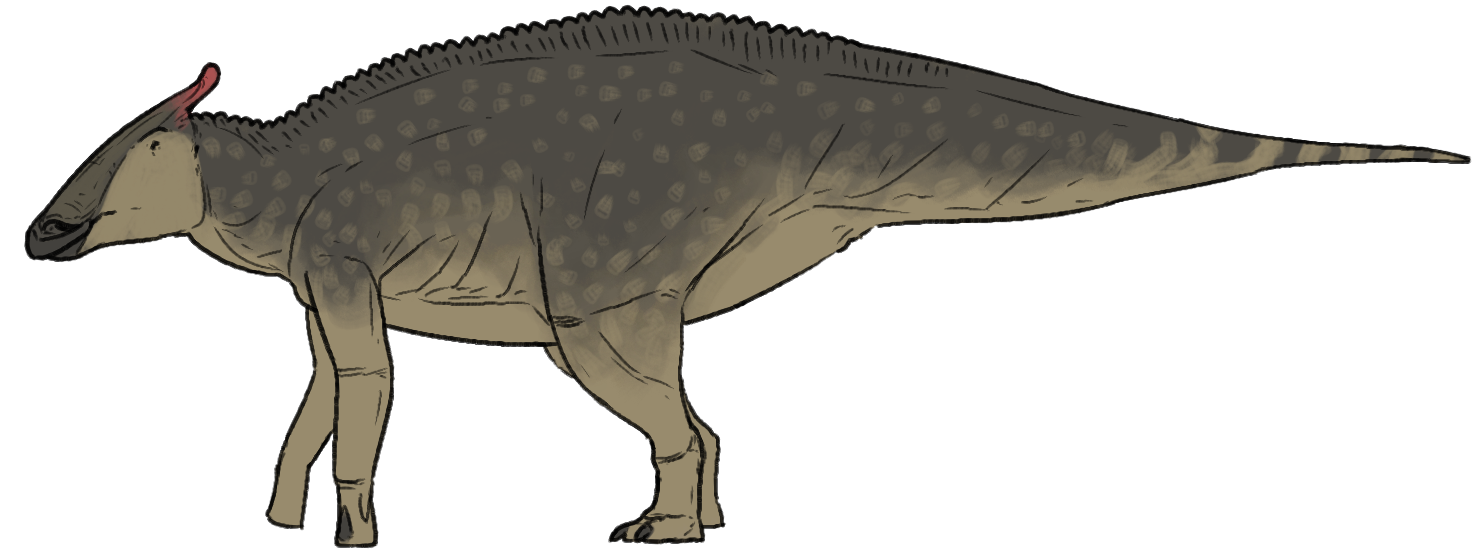
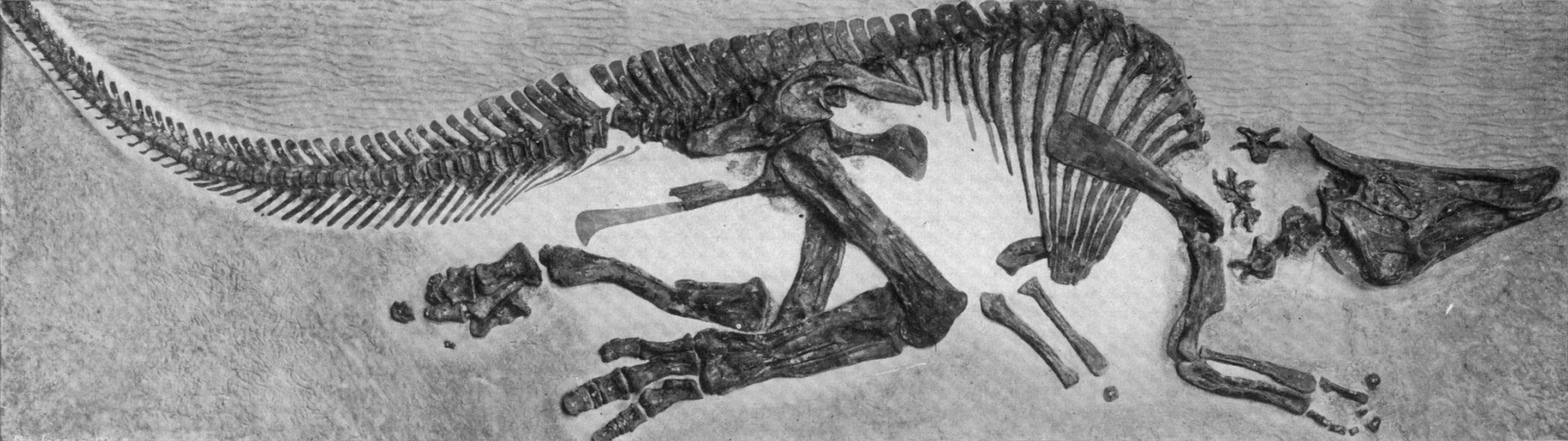
Saurolophus osborni was a large solid-crested hadrosaur from the upper Horseshoe Canyon Formation of Alberta. Unlike the long hollow tubes of Parasaurolophus and Corythosaurus, its spike-like crest was built mainly from solid nasal bone and projected upward and backward from the skull roof. The nearly complete holotype preserves the animal from skull to tail and made Saurolophus one of the first hadrosaurs known from such an informative skeleton. A second, larger species from Mongolia shows that this genus ranged across Late Cretaceous Asia and North America, although this profile concerns only the Canadian type species.
Its fossils occur between approximately 72.2 and 69.6 million years ago. Values shown here are approximate and reflect the current curated seed dataset.
Form and function
The skull ended in a broad toothless beak followed by dental batteries containing hundreds of continually replaced teeth. Its narrow solid crest was buttressed by extensions of the frontal and prefrontal bones. Powerful hind limbs, shorter forelimbs with hoof-like fingers and a stiffened tail allowed both four-legged walking and bipedal movement. Ossified tendons reinforced the spine. Skin impressions associated with early specimens show a covering of small scales, while the precise outline and colour of soft tissue around the crest remain unknown.
Evolutionary position
This simplified classification path shows one placement from Dinosauria to this species. Each step is clickable, and other analyses may support alternative relationships.
Open interactive positionScale
Simplified length comparison using preferred dataset estimates; body shape and posture are not represented.
Scientific record
Barnum Brown and an American Museum of Natural History crew discovered the nearly complete skeleton AMNH 5220 beside Alberta's Red Deer River in 1911. Brown named Saurolophus osborni in 1912 and followed it with a detailed skeletal monograph in 1913. The species honours American Museum president Henry Fairfield Osborn. The holotype was prepared as a dramatic panel mount that preserves the side on which the animal lay in the ground. Later skulls, including AMNH 5221 and CMN 8796, allowed Phil Bell to redescribe the crest and braincase in 2011.
Discovery credit: Barnum Brown, American Museum Alberta expedition.
Naming authors: Barnum Brown.
Palaeoenvironment
The upper Horseshoe Canyon Formation records river channels, floodplains, swamps and coastal lowlands near the retreating Western Interior Seaway. Conifers, flowering plants and wetland vegetation supplied abundant food. Saurolophus shared the broader formation with Edmontosaurus, Hypacrosaurus, ceratopsians, armoured dinosaurs and tyrannosaurs such as Albertosaurus. Because the formation spans several million years, its complete species list was not one simultaneous community.
Saurolophus cropped plants with its beak and ground them between complex tooth batteries. It normally could walk on four limbs and rear or run bipedally when useful. The crest was conspicuous and may have supported species recognition, visual display or additional soft tissue, but it was not the long hollow resonating tube found in lambeosaurines. Trackways and hadrosaur bonebeds elsewhere support social behaviour in the family, yet the three Canadian specimens alone do not reveal herd size or migration.
Worth knowing
Fossil distribution
Red Deer River, central Alberta, Canada
Horseshoe Canyon Formation
regional marker
Markers are deliberately approximate. They identify published fossil areas without exposing sensitive excavation coordinates.
Open interactive mapFossil specimen record
New York City, United States
Repository of the original nearly complete holotype collected by Barnum Brown and historically displayed as a panel mount. Gallery arrangements can change, so current public display should be confirmed before travel.
A research repository is not necessarily a public exhibit. Loan and display status can change, so check with the institution before visiting.
Media record
Evidence
American Museum of Natural History
Open sourceBarnum Brown · Bulletin of the American Museum of Natural History 31(14) · 1912
Open sourceBarnum Brown · Bulletin of the American Museum of Natural History 32(19) · 1913
Open sourcePhil R. Bell · Cretaceous Research 32(1) · 2011
Open source