Bighorn Basin fossil region
Montana and Wyoming, United States
Cloverly Formation
regional marker
Pronunciation: SORE-oh-PEL-tah ed-WARD-so-rum
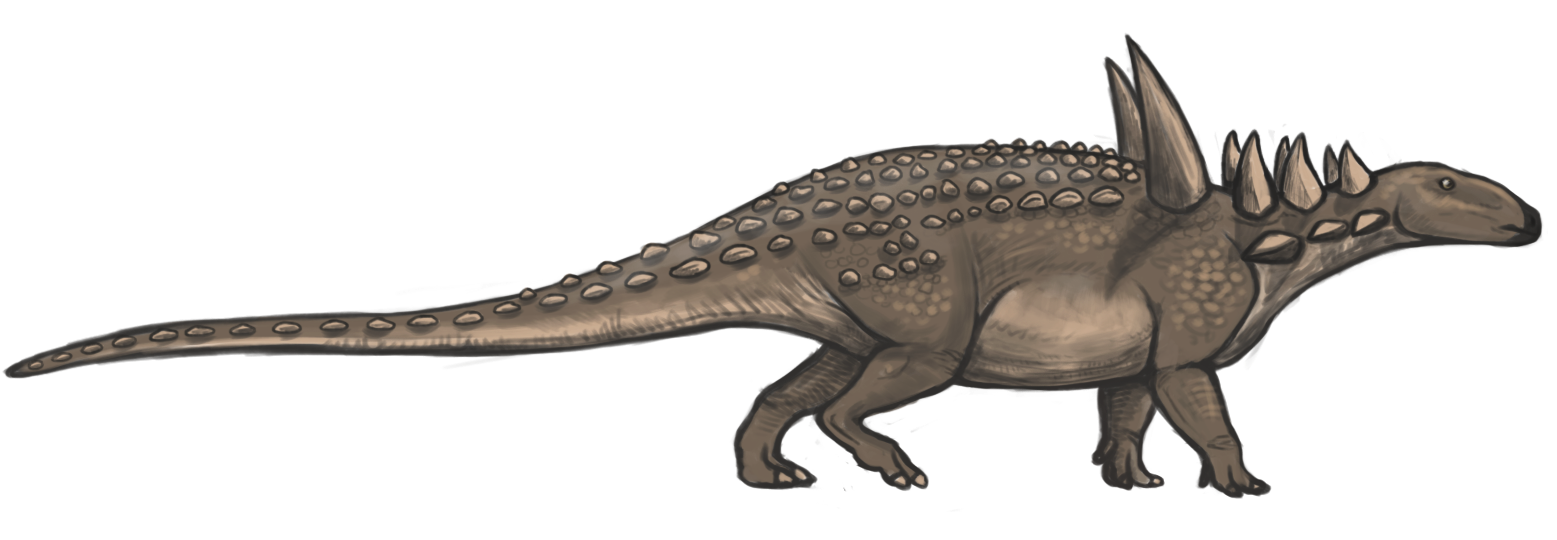
A heavily armored Cloverly nodosaur with rows of bony plates and enormous paired spines projecting from its shoulders.
Last updated 26 July 2026
Field guide
Sauropelta edwardsorum was a large nodosaurid ankylosaur from the Early Cretaceous of Montana and Wyoming. A mosaic of bony plates protected its neck, back and tail, while two pairs of especially long spines guarded the shoulder region. Unlike later ankylosaurids, Sauropelta lacked a tail club. Several partial skeletons preserve much of its armor in place, making it one of the clearest examples of early nodosaurid defence.
Its fossils occur between approximately 115 and 108 million years ago. Values shown here are approximate and reflect the current curated seed dataset.
Form and function
The small, low skull ended in a broad plant-cropping beak. The neck carried half-rings of armor, and rows of rounded and keeled osteoderms covered the broad back. Large triangular spines projected sideways from the shoulders. Stout limbs supported a low, wide body, while the long tail remained flexible and lacked a terminal club.
Evolutionary position
This simplified classification path shows one placement from Dinosauria to this species. Each step is clickable, and other analyses may support alternative relationships.
Open interactive positionScale
Simplified length comparison using preferred dataset estimates; body shape and posture are not represented.
Scientific record
Barnum Brown collected the holotype, AMNH 3032, from the Cloverly Formation of Montana during the early 1930s but did not formally describe it. John Ostrom combined Brown's material with discoveries from Yale expeditions and named Sauropelta edwardsi in 1970. The grammatically corrected spelling edwardsorum is now widely used and honours Nell and Tom Edwards.
Discovery credit: Barnum Brown, American Museum field crews.
Naming authors: John H. Ostrom.
Palaeoenvironment
Sauropelta inhabited the same Cloverly floodplains and seasonal woodlands as Tenontosaurus. It browsed among conifers, cycads, ferns and early flowering plants while large theropods such as Acrocanthosaurus occupied the ecosystem.
Low jaws and small teeth suit selective browsing on ground-level vegetation. Armor and shoulder spines provided passive protection and may also have served for display. There is no direct evidence for herd size, combat behaviour or parental care.
Worth knowing
Fossil distribution
Montana and Wyoming, United States
Cloverly Formation
regional marker
Markers are deliberately approximate. They identify published fossil areas without exposing sensitive excavation coordinates.
Open interactive mapFossil specimen record
New York, United States
The museum houses holotype AMNH 3032 and additional material collected by Barnum Brown.
A research repository is not necessarily a public exhibit. Loan and display status can change, so check with the institution before visiting.
Media record
Evidence
John H. Ostrom · Bulletin of the Peabody Museum of Natural History 35 · 1970
Open sourceNatural History Museum, London
Open source