Black Ven–Charmouth coastal cliffs
West Dorset, England, United Kingdom
Charmouth Mudstone Formation
regional marker
Pronunciation: skel-EYE-doh-SORE-us hair-ih-SON-ee-eye
A remarkably complete Early Jurassic armoured dinosaur from Dorset with rows of keeled plates, small spikes and a skull sheathed in keratinous scutes.
Last updated 23 July 2026
Field guide
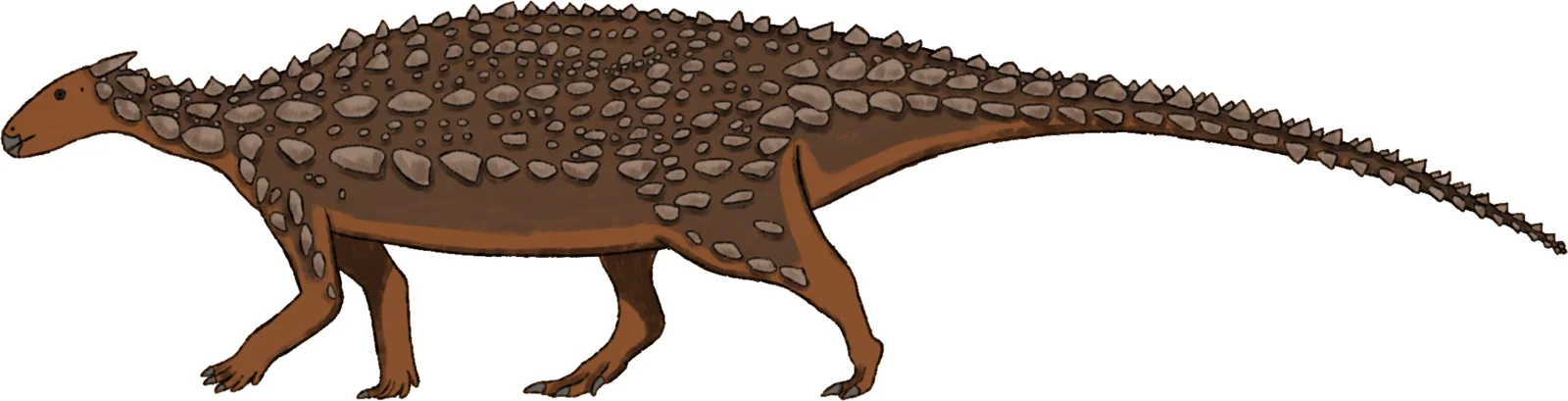
Scelidosaurus harrisonii was an early armoured ornithischian from the Jurassic coast of southern England. Several articulated skeletons preserve nearly the entire animal, making it unusually informative for the beginning of thyreophoran evolution. Its low body carried multiple longitudinal rows of osteoderms, ranging from small ossicles to keeled plates and pointed elements around the neck and shoulders. A modern redescription found it closer to ankylosaurs than to stegosaurs, but the deepest branches of the armoured-dinosaur tree remain sensitive to analytical choices.
Its fossils occur between approximately 193 and 190 million years ago. Values shown here are approximate and reflect the current curated seed dataset.
Form and function
The skull was long and low, with a narrow beak and leaf-shaped teeth. Keratinous scutes covered much of the skull roof, inferred from the texture and boundaries of the underlying bone. Three principal rows of larger osteoderms ran along each side of the neck, trunk and tail, with smaller ossicles between them. Robust hind limbs and shorter forelimbs supported habitual quadrupedal movement, although limb anatomy retained features inherited from bipedal ancestors. Its jaws moved mainly up and down, with limited flexion helping pulp and shear vegetation.
Evolutionary position
This simplified classification path shows one placement from Dinosauria to this species. Each step is clickable, and other analyses may support alternative relationships.
Open interactive positionScale
Simplified length comparison using preferred dataset estimates; body shape and posture are not represented.
Scientific record
Quarry owner James Harrison sent fossil bones from the cliffs near Charmouth to Richard Owen beginning in 1858. Owen named Scelidosaurus harrisonii in 1861 and later produced a fuller monograph. The principal type skeleton NHMUK R1111 is held by London's Natural History Museum. Additional articulated specimens from the same Dorset coast, including material prepared in the twenty-first century, allowed David Norman to redescribe the skull, armour, skeleton and biology in a series of studies culminating in 2020.
Discovery credit: James Harrison.
Naming authors: Richard Owen.
Palaeoenvironment
The Charmouth Mudstone Formation accumulated in a shallow marine setting along the Early Jurassic coast. Scelidosaurus carcasses were transported from nearby land into the sea, where fine sediment buried them. The marine rocks preserve ammonites, fish and marine reptiles exceptionally well, but provide only indirect evidence for the vegetation and terrestrial community in which the living dinosaur fed.
Scelidosaurus was a low-browsing herbivore. Jaw reconstruction suggests mainly vertical biting with some controlled flexion that improved plant processing. Its armour plausibly reduced injury from predators and may also have contributed to display or species recognition. The fossils do not reveal herd structure, parental care, colour patterns or how often it adopted a bipedal stance.
Worth knowing
Fossil distribution
West Dorset, England, United Kingdom
Charmouth Mudstone Formation
regional marker
Markers are deliberately approximate. They identify published fossil areas without exposing sensitive excavation coordinates.
Open interactive mapFossil specimen record
London, United Kingdom
The museum cares for the historically important partial articulated type skeleton from Dorset. Its current public display status may change with gallery rotations.
A research repository is not necessarily a public exhibit. Loan and display status can change, so check with the institution before visiting.
Media record
Evidence
David B. Norman · Zoological Journal of the Linnean Society 191(1), 1–86 · 2020
Open sourceNatural History Museum, London
Open source