Western Liaoning fossil region
Liaoning Province, China
Yixian Formation
regional marker
Pronunciation: SIGH-no-sore-OP-ter-iks PRY-mah
A small Jehol coelurosaur whose articulated fossils preserve simple filamentous feathers, gut contents and a striped, countershaded colour pattern.
Last updated 25 July 2026
Field guide
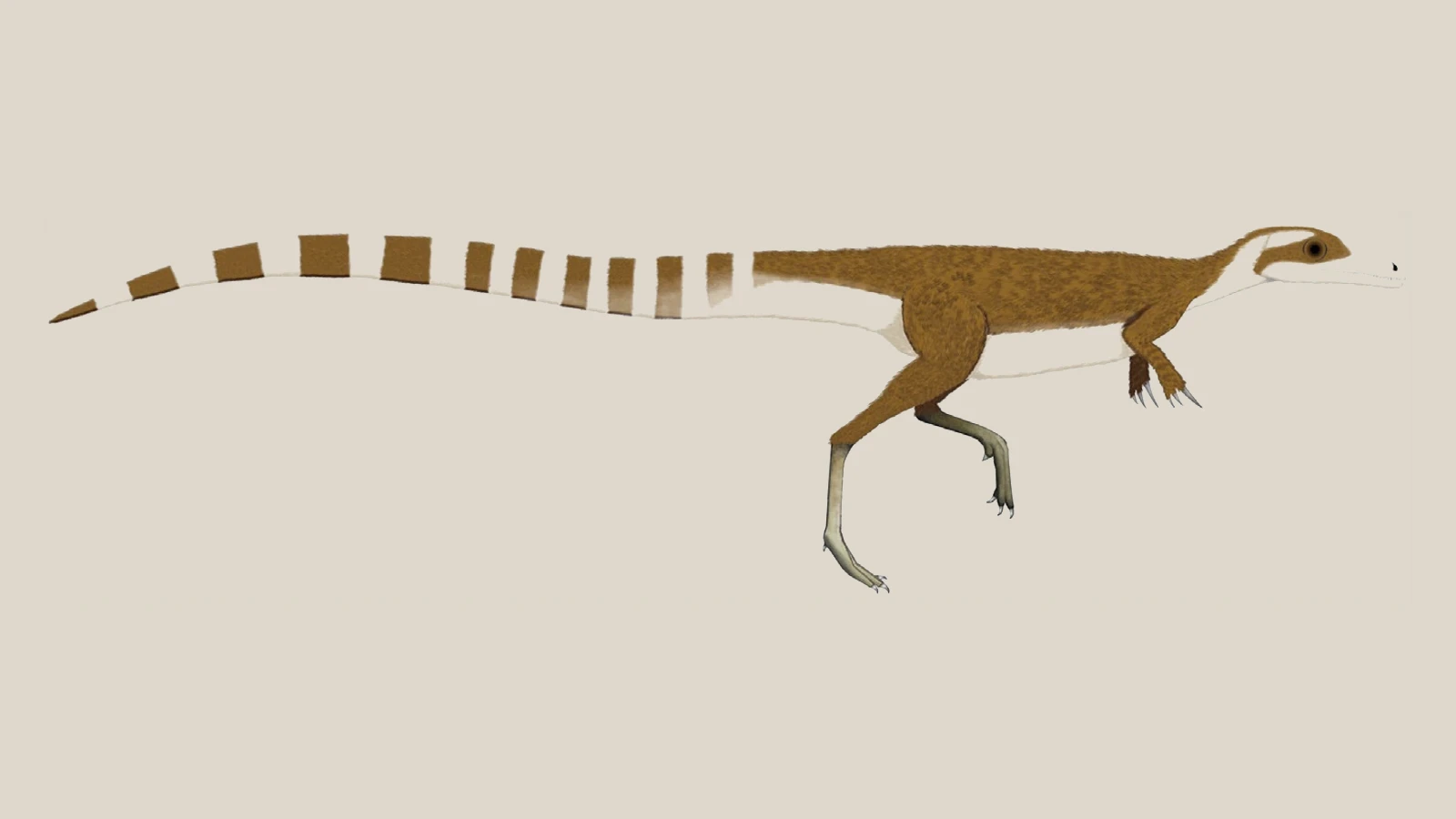
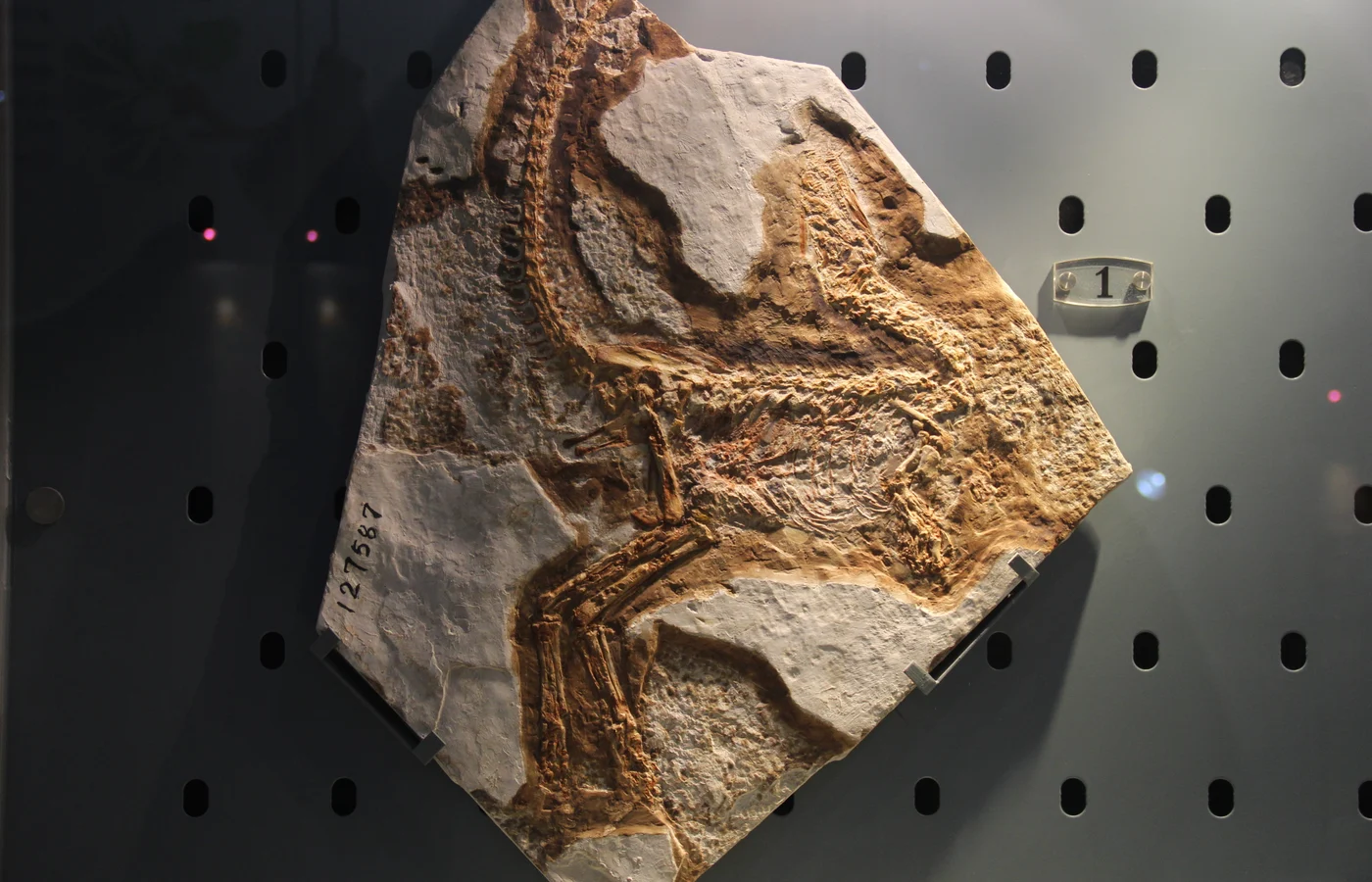
Sinosauropteryx prima transformed the study of dinosaur appearance when it became the first non-avian dinosaur reported with a halo of filamentous integument. Several nearly complete, articulated specimens from the Yixian Formation preserve bones, soft-tissue outlines and stomach contents. Microscopic pigment evidence and the distribution of dark fibres later allowed researchers to reconstruct a dark back, pale underside, facial mask and banded tail, providing an unusually evidence-based colour pattern for a non-avian dinosaur.
Its fossils occur between approximately 125 and 122 million years ago. Values shown here are approximate and reflect the current curated seed dataset.
Form and function
Sinosauropteryx was a lightly built biped with a small low skull, pointed teeth, short three-fingered arms and a tail containing more than sixty vertebrae. Simple unbranched filaments formed a fuzzy covering along the head, back and tail; they were far less complex than modern flight feathers. The tail was proportionally very long and carried alternating pigmented bands. A narrow body, long hind limbs and balancing tail indicate agile terrestrial locomotion.
Evolutionary position
This simplified classification path shows one placement from Dinosauria to this species. Each step is clickable, and other analyses may support alternative relationships.
Open interactive positionScale
Simplified length comparison using preferred dataset estimates; body shape and posture are not represented.
Scientific record
Farmers found the first split slab and counterslab in Liaoning Province in 1996, during the rapid expansion of discoveries from the Jehol Biota. Qiang Ji and Shu'an Ji named Sinosauropteryx prima later that year. Pei-ji Chen and colleagues published a detailed anatomical description in Nature in 1998. Pigment studies culminated in a 2017 reconstruction of its countershading and striped tail. In 2025, Rui Qiu and colleagues recognized a second Sinosauropteryx species and proposed Sinosauropterygidae for the Jehol forms traditionally grouped with compsognathids.
Discovery credit: Local fossil collectors in Liaoning Province.
Naming authors: Qiang Ji, Shu'an Ji.
Palaeoenvironment
The Yixian Formation preserves lakes, volcanically influenced floodplains, woodlands and more open habitats within the Jehol Biota of northeastern China. Sinosauropteryx lived among early birds, mammals, lizards, pterosaurs and many other feathered dinosaurs. Its countershading pattern best matches an animal using relatively open environments, suggesting that the Jehol landscape was a mosaic rather than an unbroken forest.
Pointed teeth and preserved gut contents show that Sinosauropteryx hunted small vertebrates. One specimen contains a lizard in the abdominal region, while material historically referred to the genus has also yielded mammal remains. The long legs and balancing tail suit an agile ground predator. Its countershading, facial mask and tail bands probably contributed to camouflage or visual signalling, but the precise function of each pattern cannot be tested directly.
Worth knowing
Fossil distribution
Liaoning Province, China
Yixian Formation
regional marker
Markers are deliberately approximate. They identify published fossil areas without exposing sensitive excavation coordinates.
Open interactive mapFossil specimen record
Nanjing, China
The NIGP collection preserves the split holotype slab and counterslab catalogued as NIGP 127586.
A research repository is not necessarily a public exhibit. Loan and display status can change, so check with the institution before visiting.
Media record
Evidence
Qiang Ji, Shu'an Ji · Chinese Geology 233, 30–33 · 1996
Open sourcePei-ji Chen, Zhi-ming Dong, Shuo-nan Zhen · Nature 391, 147–152 · 1998
Open sourceFiann M. Smithwick, Robert Nicholls, Innes C. Cuthill, Jakob Vinther · Current Biology 27(21), 3337–3343.e2 · 2017
Open sourceRui Qiu, Xiaolin Wang, Shunxing Jiang and 2 coauthors · National Science Review 12(5), nwaf068 · 2025
Open sourceNatural History Museum, London
Open source