Garden Park Fossil Area
Colorado, United States
Morrison Formation
approximate site marker
Pronunciation: STEG-oh-SORE-us STEN-ops
The best-known plated dinosaur: a low-browsing Morrison Formation herbivore with two rows of tall back plates and four formidable tail spikes. Its exceptionally complete holotype preserves rare details including a skull and throat ossicles.
Last updated 13 July 2026
Field guide
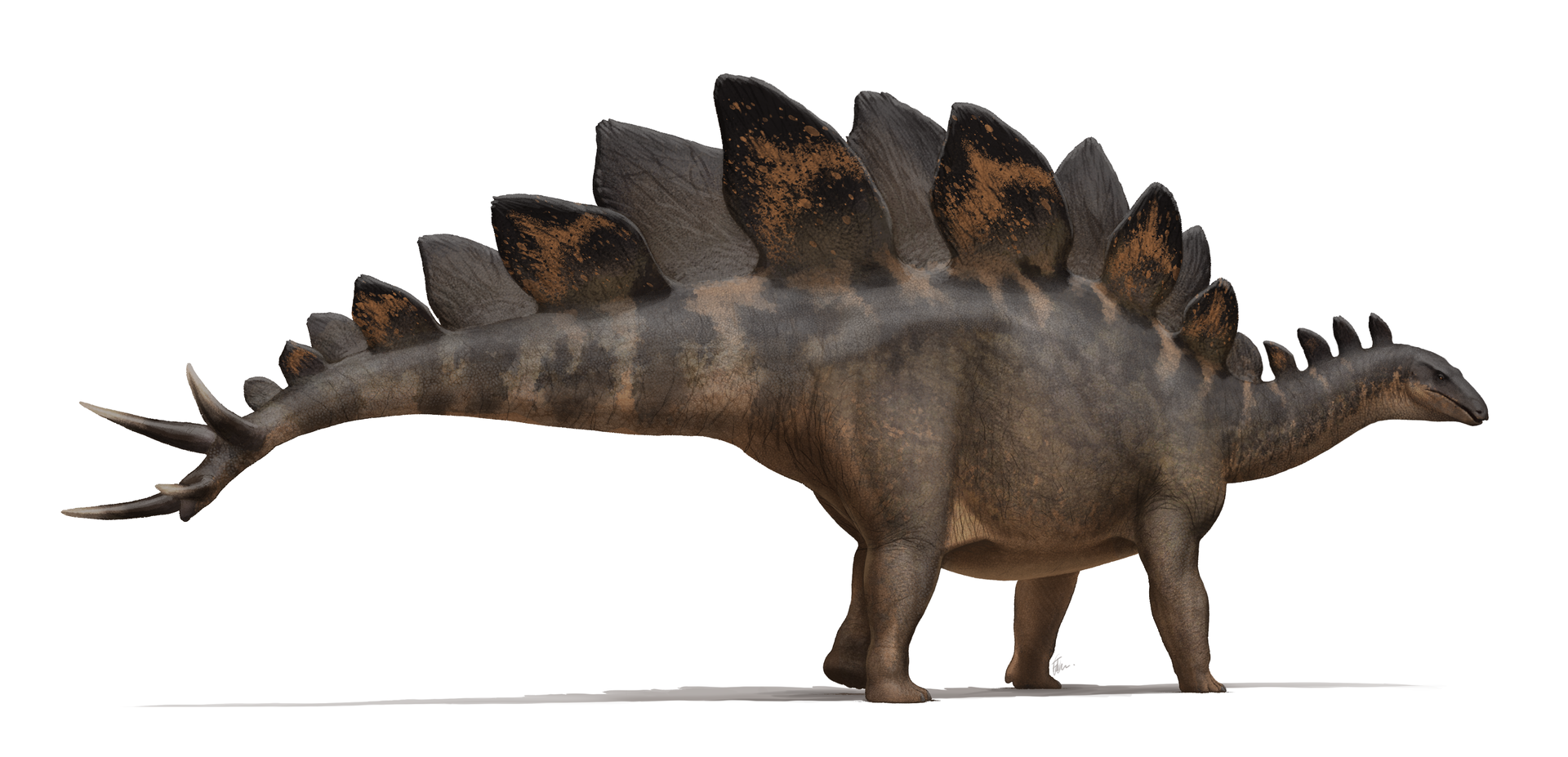
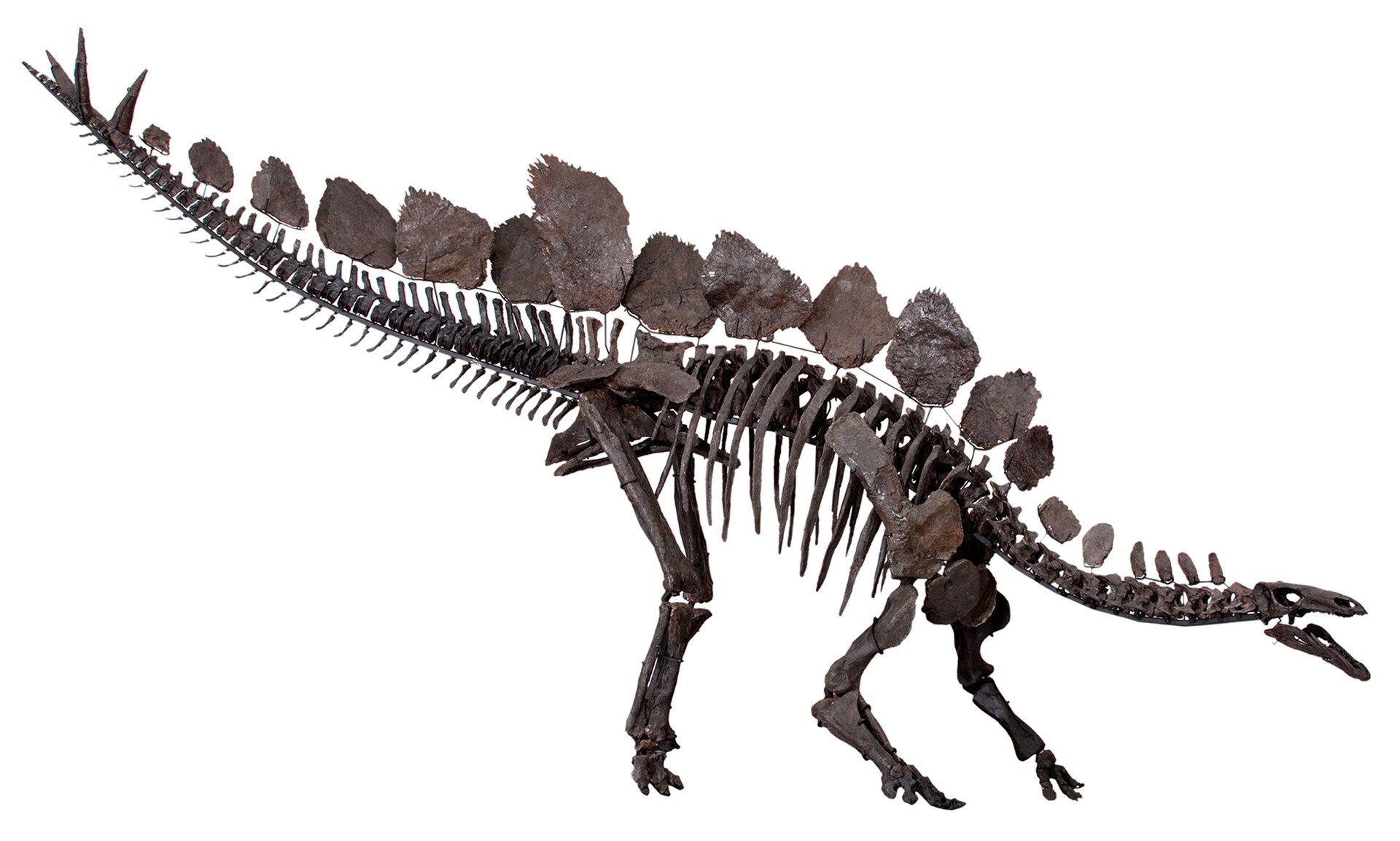
Stegosaurus stenops was a large, four-legged herbivore from Late Jurassic western North America. Short forelimbs and longer hind limbs produced its distinctive arched profile, while large dermal plates rose in two rows along the neck, back and front of the tail. Four keratin-covered spikes armed the tail tip. Several unusually informative skeletons make S. stenops the anatomical standard for its genus: the flattened but articulated holotype USNM V4934 and the three-dimensionally preserved London specimen NHMUK PV R36730, nicknamed Sophie.
Its fossils occur between approximately 155 and 150 million years ago. Values shown here are approximate and reflect the current curated seed dataset.
Form and function
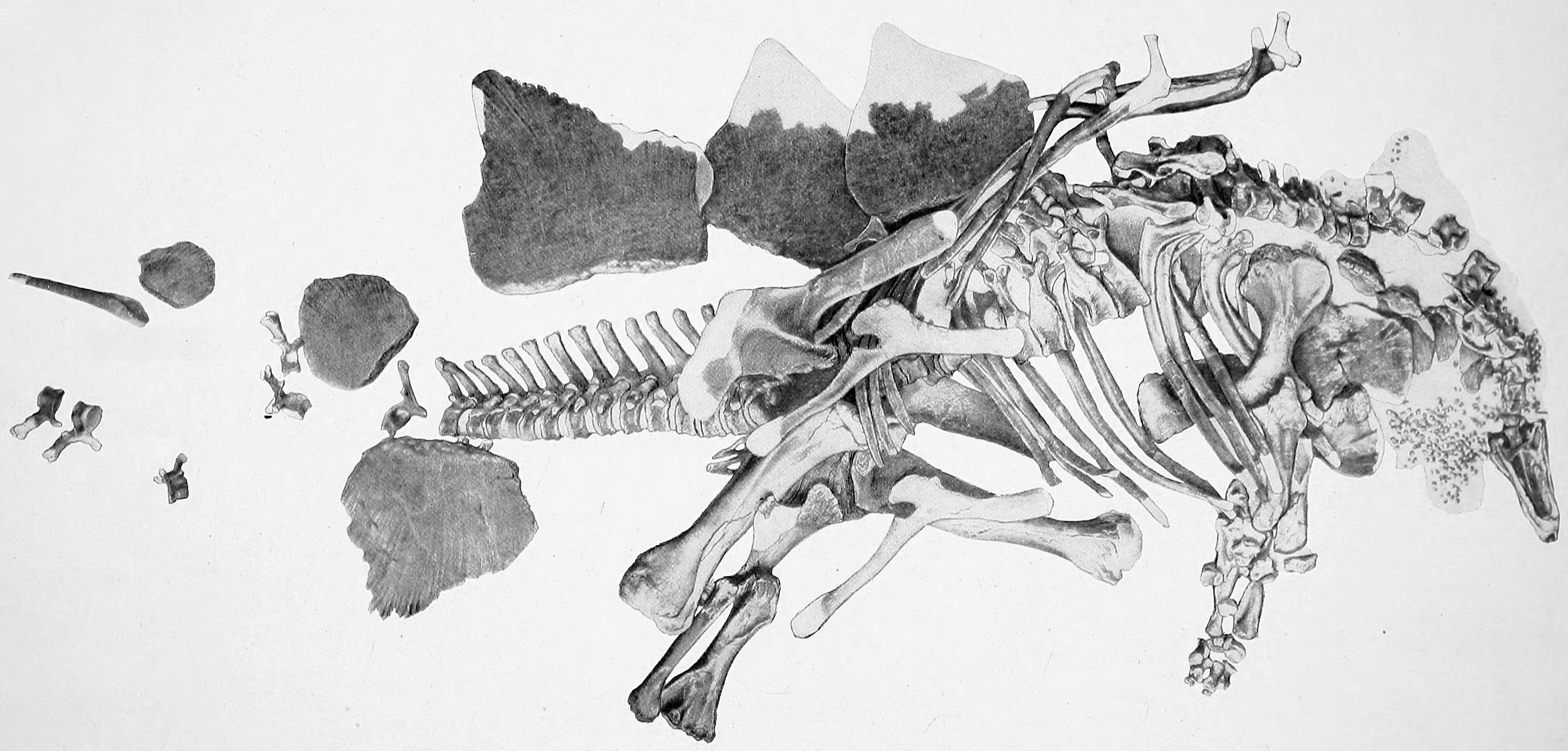
Holotype USNM V4934 preserves an articulated skeleton, skull, plates, tail spikes and a patch of small rounded ossicles beneath the throat. Burial compressed much of it into a slab, so not every bone retains its original three-dimensional shape. Sophie complements it with a largely complete, three-dimensionally preserved young-adult skeleton. Together these specimens show a small, low skull; a deep torso; column-like hind limbs; spreading, weight-bearing forefeet; two plate rows; and a flexible, muscular tail ending in four spikes.
Evolutionary position
This simplified classification path shows one placement from Dinosauria to this species. Each step is clickable, and other analyses may support alternative relationships.
Open interactive positionScale
Simplified length comparison using preferred dataset estimates; body shape and posture are not represented.
Scientific record
Marshall P. Felch uncovered the articulated holotype at Felch-Marsh Quarry near Garden Park, Colorado, in 1886. Othniel Charles Marsh named Stegosaurus stenops in 1887; stenops refers to its narrow face. Charles W. Gilmore's 1914 monograph provided the first comprehensive description of the Smithsonian skeleton. Because the original type species S. armatus rested on much poorer material, the International Commission on Zoological Nomenclature formally made S. stenops the type species of Stegosaurus in 2013.
Discovery credit: Marshall P. Felch.
Naming authors: Othniel Charles Marsh.
Palaeoenvironment
S. stenops lived on the seasonally dry river floodplains represented by the Morrison Formation. River channels, ponds and wetter lowlands crossed more open areas carrying conifers, cycads, ferns, horsetails and other low plants. It shared this ecosystem with sauropods such as Diplodocus and Camarasaurus, ornithopods including Camptosaurus, and predators including Allosaurus and Ceratosaurus.
Its beak, small teeth and jaw mechanics support cropping low to medium-height vegetation rather than chewing like a mammal. The tail spikes were mechanically capable defensive weapons, although no fossil records a particular strike by this individual species. Plate function is less settled: display, species recognition and heat exchange have all been proposed, and the vessels visible in plate bone do not by themselves identify one purpose. Trackways and limb anatomy show an obligate quadruped; speed estimates remain model dependent.
Worth knowing
Fossil distribution
Colorado, United States
Morrison Formation
approximate site marker
Markers are deliberately approximate. They identify published fossil areas without exposing sensitive excavation coordinates.
Open interactive mapFossil specimen record
Washington, D.C., United States
Research repository for original holotype USNM V4934, collected by Marshall P. Felch at Felch-Marsh Quarry. The Smithsonian record identifies it as a complete, updated mounted skeleton; access to individual original bones can vary with research and conservation needs.
London, United Kingdom
Largely original mounted skeleton NHMUK PV R36730 ('Sophie'), with only a few replica bones. The three-dimensionally preserved young adult has been on permanent display since December 2014 and is currently in Earth Hall.
A research repository is not necessarily a public exhibit. Loan and display status can change, so check with the institution before visiting.
Media record
Evidence
Othniel Charles Marsh · American Journal of Science · 1887
Open sourceCharles W. Gilmore · Bulletin of the United States National Museum 89 · 1914
Open sourceInternational Commission on Zoological Nomenclature · Bulletin of Zoological Nomenclature · 2013
Open sourceSusannah C. R. Maidment, Charlotte Brassey, Paul M. Barrett · PLOS ONE · 2015
Open sourceCharlotte A. Brassey, Susannah C. R. Maidment, Paul M. Barrett · Biology Letters · 2015
Open sourceStephan Lautenschlager, Charlotte A. Brassey, David J. Button, Paul M. Barrett · Scientific Reports · 2016
Open sourceSmithsonian National Museum of Natural History
Open sourceNatural History Museum, London
Open source