Gadoufaoua fossil region
Ténéré Desert, Agadez Region, Niger
Elrhaz Formation
regional marker
Pronunciation: SOO-koh-MY-mus ten-er-EN-sis
A large, long-snouted spinosaurid from Early Cretaceous Niger with conical teeth, powerful forelimbs, an enlarged thumb claw and a low sail over its hips.
Last updated 23 July 2026
Field guide
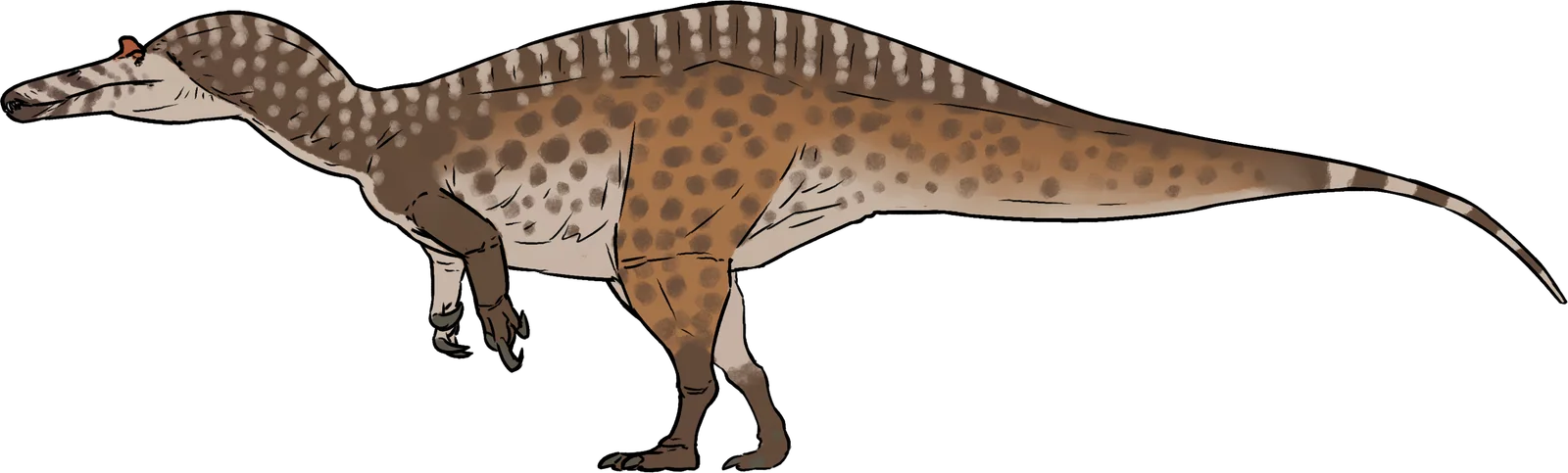
Suchomimus tenerensis is one of the most complete spinosaurids yet recovered. Its partial skull and skeleton revealed that the group combined an elongated, crocodile-like snout with strong forelimbs and a large first-finger claw. The original reconstruction reached about eleven metres, although later mass and body-proportion estimates vary. Suchomimus is traditionally regarded as a close African relative of the European Baryonyx. A 2026 study renewed the proposal that it may represent the same taxon as the fragmentary Cristatusaurus lapparenti, so its name and precise taxonomic status are currently debated rather than settled.
Its fossils occur between approximately 125 and 112 million years ago. Values shown here are approximate and reflect the current curated seed dataset.
Form and function
The snout was extremely long, low and transversely narrow, expanding near its tip into a tooth-bearing rosette. Each premaxilla held seven finely serrated, slightly recurved conical teeth. The nostrils sat farther back than in most theropods. Robust upper arms, enlarged forearm muscle attachments and a huge curved thumb claw formed a powerful grasping apparatus. Blade-shaped neural spines produced a shallower ridge or sail over the back and hips than the deep sail reconstructed for Spinosaurus.
Evolutionary position
This simplified classification path shows one placement from Dinosauria to this species. Each step is clickable, and other analyses may support alternative relationships.
Open interactive positionScale
Simplified length comparison using preferred dataset estimates; body shape and posture are not represented.
Scientific record
A field team led by Paul Sereno recovered the partial disarticulated skeleton MNN GDF500 from the Elrhaz Formation at Gadoufaoua in Niger's Ténéré Desert. Sereno and twelve coauthors named Suchomimus tenerensis in Science in November 1998. The holotype and referred material are catalogued in the Musée National du Niger in Niamey. The genus combines Greek words for crocodile and mimic, while tenerensis refers to the Ténéré region.
Naming authors: Paul C. Sereno, Allison L. Beck, Didier B. Dutheil and 10 coauthors.
Palaeoenvironment
The Elrhaz Formation records broad river channels and vegetated floodplains crossing what is now the Ténéré Desert. Suchomimus shared this freshwater landscape with the sail-backed herbivore Ouranosaurus, the iguanodontian Lurdusaurus, sauropods, fishes, turtles and several large crocodile-line reptiles.
Its narrow snout, conical teeth and enlarged jaw tip are compatible with seizing fish, but they do not demonstrate an exclusively fish-based diet. Strong arms and the enlarged thumb claw may also have helped restrain prey or process carcasses. The skeleton does not reveal hunting style, swimming ability, social behaviour or parental care.
Worth knowing
Fossil distribution
Ténéré Desert, Agadez Region, Niger
Elrhaz Formation
regional marker
Markers are deliberately approximate. They identify published fossil areas without exposing sensitive excavation coordinates.
Open interactive mapFossil specimen record
Niamey, Niger
Permanent repository of the original partial skull and skeleton and catalogued referred bones. Continuous public exhibition is not confirmed.
A research repository is not necessarily a public exhibit. Loan and display status can change, so check with the institution before visiting.
Media record
Evidence
Paul C. Sereno, Allison L. Beck, Didier B. Dutheil and 10 coauthors · Science 282(5392), 1298–1302 · 1998
Open sourceFrédéric Pittet · Geodiversitas 48(12), 227–272 · 2026
Open source