Nemegt Basin
Gobi Desert, Mongolia
Nemegt Formation
regional marker
Pronunciation: TAR-boh-SORE-us bah-TAR
A giant Mongolian tyrannosaurine known from numerous skulls and skeletons, including a tiny juvenile that records how its lighter feeding apparatus developed into the deep, force-resistant adult skull.
Last updated 13 July 2026
Field guide
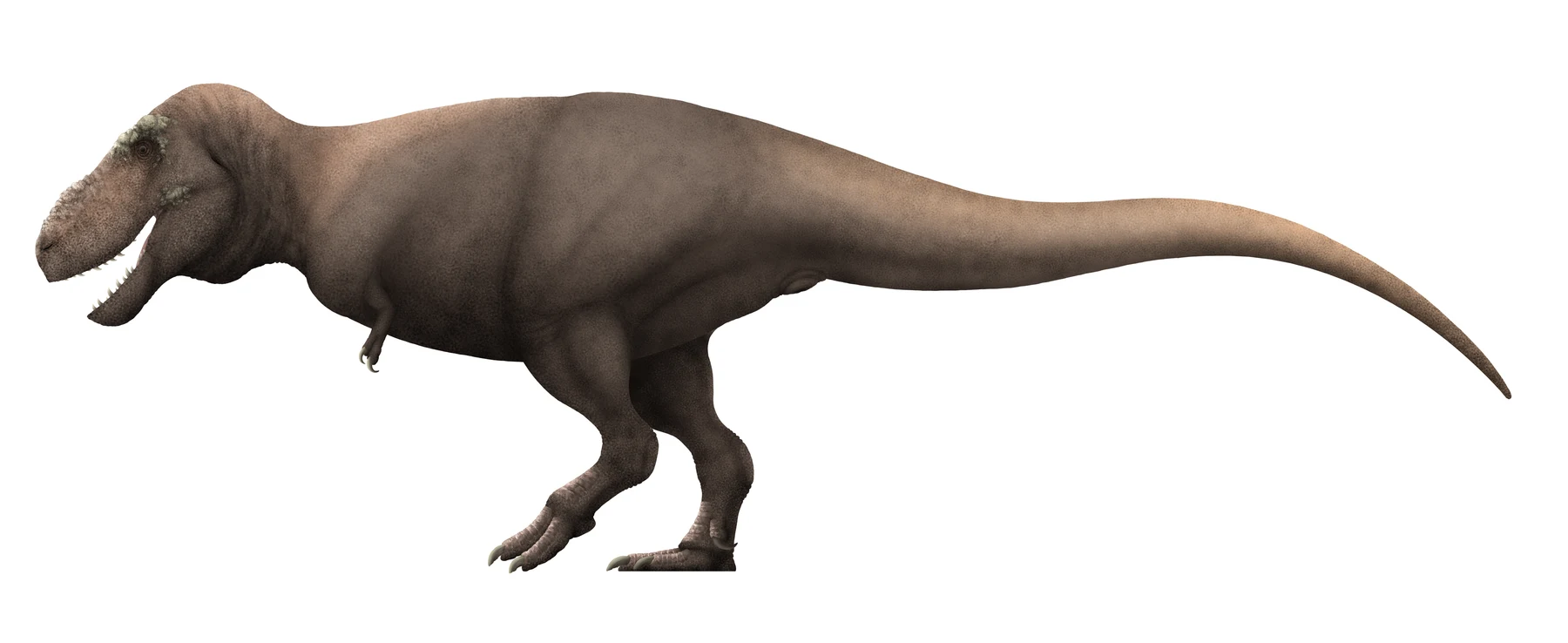
Tarbosaurus bataar was the dominant large predator in the river systems preserved by Mongolia’s Nemegt Formation. Like Tyrannosaurus rex, it combined a huge tooth-bearing head, two-fingered forelimbs, powerful hind limbs and a long balancing tail. It was not simply an Asian copy: the adult skull was relatively narrower through the snout and lower cheek, with a distinctive domed nasal region and a differently braced lower jaw. A broad sample of skulls and partial skeletons makes Tarbosaurus one of Asia’s best-known large theropods. Rare juvenile material adds a developmental dimension—the smallest described skull lacked several adult reinforcements, indicating that young and mature animals handled food differently as the head deepened and strengthened.
Its fossils occur between approximately 72 and 68 million years ago. Values shown here are approximate and reflect the current curated seed dataset.
Form and function
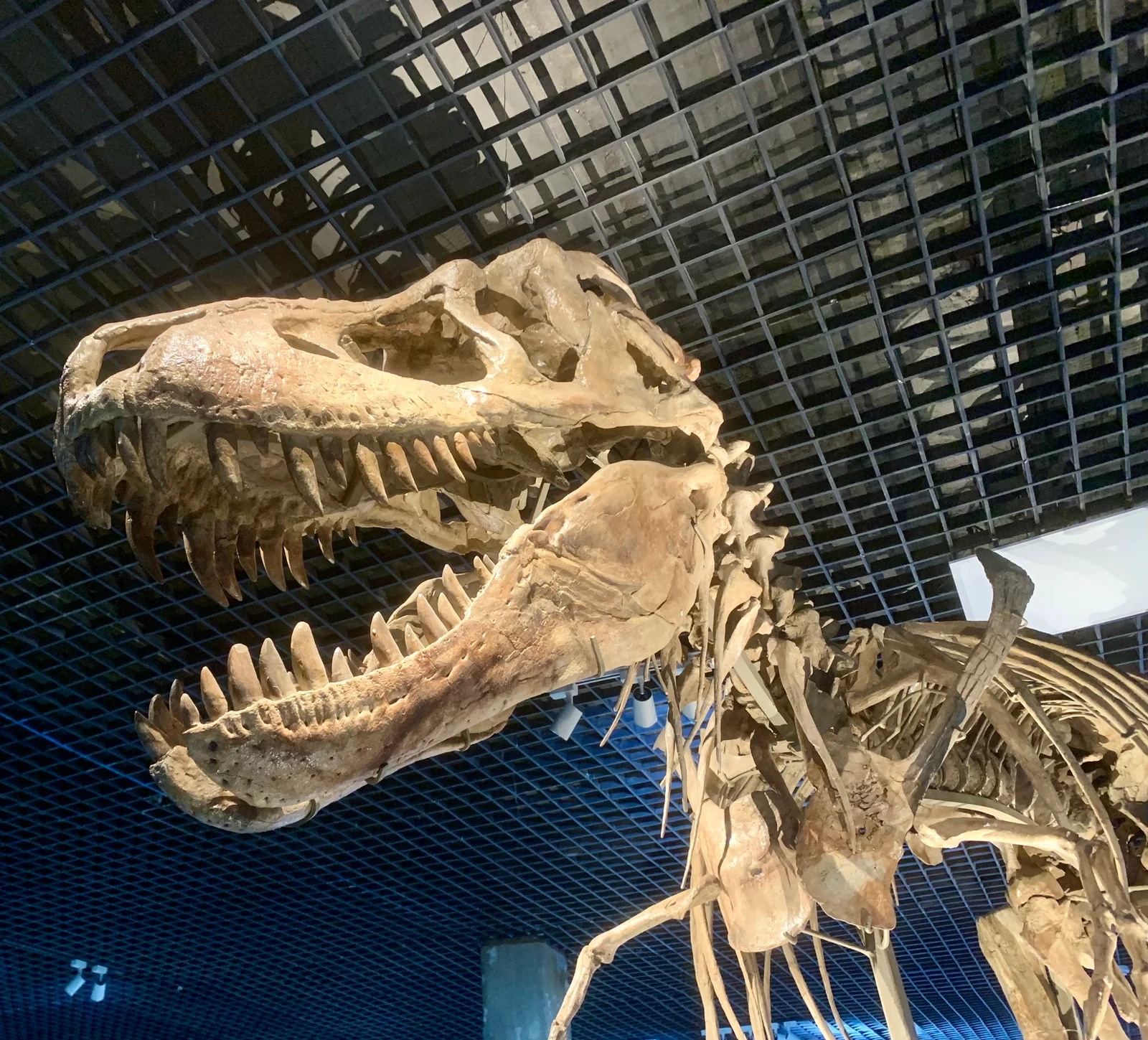
The holotype skull is about 1.22 metres long, with 13 maxillary tooth positions and 15 in the dentary. Adult teeth were thick, slightly recurved and serrated, and were replaced continuously. Compared with Tyrannosaurus, the skull was less abruptly expanded behind the snout; its nasals formed a pronounced dome and were less integrated into the main path transmitting bite stresses through the upper jaw. Interlocking bones made the rear of the lower jaw particularly rigid. The neck was short and muscular, the torso carried over long, sturdy hind limbs, and the tail counterbalanced the head. The tiny arms ended in two functional fingers. Juveniles had a shallower, more lightly built skull without some adult features associated with resisting large feeding forces.
Evolutionary position
This simplified classification path shows one placement from Dinosauria to this species. Each step is clickable, and other analyses may support alternative relationships.
Open interactive positionScale
Simplified length comparison using preferred dataset estimates; body shape and posture are not represented.
Scientific record
An expedition of the USSR Academy of Sciences found skull PIN 551-1 and associated cervical vertebrae at Nemegt in 1946. Evgeny A. Maleev described the specimen in 1955 as Tyrannosaurus bataar; later revisions separated it as Tarbosaurus bataar and combined several other Mongolian tyrannosaur names with the same growth series. Subsequent Soviet-Mongolian, Polish-Mongolian, Mongolian and Japanese expeditions recovered many more individuals. Among the most informative is MPC-D 107/7 from Bugin Tsav, a roughly two- to three-year-old animal with a 290-millimetre skull and much of its skeleton preserved. A 2026 reassessment proposed that the immature types of Raptorex kriegsteini and the Chinese Asiatyrannus xui are also juvenile Tarbosaurus, but that wide-ranging synonymy remains a recent hypothesis rather than an uncontested fact.
Discovery credit: Mongolian Paleontological Expedition of the USSR Academy of Sciences.
Naming authors: Evgeny A. Maleev.
Palaeoenvironment
The Nemegt Formation records broad river channels, sandy bars, muddy overbanks and vegetated floodplains in a strongly seasonal but appreciably wetter setting than the older desert deposits beneath it. Fish, turtles and crocodyliforms occupied its waterways. Large herbivores included the hadrosaur Saurolophus, the long-armed Deinocheirus, Therizinosaurus, the sauropods Nemegtosaurus and Opisthocoelicaudia, and several smaller ornithomimosaurs and pachycephalosaurs. The formation accumulated across a large basin over time, so appearing in the same named unit does not prove that every listed animal met at one place or moment.
Tarbosaurus was unquestionably carnivorous, but fossils reveal feeding episodes rather than one fixed hunting style. A nearly complete Saurolophus skeleton preserves concentrated punctures, drag marks and bite-and-drag traces on one humerus. Their placement indicates deliberate access to remaining soft tissues after much of the carcass was already unavailable, strong evidence for scavenging on that individual—not proof that Tarbosaurus only scavenged. Adult skull construction accommodated much greater feeding loads than the shallow skull of juvenile MPC-D 107/7, supporting an age-related shift in prey size or feeding technique. No bonebed, trackway or nest demonstrates pack hunting, social hierarchy or parental care.
Worth knowing
Fossil distribution
Gobi Desert, Mongolia
Nemegt Formation
regional marker
Markers are deliberately approximate. They identify published fossil areas without exposing sensitive excavation coordinates.
Open interactive mapFossil specimen record
Warsaw, Poland
The permanent exhibition currently presents two Tarbosaurus skeletal mounts from the Gobi material: a modern horizontal-backed mount and a historical upright mount. The museum captions the featured modern skeleton as original, while restored and supporting portions remain part of any mount.
Ulaanbaatar, Mongolia
The museum’s current exhibit page lists a 7.5-metre mounted individual and states that about 75 percent is fossil and the remainder replica. The percentage applies to that display, not to every known Tarbosaurus skeleton.
A research repository is not necessarily a public exhibit. Loan and display status can change, so check with the institution before visiting.
Media record
Evidence
Evgeny A. Maleev · Doklady, Academy of Sciences USSR 104(4) · 1955
Open sourceJørn H. Hurum, Karol Sabath · Acta Palaeontologica Polonica 48(2) · 2003
Open sourceTakanobu Tsuihiji, Mahito Watabe, Khishigjav Tsogtbaatar and 7 coauthors · Journal of Vertebrate Paleontology 31(3) · 2011
Open sourceDavid W. E. Hone, Mahito Watabe · Acta Palaeontologica Polonica 55(4) · 2010
Open sourceChangyu Yun, Rafael Delcourt, Philip J. Currie · Lethaia 58(4) · 2025
Open sourceGorm Skouboe Raun, Colton Chase Coppock, Demchig Badamgarav and 2 coauthors · Cretaceous Research 186, 106412 · 2026
Open sourceAustralian Museum
Open sourceMuseum of Evolution, Polish Academy of Sciences
Open sourceNational Museum of Natural History, Mongolia
Open source