Ghost Ranch, Hayden Quarry region
New Mexico, United States
Chinle Formation
approximate site marker
Pronunciation: TAH-wah HAL-eye
A lightly built Late Triassic theropod from Ghost Ranch, represented by several articulated skeletons that illuminate early dinosaur dispersal.
Last updated 26 July 2026
Field guide
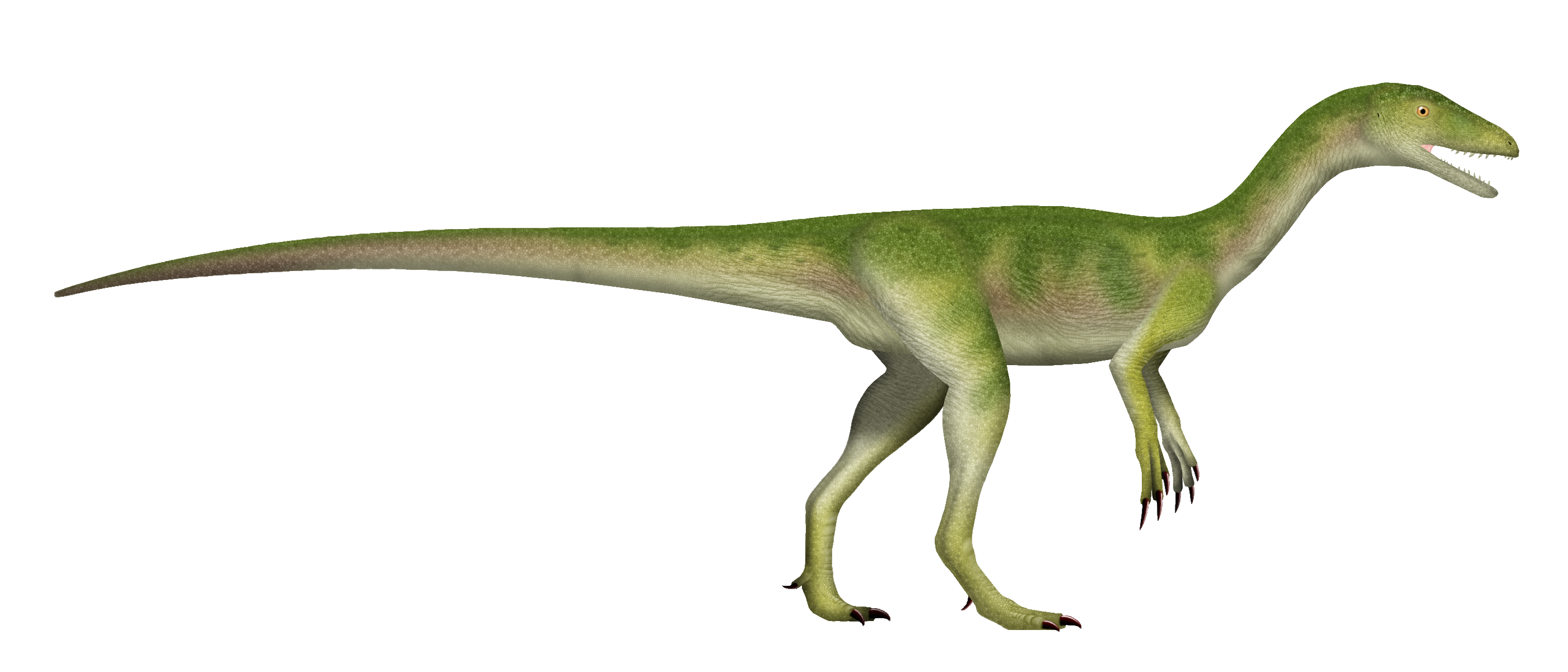
Tawa hallae was an early theropod from the Late Triassic Chinle Formation of New Mexico. Multiple associated skeletons preserve nearly the entire body, including a delicate skull. Tawa combines primitive dinosaur features with traits seen in later theropods, making it important for understanding the earliest radiation of carnivorous dinosaurs. Its presence alongside other distantly related early dinosaurs at Ghost Ranch supports repeated dispersal into North America rather than a single local radiation.
Its fossils occur between approximately 215 and 213 million years ago. Values shown here are approximate and reflect the current curated seed dataset.
Form and function
Tawa had a long, low skull with recurved serrated teeth, a flexible neck, grasping hands and long hind limbs. Air spaces invaded parts of the neck vertebrae, an early expression of the pneumatic system elaborated in later theropods and birds. Its lightly built skeleton and long tail supported agile bipedal movement.
Evolutionary position
This simplified classification path shows one placement from Dinosauria to this species. Each step is clickable, and other analyses may support alternative relationships.
Open interactive positionScale
Simplified length comparison using preferred dataset estimates; body shape and posture are not represented.
Scientific record
A field team led by Alex Downs discovered the first Tawa material in the Hayden Quarry at Ghost Ranch in 2004. Continued excavation produced skeletons of several growth stages. Sterling Nesbitt and colleagues named Tawa hallae in Science in 2009. Tawa is the Hopi name for the Sun spirit, and the species honours Ruth Hall, founder of the Ghost Ranch Museum of Paleontology.
Discovery credit: Alex Downs, Ghost Ranch field crews.
Naming authors: Sterling J. Nesbitt, Nathan D. Smith, Randall B. Irmis and 3 coauthors.
Palaeoenvironment
The Chinle Formation at Ghost Ranch records river channels and seasonal floodplains in an increasingly arid interior of Pangaea. Tawa lived alongside coelophysoids, the unusual Daemonosaurus, crocodile-line archosaurs and other reptiles.
Tawa's teeth and grasping hands identify it as a small carnivore that probably hunted vertebrates and other manageable prey. Several individuals accumulated in the Hayden Quarry, but the burial assemblage does not establish social hunting or herd structure.
Worth knowing
Fossil distribution
New Mexico, United States
Chinle Formation
approximate site marker
Markers are deliberately approximate. They identify published fossil areas without exposing sensitive excavation coordinates.
Open interactive mapFossil specimen record
Abiquiú, United States
Ghost Ranch interprets the Hayden Quarry discoveries and the early dinosaurs recovered from its Chinle Formation badlands.
A research repository is not necessarily a public exhibit. Loan and display status can change, so check with the institution before visiting.
Media record
Evidence
Sterling J. Nesbitt, Nathan D. Smith, Randall B. Irmis and 3 coauthors · Science 326(5959), 1530–1533 · 2009
Open sourceU.S. National Science Foundation
Open source