Bighorn Basin fossil region
Montana and Wyoming, United States
Cloverly Formation
regional marker
Pronunciation: ten-ON-toh-SORE-us tih-LET-eye
A common Cloverly Formation ornithopod with a powerful body and an exceptionally long, tendon-stiffened tail.
Last updated 26 July 2026
Field guide
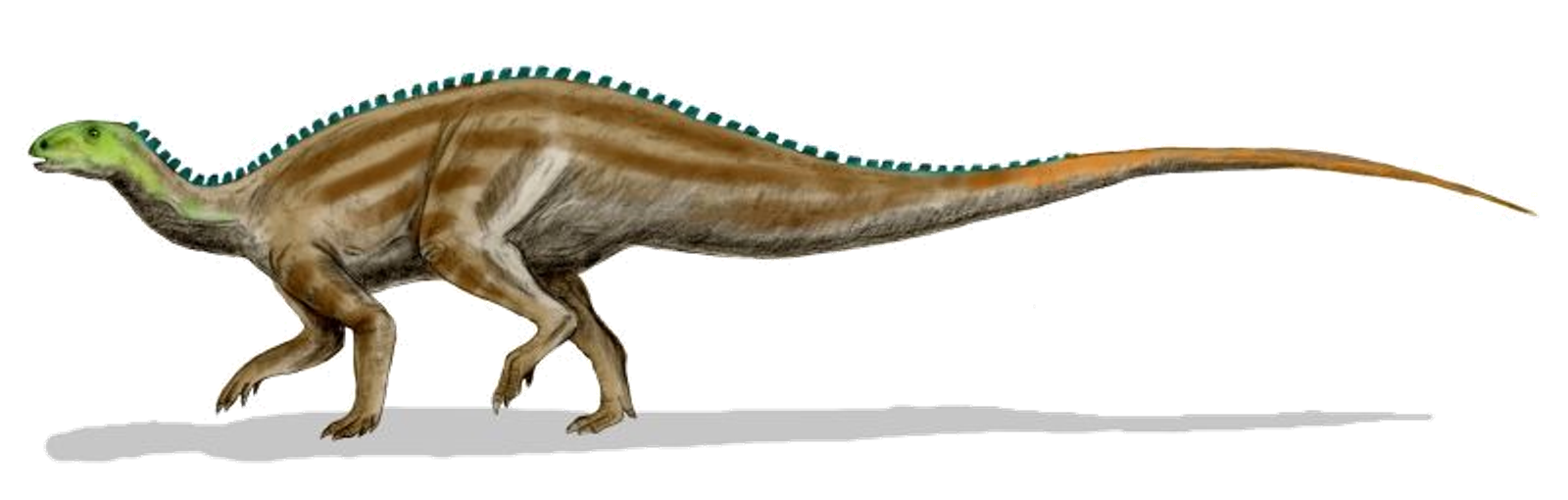
Tenontosaurus tilletti was a medium-sized, early-diverging iguanodontian from western North America. Numerous skeletons make it one of the best-known dinosaurs of the Cloverly Formation. It combined a relatively small head and beaked mouth with a deep torso, strong limbs and a tail that accounted for more than half its body length. Associations with Deinonychus teeth and remains have made it central to debates about predator–prey interactions, although the fossil sites record feeding more securely than coordinated hunting.
Its fossils occur between approximately 115 and 108 million years ago. Values shown here are approximate and reflect the current curated seed dataset.
Form and function
The skull was low and narrow, with a horny beak at the front and closely packed cheek teeth behind it. Long forelimbs and broad hands could support the body during slow movement, while robust hind limbs also permitted bipedal locomotion. Bundles of ossified tendons reinforced the spine and the very long, deep tail.
Evolutionary position
This simplified classification path shows one placement from Dinosauria to this species. Each step is clickable, and other analyses may support alternative relationships.
Open interactive positionScale
Simplified length comparison using preferred dataset estimates; body shape and posture are not represented.
Scientific record
An American Museum of Natural History expedition found the first material in Montana in 1903. Barnum Brown collected additional Cloverly skeletons during the 1930s. John Ostrom named Tenontosaurus tilletti in 1970 from holotype AMNH 3040, honouring the Lloyd Tillett family, whose ranch supported Yale field crews.
Discovery credit: American Museum of Natural History field crews.
Naming authors: John H. Ostrom.
Palaeoenvironment
The Cloverly Formation preserves river floodplains, channels and seasonally dry woodland east of the young Rocky Mountain region. Tenontosaurus lived alongside Deinonychus, Sauropelta, small mammals, turtles and crocodyliforms.
Tenontosaurus cropped low vegetation and could probably switch between two-legged and four-legged movement. Several sites combine Tenontosaurus bones with Deinonychus teeth or remains, demonstrating scavenging or predation but not proving coordinated pack hunting. Herding and use of the tail as a weapon remain plausible but unconfirmed.
Worth knowing
Fossil distribution
Montana and Wyoming, United States
Cloverly Formation
regional marker
Markers are deliberately approximate. They identify published fossil areas without exposing sensitive excavation coordinates.
Open interactive mapFossil specimen record
New York, United States
The museum houses holotype AMNH 3040 and important additional Cloverly material.
A research repository is not necessarily a public exhibit. Loan and display status can change, so check with the institution before visiting.
Media record
Evidence
John H. Ostrom · Bulletin of the Peabody Museum of Natural History 35 · 1970
Open sourceJonathan P. Tennant · Journal of Vertebrate Paleontology 32(6), 1377–1404 · 2012
Open sourceAmerican Museum of Natural History
Open source