Nemegt Basin
Gobi Desert, Mongolia
Nemegt Formation
regional marker
Pronunciation: theh-RIZ-ih-noh-SORE-us keh-LON-ih-FOR-mis
A giant, plant-eating theropod from Mongolia known chiefly from enormous forelimbs and blade-like claw bones; its familiar long-necked, broad-bellied body is reconstructed from more complete relatives.
Last updated 14 July 2026
Field guide
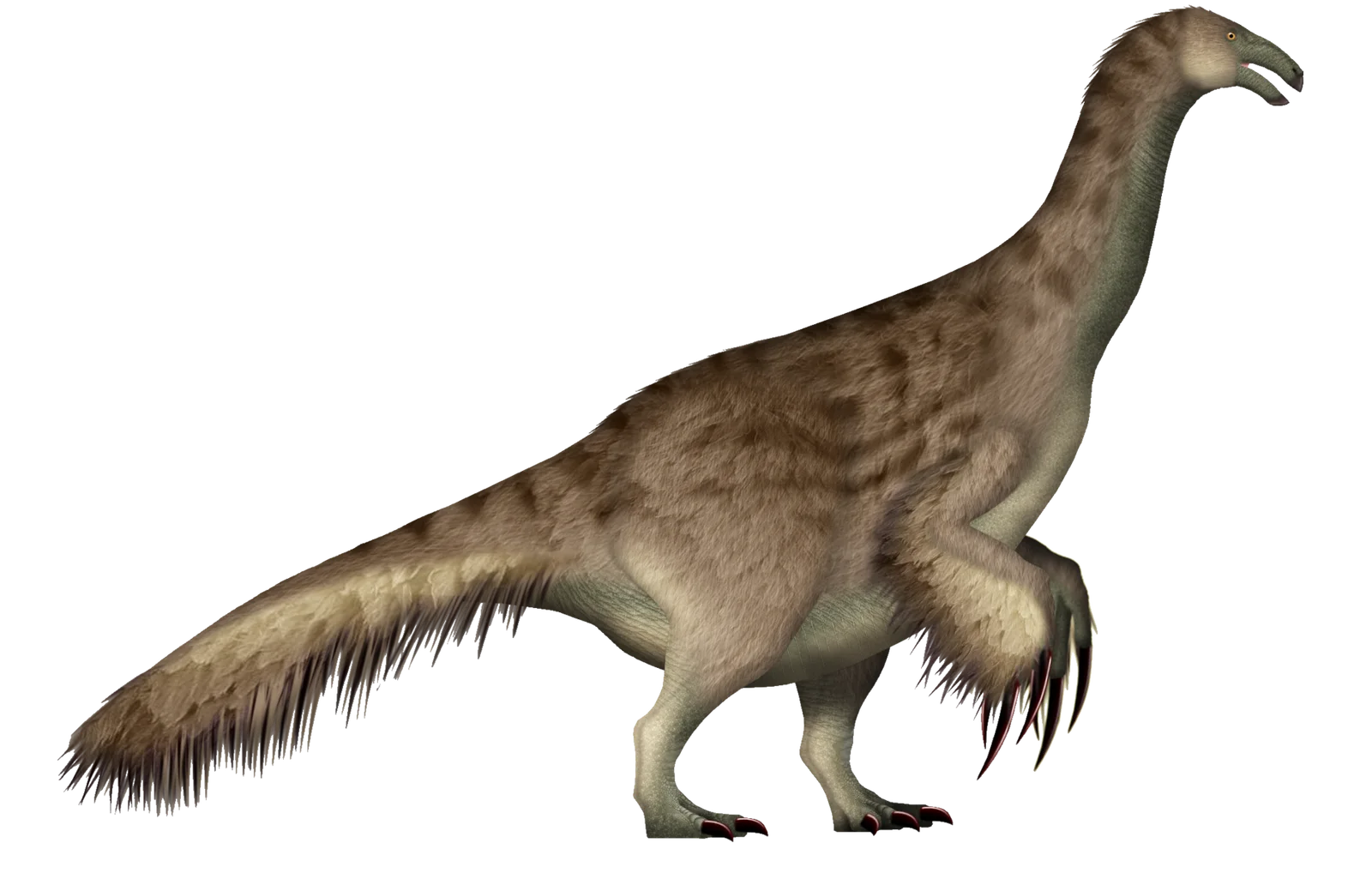
Therizinosaurus cheloniformis was the largest known member of a highly unusual branch of maniraptoran theropods that shifted away from the predatory body plan of their ancestors. Its directly known remains are striking but incomplete: giant shoulder and arm bones, three-fingered hands with extremely elongated unguals, ribs and referred hind-limb material. No complete skull, vertebral column or articulated whole skeleton has been found. The small head, long neck, deep torso, broad pelvis and feather-like covering in modern reconstructions therefore come mainly from related therizinosaurs. That comparative framework is strong enough to identify a giant bipedal herbivore, but it cannot fill every anatomical gap with equal confidence.
Its fossils occur between approximately 70 and 66 million years ago. Values shown here are approximate and reflect the current curated seed dataset.
Form and function
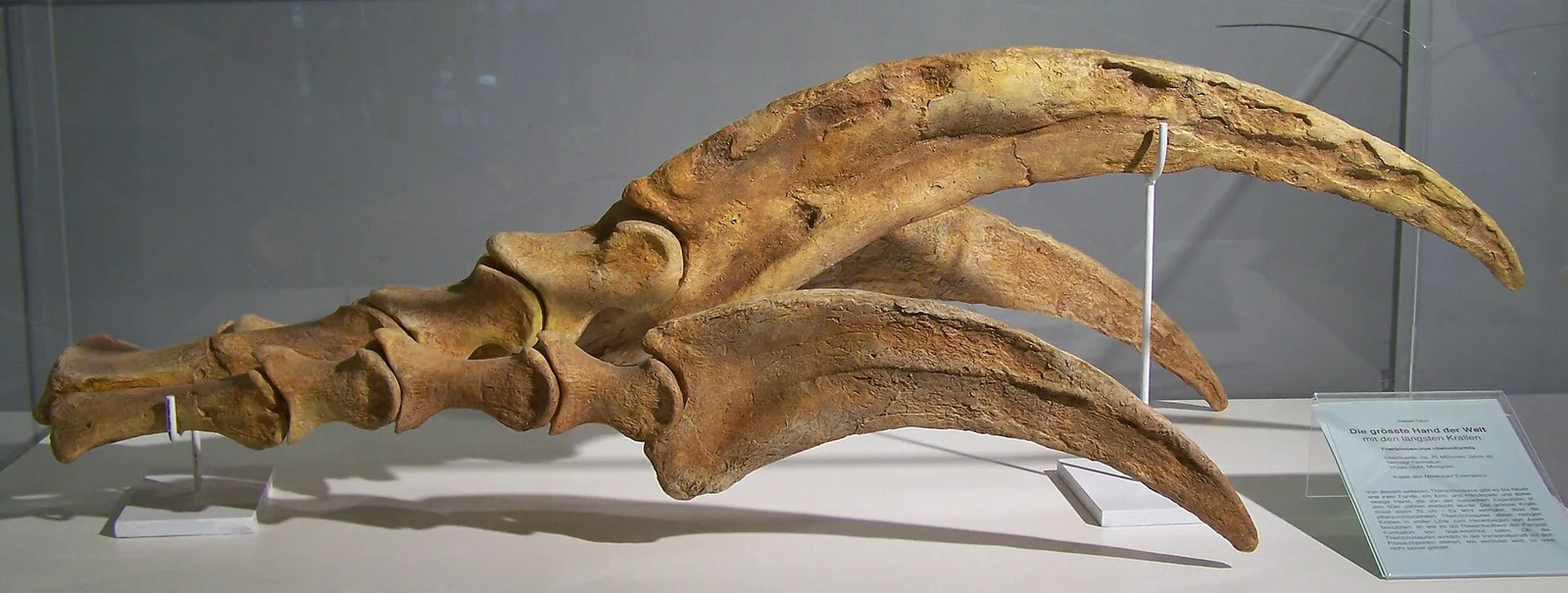
Referred forelimb MPC-D 100/15 includes both scapulocoracoids, humeri about 76 centimetres long, forearm bones, wrist elements and much of a right hand. Each hand had three long functional fingers. The largest incomplete bony unguals reach roughly 50–65 centimetres; a keratin sheath extended them in life, but a one-metre total claw is a reconstruction rather than a preserved measurement. These unguals are unusually straight, flattened side-to-side and poor at resisting several heavy-load scenarios in recent models. Referred hind-limb material supports bipedal locomotion and a broad, four-toed foot characteristic of advanced therizinosaurs. The long neck, small beaked head, capacious gut and feathers are plausible family-level inferences, not structures preserved with this species.
Evolutionary position
This simplified classification path shows one placement from Dinosauria to this species. Each step is clickable, and other analyses may support alternative relationships.
Open interactive positionScale
Simplified length comparison using preferred dataset estimates; body shape and posture are not represented.
Scientific record
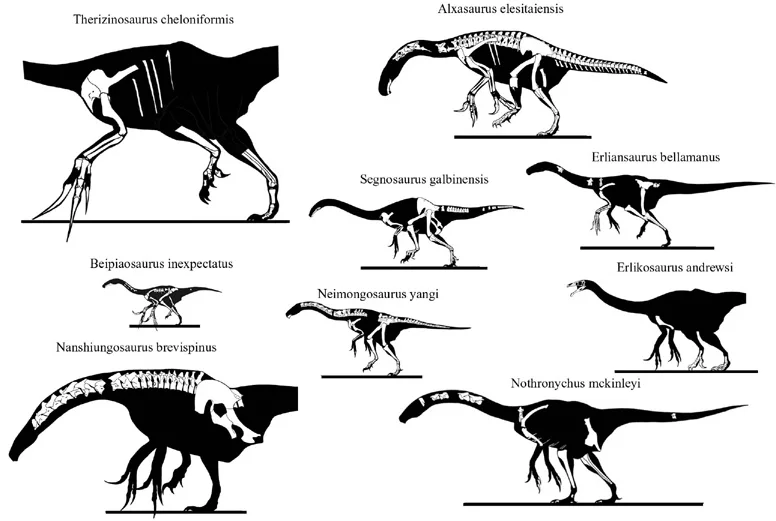
The Mongolian Paleontological Expedition of the USSR Academy of Sciences found the holotype PIN 551-483 at Nemegt’s Quarry V in 1948. It comprises three incomplete hand unguals, a metacarpal fragment and rib fragments. Evgeny A. Maleev named Therizinosaurus cheloniformis in 1954 but interpreted the animal as an enormous turtle-like aquatic reptile whose claws might cut vegetation. Rinchen Barsbold described giant shoulder, arm and hand material from additional Nemegt localities in 1976 and recognized a theropod. Discoveries of more complete relatives—especially Erlikosaurus, Alxasaurus, Beipiaosaurus and North American forms—eventually established therizinosaurs as herbivorous or omnivorous maniraptorans and supplied the missing body outline.
Discovery credit: Mongolian Paleontological Expedition of the USSR Academy of Sciences.
Naming authors: Evgeny A. Maleev.
Palaeoenvironment
Therizinosaurus inhabited the extensive river channels and floodplains of the Nemegt Formation in southern Mongolia. Seasonal floods laid down sandbars and muddy overbank deposits, while plants supported an unusually varied large-herbivore community. Saurolophus, Deinocheirus, gallimimids, pachycephalosaurs and sauropods shared the wider formation; Tarbosaurus was its largest known predator. Therizinosaurus remains come from several Nemegt localities, including Nemegt, Hermiin Tsav and Altan Uul, so the animal occupied a regional landscape rather than one precisely mapped quarry point.
Herbivory is strongly supported by the anatomy and evolutionary distribution of better-known therizinosaurs, although Therizinosaurus itself preserves no skull or teeth. Its long arms and claws inspired feeding, digging and defence hypotheses. A 2014 finite-element study found hook-and-pull use more compatible than digging for most therizinosaurs, whereas a broader 2023 analysis found the extreme Therizinosaurus unguals poorly suited to all tested high-stress tasks and proposed display or intimidation as their principal role. These models test idealized forces on claw bones; they do not show that the living hands never touched vegetation or struck an attacker. No trackway, nest, healed combat wound or group association establishes its speed, temperament, sociality or parental behaviour.
Worth knowing
Fossil distribution
Gobi Desert, Mongolia
Nemegt Formation
regional marker
Markers are deliberately approximate. They identify published fossil areas without exposing sensitive excavation coordinates.
Open interactive mapFossil specimen record
Katsuyama, Japan
The museum’s updated specimen database maps a Therizinosaurus forelimb display to the second-floor escalator hall and records Mongolia and the Nemegt Formation. Because the public entry does not claim original fossil bone, this database conservatively identifies the display as a cast.
Warsaw, Poland
The museum’s official guidebook identifies the cabinet’s largest displayed claw as Therizinosaurus and discusses feeding and defence hypotheses. The guide does not identify it as original fossil material, so it is recorded conservatively as a cast.
A research repository is not necessarily a public exhibit. Loan and display status can change, so check with the institution before visiting.
Media record
Evidence
Evgeny A. Maleev · Priroda 1954(3) · 1954
Open sourceRinchen Barsbold · Paleontology and Biostratigraphy of Mongolia, Joint Soviet-Mongolian Paleontological Expedition Transactions · 1976
Open sourceLindsay E. Zanno · Journal of Systematic Palaeontology 8(4) · 2010
Open sourceStephan Lautenschlager · Proceedings of the Royal Society B 281(1785) · 2014
Open sourceZichuan Qin, Chun-Chi Liao, Michael J. Benton, Emily J. Rayfield · Communications Biology 6, 181 · 2023
Open sourceNatural History Museum, London
Open sourceFukui Prefectural Dinosaur Museum
Open sourceMuseum of Evolution, Polish Academy of Sciences · 2017
Open source