Dry Mesa Dinosaur Quarry region
Montrose County, Colorado, United States
Morrison Formation
regional marker
Pronunciation: TOR-voh-SORE-us TAN-er-eye
A large, robust megalosaurid predator from the Morrison Formation, distinguished by massive three-fingered forelimbs and fragmentary skull material.
Last updated 23 July 2026
Field guide
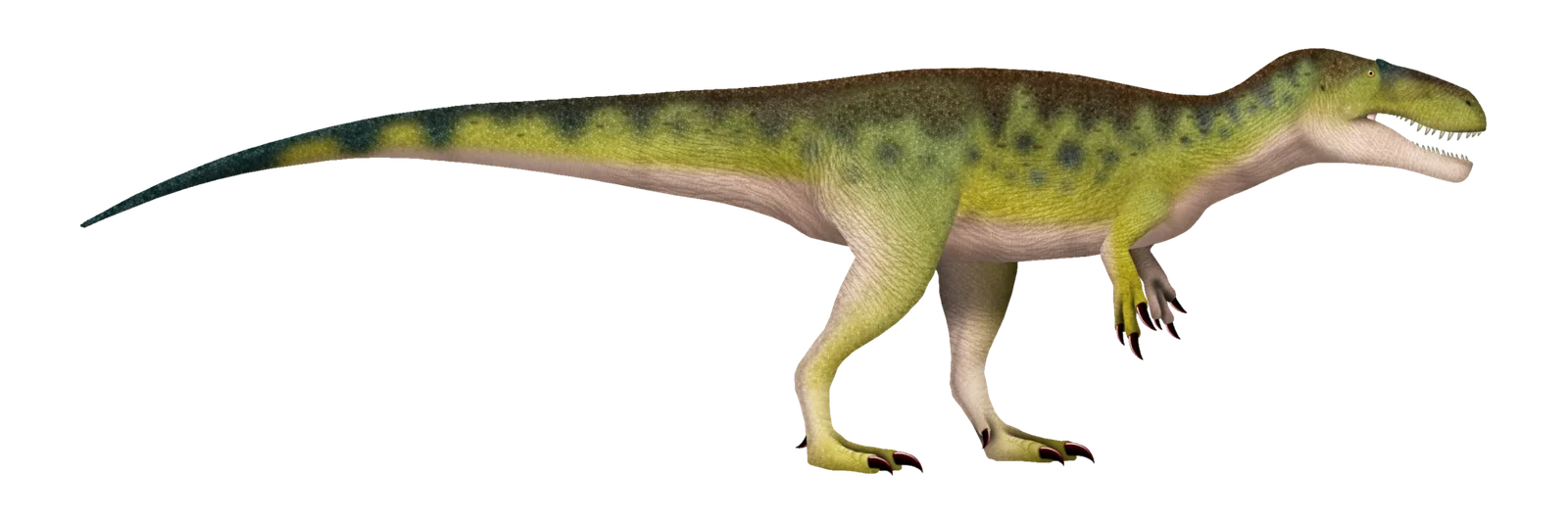
Torvosaurus tanneri was among the largest theropods in the Late Jurassic Morrison ecosystem of western North America. It belonged to Megalosauridae, an older radiation of large predators distinct from the allosaurids that shared its environment. Fossils from the Dry Mesa Dinosaur Quarry include the type forelimbs and referred skull, vertebral, pelvic and hind-limb bones. Together they indicate a deep-bodied, heavy-headed carnivore with massive arms and a large claw on the inner finger. No single complete skeleton is known, so the familiar whole-animal reconstruction combines multiple individuals.
Its fossils occur between approximately 153 and 148 million years ago. Values shown here are approximate and reflect the current curated seed dataset.
Form and function
Torvosaurus had a large, deep skull armed with thick, laterally compressed and serrated teeth. The forelimbs were unusually robust for a giant theropod: the humerus was massive, the ulna short, and the hand retained three functional clawed fingers with an enlarged first claw. A broad pelvis and powerful hind limbs supported a heavy bipedal body. Megalosaurid features in the jaws, vertebrae and pelvis distinguish it from Allosaurus. Preserved elements imply a long muscular tail, but much of the skull and skeleton remains reconstructed from related taxa.
Evolutionary position
This simplified classification path shows one placement from Dinosauria to this species. Each step is clickable, and other analyses may support alternative relationships.
Open interactive positionScale
Simplified length comparison using preferred dataset estimates; body shape and posture are not represented.
Scientific record
Vivian and Eddie Jones discovered a large theropod toe bone in the Dry Mesa area in 1971, prompting James Jensen's Brigham Young University excavations. Peter Galton and Jensen named Torvosaurus tanneri in 1979 from paired forelimb bones catalogued as BYU 2002, with other Dry Mesa bones referred to the species. Brooks Britt's 1991 monograph described additional cranial and postcranial material and clarified its osteology. The genus means savage lizard; the species honours Nathan Eldon Tanner, a counsellor in the First Presidency of the Church of Jesus Christ of Latter-day Saints.
Discovery credit: Vivian Jones, Eddie Jones, James A. Jensen.
Naming authors: Peter M. Galton, James A. Jensen.
Palaeoenvironment
The Morrison Formation records seasonally dry river floodplains, wetlands and gallery forests across western North America. At Dry Mesa, Torvosaurus occurred in an exceptionally diverse dinosaur assemblage that included Allosaurus, Ceratosaurus, several sauropods, Stegosaurus and smaller ornithischians. Its rarity relative to Allosaurus makes its precise ecological role difficult to quantify.
Large serrated teeth, a deep skull and powerful grasping forelimbs identify Torvosaurus as a macropredator and carcass feeder. It could probably attack large herbivores, but no specific prey choice is demonstrated by gut contents or an associated kill site. Coexistence with Allosaurus and Ceratosaurus may reflect ecological partitioning, yet direct evidence for how these predators divided food or habitat is limited. No fossil association supports pack hunting.
Worth knowing
Fossil distribution
Montrose County, Colorado, United States
Morrison Formation
regional marker
Markers are deliberately approximate. They identify published fossil areas without exposing sensitive excavation coordinates.
Open interactive mapFossil specimen record
Provo, United States
The museum preserves holotype BYU 2002 and referred original bones from the Dry Mesa Dinosaur Quarry.
A research repository is not necessarily a public exhibit. Loan and display status can change, so check with the institution before visiting.
Media record
Evidence
Peter M. Galton, James A. Jensen · Brigham Young University Geology Studies 26(1), 1–12 · 1979
Open sourceBrooks B. Britt · Brigham Young University Geology Studies 37, 1–72 · 1991
Open sourceBrigham Young University
Open source