Wujiaba fossil site region
Zigong, Sichuan Province, China
Upper Shaximiao Formation
regional marker
Pronunciation: too-YANG-oh-SORE-us mul-tee-SPY-nus
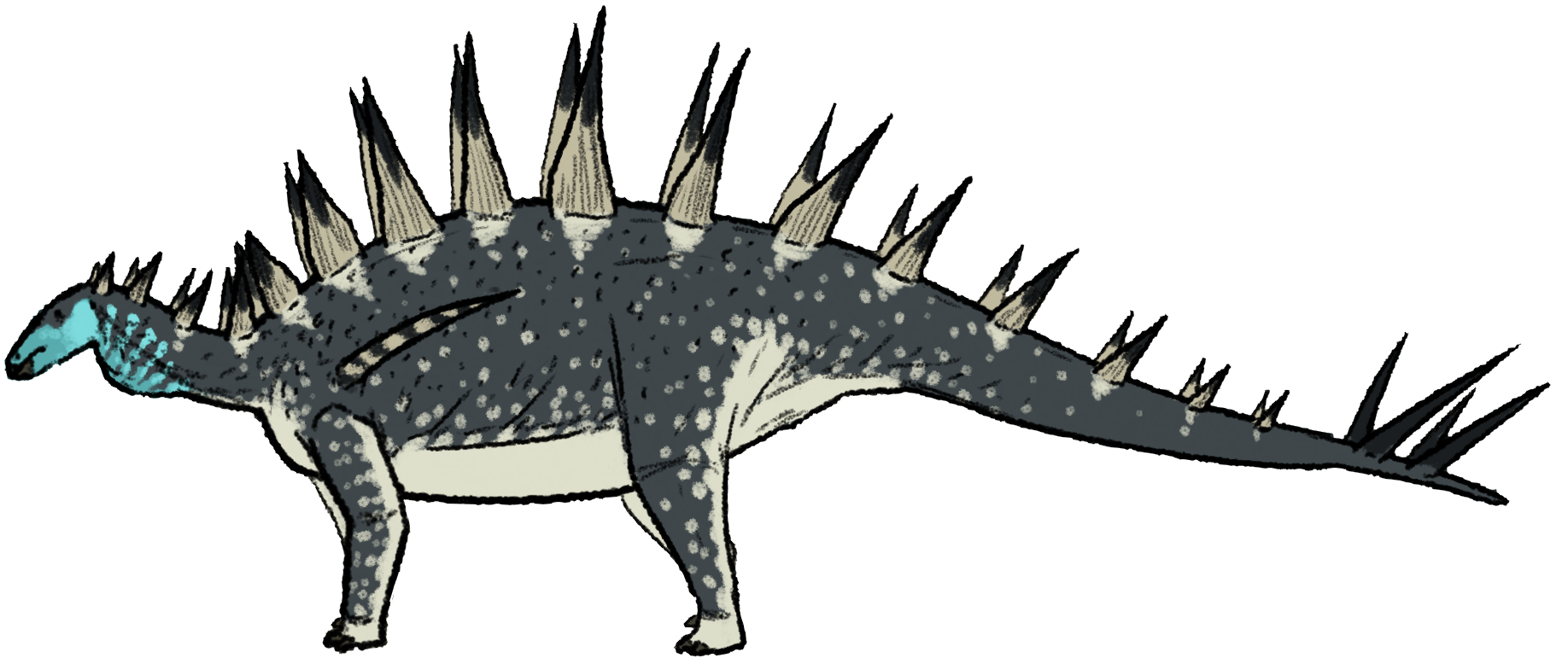
A well-represented Chinese stegosaur with a long low skull, changing plate shapes along its back and formidable spikes toward the end of the tail.
Last updated 16 July 2026
Field guide
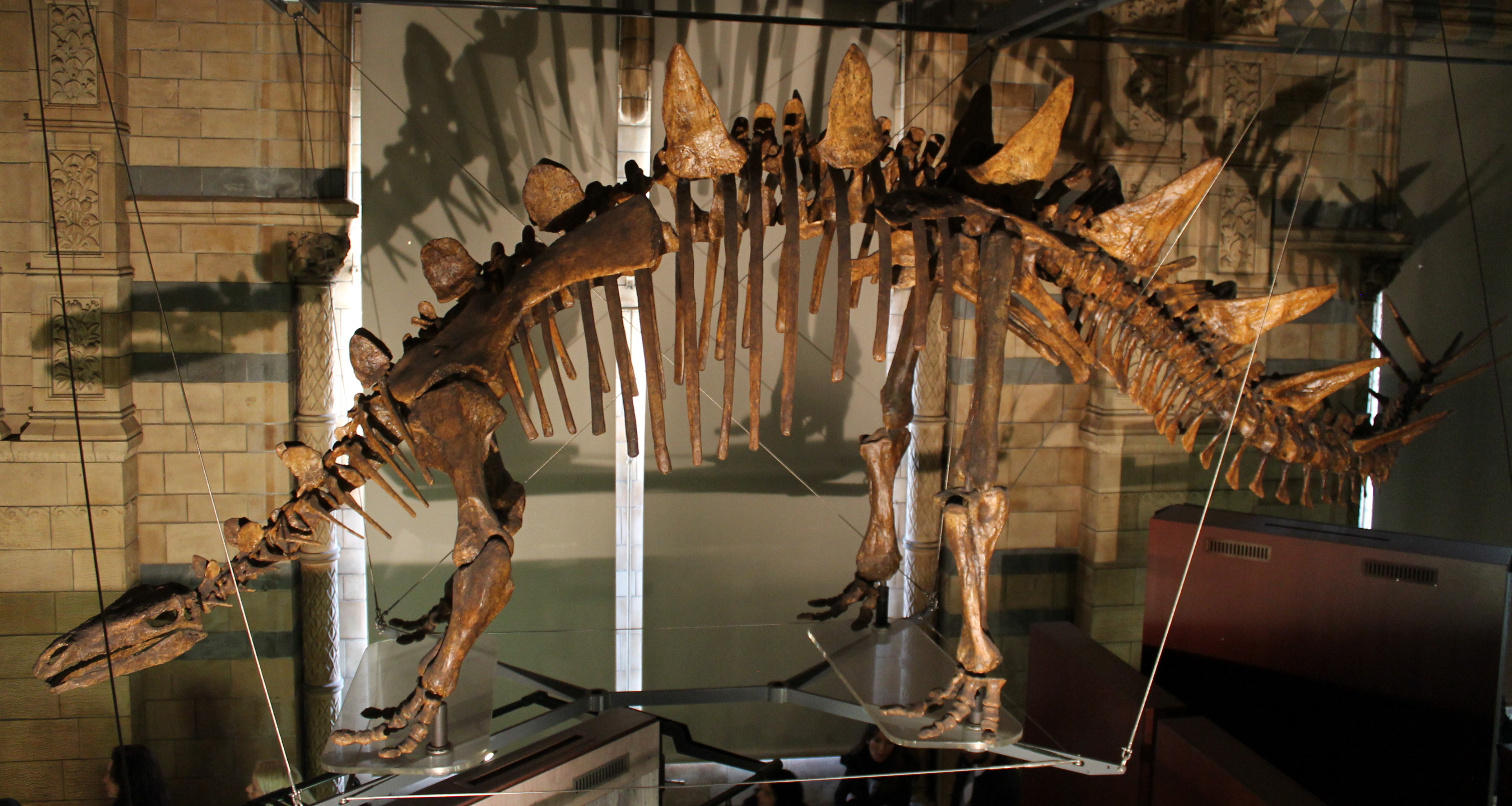
Tuojiangosaurus multispinus was one of the first nearly complete stegosaurs described from China and remains an emblem of the Upper Shaximiao Formation. Its body combined a low head, arched back, robust limbs, alternating plates and a tail armed with spikes. The original reconstruction estimated 17 pairs of dermal armour, although plates and spikes were not preserved in one uninterrupted life position. Consequently, the exact sequence and the placement of isolated long spines shown on museum mounts remain more uncertain than the underlying skeleton.
Its fossils occur between approximately 157 and 154 million years ago. Values shown here are approximate and reflect the current curated seed dataset.
Form and function
The combined holotype and paratype preserve an incompletely known but reconstructable low, narrow skull; much of the vertebral column; both girdles; major limb bones; and numerous dermal plates. Plates were small and rounded near the neck, tall and triangular over the back, then lower and more spike-like toward the pelvis and tail. The mouth carried numerous closely packed leaf-shaped teeth for cropping plants. Forelimbs were shorter than the hind limbs, the pelvis was broad and the tail provided the lever for several long defensive spikes.
Evolutionary position
This simplified classification path shows one placement from Dinosauria to this species. Each step is clickable, and other analyses may support alternative relationships.
Open interactive positionScale
Simplified length comparison using preferred dataset estimates; body shape and posture are not represented.
Scientific record
Construction work at Wujiaba near Zigong exposed stegosaur remains in 1974. Chinese palaeontologists excavated two partial skeletons from the base of the Upper Shaximiao Formation. Dong Zhiming, Li Xuanmin, Zhou Shiwu and Chang Yijong named Tuojiangosaurus multispinus in 1977, exactly a century after Stegosaurus was named in North America. CV 209 was selected as the holotype and CV 210 as the paratype. Their 1983 monograph expanded the description, combined the incomplete skulls and mapped how different armour shapes may have been distributed along the body.
Discovery credit: Wujiaba construction workers, Zigong field team.
Naming authors: Dong Zhiming, Li Xuanmin, Zhou Shiwu, Chang Yijong.
Palaeoenvironment
The Upper Shaximiao Formation preserves river channels, floodplains and lakes within the Sichuan Basin under a warm, seasonally wet climate. Tuojiangosaurus fed among vegetation including conifers, cycads and ferns. The broader dinosaur fauna included sauropods such as Mamenchisaurus, other stegosaurs and large theropods including Yangchuanosaurus, although the formation spans enough time that not every species was a direct contemporary.
The small skull and leaf-shaped teeth indicate a low-browsing herbivore that clipped rather than chewed vegetation extensively. Tail spikes formed the clearest defensive weapon, but fossils do not preserve a swing or an injury directly caused by this species. Plates may have aided display, recognition or heat exchange; their vascularised bone alone cannot choose one function. No trackway, nest or bonebed securely establishes herd size, parental care or mating behaviour for Tuojiangosaurus.
Worth knowing
Fossil distribution
Zigong, Sichuan Province, China
Upper Shaximiao Formation
regional marker
Markers are deliberately approximate. They identify published fossil areas without exposing sensitive excavation coordinates.
Open interactive mapFossil specimen record
Chongqing, China
Repository associated with the original holotype and paratype skeletons from Wujiaba. The scientific literature documents the type collection; this entry does not claim that every original bone is continuously exhibited.
Katsuyama, Fukui, Japan
A reconstructed mount used to present the anatomy and armour of this representative Asian stegosaur. It is not the original Wujiaba type material.
A research repository is not necessarily a public exhibit. Loan and display status can change, so check with the institution before visiting.
Media record
Evidence
Dong Zhiming, Li Xuanmin, Zhou Shiwu, Chang Yijong · Vertebrata PalAsiatica 15(4) · 1977
Dong Zhiming, Zhou Shiwu, Zhang Yihong · Palaeontologia Sinica, New Series C 23 · 1983
Open sourceSusannah C. R. Maidment, Guangbiao Wei · Swiss Journal of Geosciences 103 · 2010
Open sourceChongqing Municipal People's Government
Open sourceFukui Prefectural Dinosaur Museum
Open source