Hell Creek fossil region
Eastern Montana, United States
Hell Creek Formation
regional marker
Pronunciation: tie-RAN-oh-SORE-us reks
A massive latest-Cretaceous tyrannosaurid with a deep, reinforced skull, bone-crushing teeth, powerful hind limbs and extremely short two-fingered arms. Exceptional skeletons reveal dramatic changes from lightly built juveniles to heavy adults.
Last updated 13 July 2026
Field guide
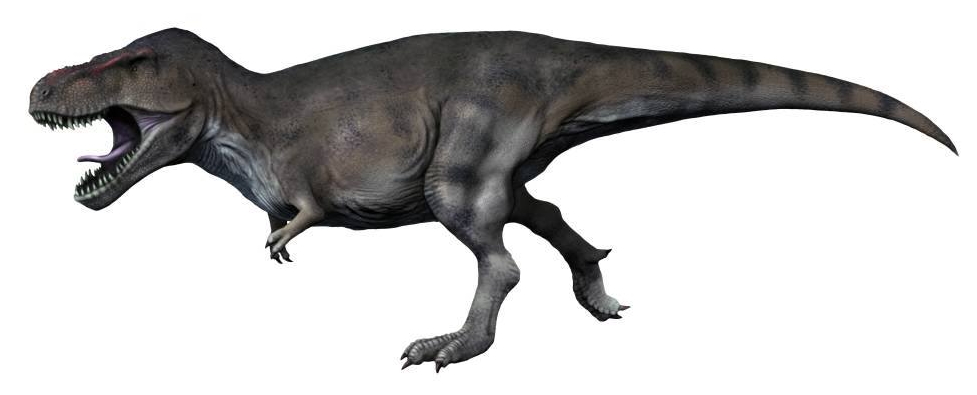
Tyrannosaurus rex lived near the end of the age of non-avian dinosaurs in western North America. Adults combined a broad, deep skull with thick, serrated teeth, a muscular neck, a barrel-shaped torso and a long counterbalancing tail. Its short arms were genuinely small but carried substantial muscle attachments and two clawed fingers. Several unusually complete skeletons—including SUE, the Wankel specimen and AMNH 5027—make adult anatomy well known. Even so, body mass, maximum speed, facial covering, juvenile taxonomy and the boundaries between proposed Tyrannosaurus species remain active research questions.
Its fossils occur between approximately 68 and 66 million years ago. Values shown here are approximate and reflect the current curated seed dataset.
Form and function
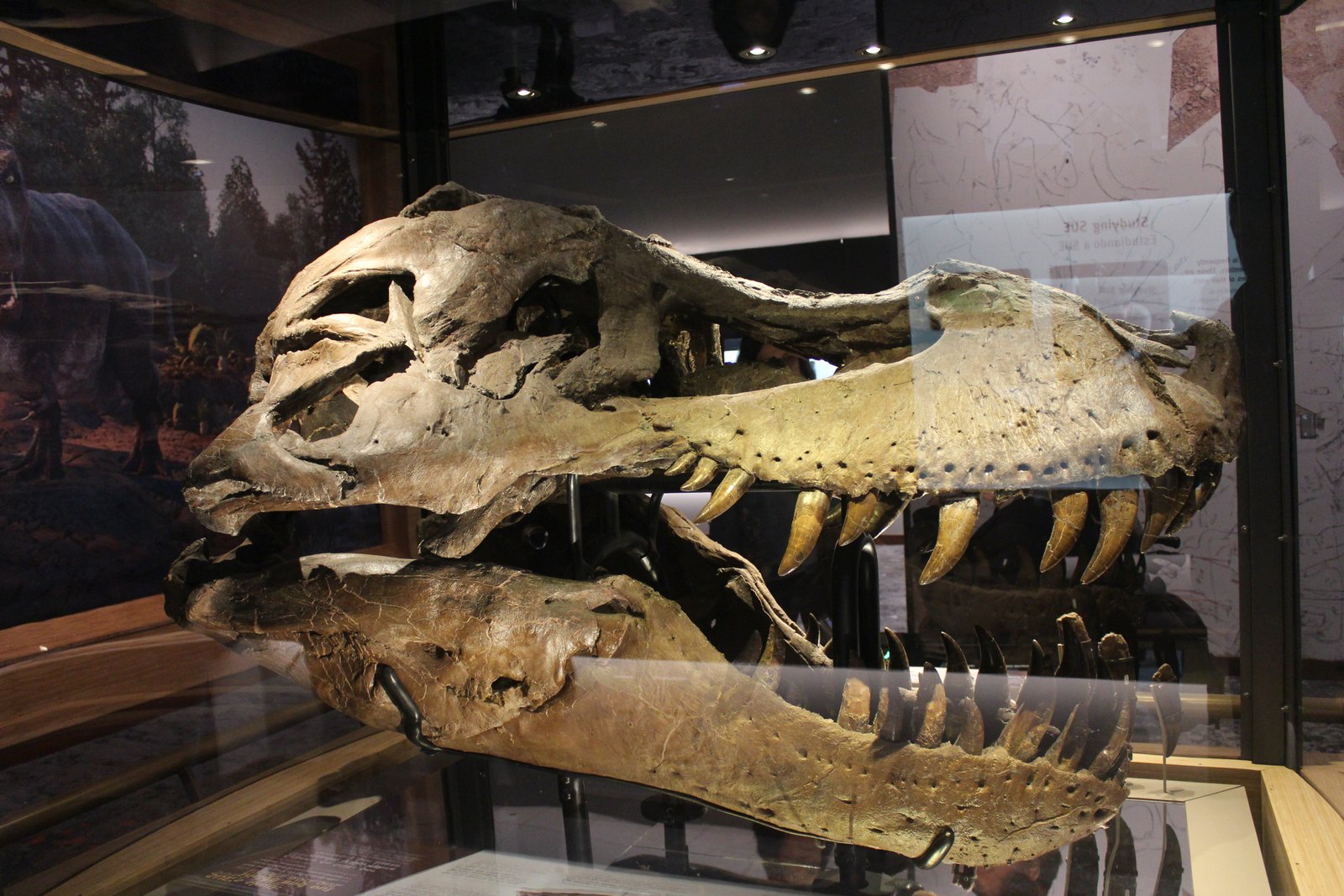
The skull was built to withstand large feeding loads: fused and braced bones formed a broad rear skull, while thick teeth could puncture and fracture bone. Growth was transformative rather than a simple enlargement. Juveniles had shallower skulls and proportionally longer, more slender legs; the torso and skull became much more robust as individuals approached adulthood. Skin impressions document small scales on limited parts of the body, but they do not preserve the entire covering.
Evolutionary position
This simplified classification path shows one placement from Dinosauria to this species. Each step is clickable, and other analyses may support alternative relationships.
Open interactive positionScale
Simplified length comparison using preferred dataset estimates; body shape and posture are not represented.
Scientific record
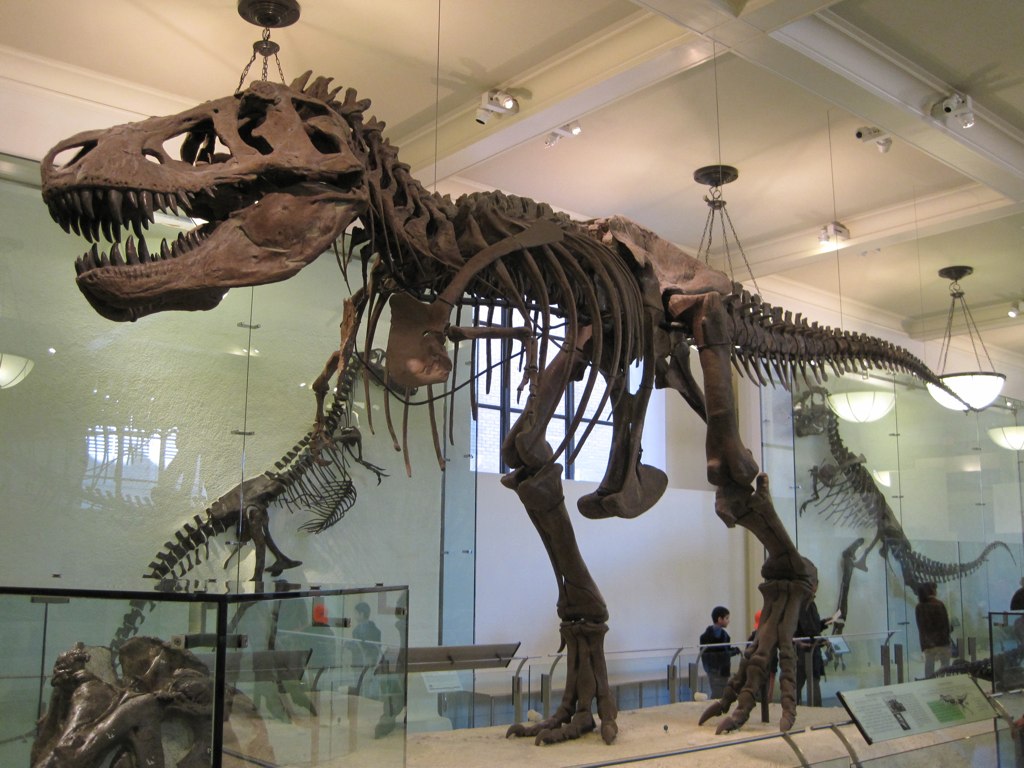
Barnum Brown and Richard Swann Lull recovered the name-bearing skeleton in the Hell Creek beds of eastern Montana in 1902 for the American Museum of Natural History. Henry Fairfield Osborn named Tyrannosaurus rex in 1905; the specimen was then AMNH 973 and is now catalogued as CM 9380 at Carnegie Museum of Natural History. Brown found the more complete AMNH 5027 at Big Dry Creek in 1908. Its historic mount went on display in New York in 1915 and was later rebuilt in a horizontal, tail-raised posture as understanding of dinosaur balance changed.
Discovery credit: Barnum Brown, Richard Swann Lull.
Naming authors: Henry Fairfield Osborn.
Palaeoenvironment
T. rex occupied humid coastal lowlands east of the retreating Western Interior Seaway. The Hell Creek and equivalent formations preserve river channels, floodplains, ponds and forested habitats with seasonal disturbance. Triceratops, Edmontosaurus, ankylosaurs, pachycephalosaurs, turtles, crocodilians, mammals and many smaller vertebrates shared this landscape.
Direct evidence supports both predation and scavenging, so treating T. rex as exclusively one or the other creates a false choice. Its teeth, skull and neck could process large carcasses and damage bone, while healed bite marks and embedded tyrannosaur teeth show interactions with living animals. Bite force and running performance are reconstructed from models rather than observed directly. Evidence for coordinated pack hunting is inconclusive, and the function of the tiny arms remains unresolved.
Worth knowing
Fossil distribution
Eastern Montana, United States
Hell Creek Formation
regional marker
Eastern Wyoming, United States
Lance Formation
regional marker
Markers are deliberately approximate. They identify published fossil areas without exposing sensitive excavation coordinates.
Open interactive mapFossil specimen record
New York, United States
Mounted specimen AMNH 5027, discovered by Barnum Brown in 1908. The free-standing mount is approximately 45 percent original fossil, supplemented with casts and reconstructed elements.
Chicago, United States
FMNH PR 2081 ('SUE'), the most complete T. rex skeleton by bone volume. The mounted body uses the original postcranial fossils; the heavy, distorted original skull is displayed separately and a corrected cast sits on the mount.
Washington, D.C., United States
The Wankel T. rex, MOR 555 / USNM 555000, displayed feeding on a Triceratops. The fossil belongs to the U.S. Army Corps of Engineers and is on a 50-year loan to the Smithsonian.
Maribo, Denmark
A composite display assembled from original bones of three different T. rex individuals, including an exceptionally well-preserved skull. It is not a single associated skeleton, and the museum states that Trinity is on display during the 2025 and 2026 seasons.
A research repository is not necessarily a public exhibit. Loan and display status can change, so check with the institution before visiting.
Media record
Evidence
Henry Fairfield Osborn · Bulletin of the American Museum of Natural History · 1905
Open sourceChristopher A. Brochu · Journal of Vertebrate Paleontology, Memoir 7 · 2003
Open sourceJohn R. Hutchinson, Karl T. Bates, Julia Molnar and 2 coauthors · PLOS ONE · 2011
Open sourceKarl T. Bates, Peter L. Falkingham · Biology Letters · 2012
Open sourcePhil R. Bell, Nicolás E. Campione, W. Scott Persons IV and 4 coauthors · Biology Letters · 2017
Open sourceThomas D. Carr · PeerJ · 2020
Open sourceAmerican Museum of Natural History
Open sourceField Museum
Open sourceSmithsonian National Museum of Natural History
Open sourceMuseum of Evolution
Open source