Dalton Wells fossil area
Utah, United States
Cedar Mountain Formation, Yellow Cat Member
approximate site marker
Pronunciation: YOO-tah-RAP-tor OSS-trom-MAY-see
The largest well-supported dromaeosaur, a powerfully built Early Cretaceous predator from eastern Utah known from scattered type material, larger BYU individuals and a remarkable multi-age sandstone block still being prepared.
Last updated 14 July 2026
Field guide
Utahraptor ostrommaysi greatly expanded the known size range of the sickle-clawed dromaeosaurids. At about 5.5 metres long, it was much stockier than Velociraptor or Deinonychus, with a deep torso, robust femora and an enlarged claw bone on the second toe of each foot. Its fame exceeds the completeness of its published anatomy: the named material is disarticulated, several bones used in early reconstructions have been reidentified, and much of the spectacular Stikes Quarry assemblage remains under preparation. That nine-ton block contains thousands of bones from young to adult Utahraptors alongside at least two plant-eating dinosaurs. It promises a much fuller picture of growth and anatomy, but the animals’ association in a natural trap cannot by itself demonstrate coordinated pack hunting.
Its fossils occur between approximately 136 and 132 million years ago. Values shown here are approximate and reflect the current curated seed dataset.
Form and function
The holotype, CEUM 184v.86, is a large second-toe ungual rather than a whole skeleton. Referred material includes additional foot bones, a premaxilla, teeth, vertebrae and substantial hind-limb elements from several individuals. The largest published femora are unusually stout for a dromaeosaur and combine mass-supporting features with the more birdward arrangement of theropod hip musculature. A 2024 comparative study used an estimated mass near 550 kilograms for one large individual, while other museum syntheses favour about 350 kilograms; both are model-dependent. The animal carried three-fingered hands, but several supposedly blade-like hand claws in early accounts were later reidentified as foot claws. As in other dromaeosaurids, the enlarged second toe was held clear of the ground and the long tail was stiffened by elongated bony processes. No Utahraptor fossil preserves feathers, although a feathered body is strongly inferred from its place among paravian theropods.
Evolutionary position
This simplified classification path shows one placement from Dinosauria to this species. Each step is clickable, and other analyses may support alternative relationships.
Open interactive positionScale
Simplified length comparison using preferred dataset estimates; body shape and posture are not represented.
Scientific record
Brigham Young University field work led by James A. Jensen recovered large dromaeosaur bones near Moab in 1975 after local collector Lin Ottinger reported the site, but the material was not named. In 1991, Robert Gaston found a giant sickle claw at the Gaston Quarry; James Kirkland, Donald Burge and Gaston described material from that quarry and a second locality in 1993 as Utahraptor ostrommaysi. The name honoured John Ostrom, whose Deinonychus research helped transform dinosaur science, and Chris Mays, who supported the project. Later authors often changed the ending to ostrommaysorum. A 2019 nomenclatural analysis concluded that the original ostrommaysi must be retained under the zoological code, so this profile uses that spelling while preserving the database’s older slug for stable links. The Stikes Quarry megablock was excavated beginning in the 2000s and transferred to the Natural History Museum of Utah; its laborious preparation continues to expose skull, juvenile and adult material.
Discovery credit: Lin Ottinger and the Brigham Young University field team, Robert Gaston, James I. Kirkland, Donald Burge.
Naming authors: James I. Kirkland, Donald Burge, Robert Gaston.
Palaeoenvironment
Utahraptor lived on the low-relief terrestrial landscapes recorded by the upper Yellow Cat Member of the Cedar Mountain Formation. Calcareous soils, spring-related deposits, ponds and episodic channels developed under a strongly seasonal, at least seasonally dry climate. A volcanic-ash-derived horizon at Utahraptor Ridge has been dated to 135.10 ± 0.34 million years, placing that part of the member in the Valanginian rather than the younger Barremian age used in many older books. Gastonia, Hippodraco, iguanodont-grade herbivores and sauropods occur in the wider member. Those animals were spread across different localities and horizons, so a formation-level list is not a single frozen community.
Teeth, jaws and the enlarged foot claw identify Utahraptor as a predator, but exactly how it subdued prey remains unresolved. Dromaeosaur foot-claw models favour grasping or pinning over a simple slashing kick, yet those tests are not direct observations of Utahraptor. The Stikes Quarry contains young and adult Utahraptors around larger herbivores in a spring-fed sand trap. The published sedimentology explains how repeated entrapment and rapid burial could concentrate the bodies; it does not show that the raptors arrived, hunted or lived as a coordinated pack. No nest, trackway or healed combat series currently demonstrates group hunting, parental care, top speed or a preferred prey species.
Worth knowing
Fossil distribution
Utah, United States
Cedar Mountain Formation, Yellow Cat Member
approximate site marker
Grand County, Utah, United States
Cedar Mountain Formation, Yellow Cat Member
regional marker
Grand County, Utah, United States
Cedar Mountain Formation, upper Yellow Cat Member
regional marker
Markers are deliberately approximate. They identify published fossil areas without exposing sensitive excavation coordinates.
Open interactive mapFossil specimen record
Price, United States
The museum’s current visitor material identifies Utahraptor as a signature exhibit. Its collections house holotype claw CEUM 184v.86 and other original Gaston Quarry material; the full-body display is a reconstruction assembled from incomplete remains rather than one skeleton.
Salt Lake City, United States
NHMU’s current species page directs visitors to Utahraptor in the Past Worlds Gallery. The institution is also the permanent repository for all Stikes Quarry megablock material, though the project page does not promise that prepared original block bones are continuously on public display.
Moab, United States
Opened in May 2025, the visitor center interprets the nearby Dalton Wells fossil area and presents a Utahraptor skeletal reconstruction with other local dinosaurs. The public sources do not identify the mount as original bone, so it is recorded conservatively as a reconstruction.
A research repository is not necessarily a public exhibit. Loan and display status can change, so check with the institution before visiting.
Media record
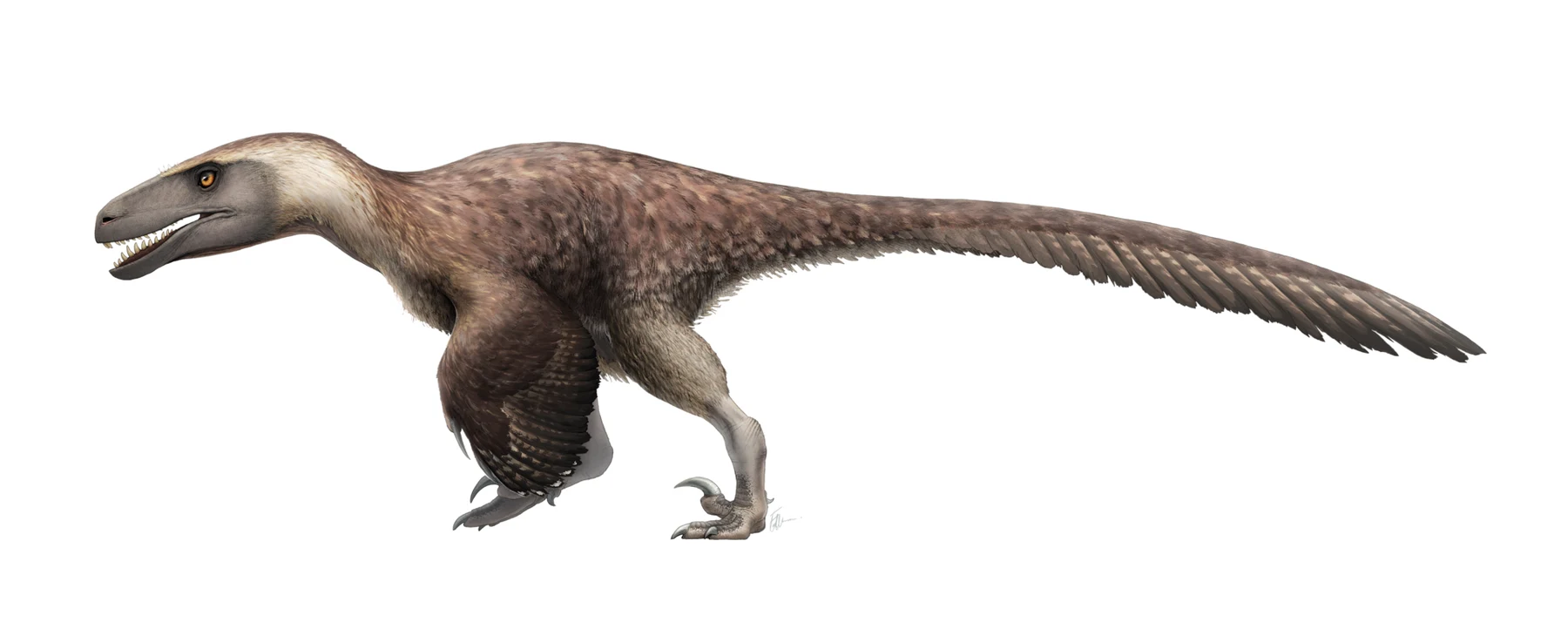
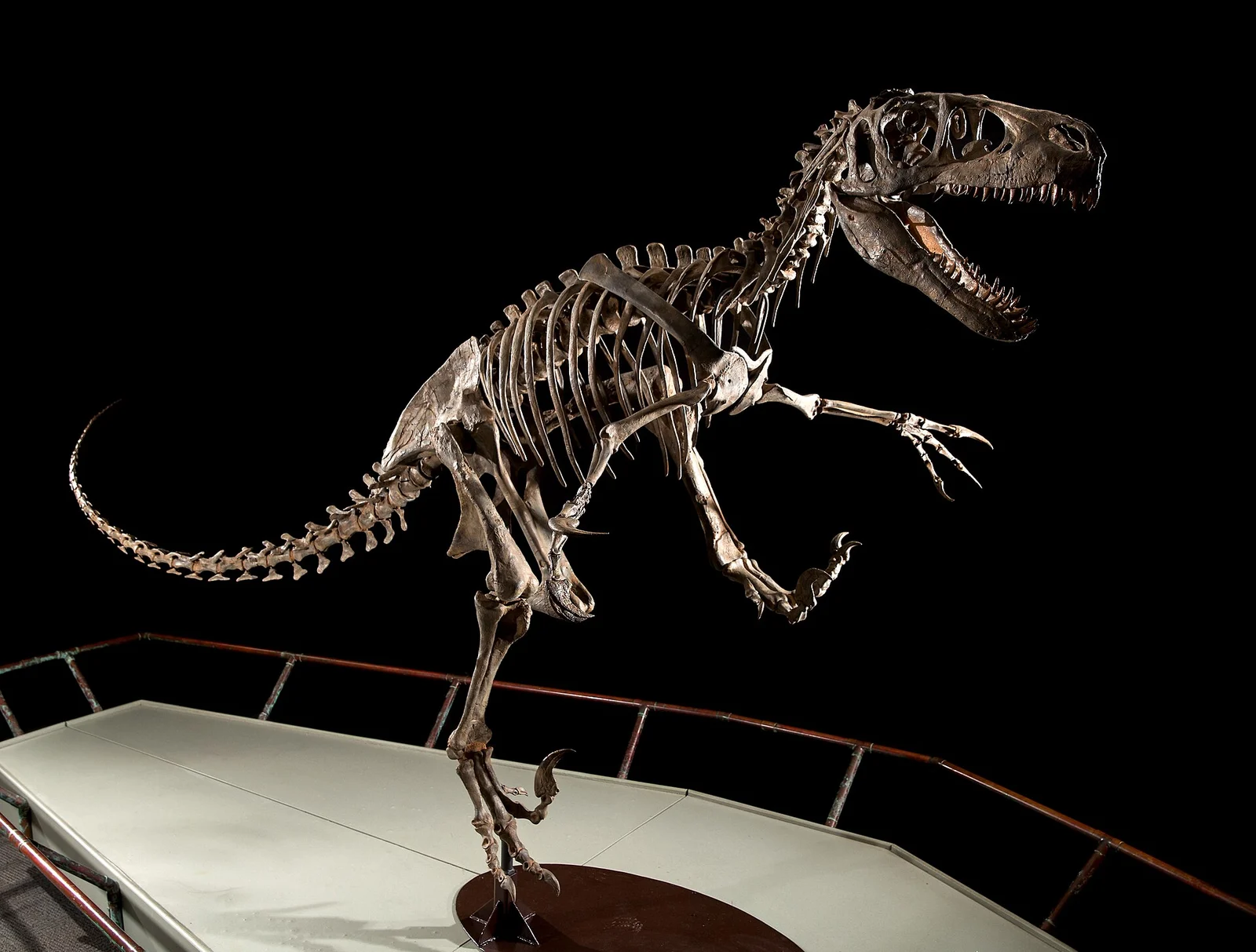
Evidence
James I. Kirkland, Donald Burge, Robert Gaston · Hunteria 2(10) · 1993
Open sourceBrooks B. Britt, Daniel J. Chure, Kenneth L. Stadtman and 3 coauthors · Journal of Vertebrate Paleontology 21(3 supplement), 36A · 2001
Open sourceJames I. Kirkland, Edward L. Simpson, Donald D. DeBlieux and 3 coauthors · PALAIOS 31(9) · 2016
Open sourceRobert M. Joeckel, Celina A. Suarez, Noah M. McLean and 7 coauthors · Geosciences 13(2), 32 · 2023
Open sourceThiago Vernaschi V. Costa, Normand David · Bulletin of Zoological Nomenclature 76 · 2019
Open sourceRomain Pintore, John R. Hutchinson, Peter J. Bishop and 2 coauthors · Paleobiology 50(2) · 2024
Open sourceNatural History Museum of Utah
Open sourceNatural History Museum, London
Open sourceUtah Geological Survey
Open sourceUtah State University Eastern Prehistoric Museum
Open sourceUtah Geological Survey · 2025
Open source