Beipiao Yixian fossil region
Western Liaoning Province, China
Yixian Formation
regional marker
Pronunciation: YOO-tee-RAN-us HWAH-lee
A nine-metre Early Cretaceous tyrannosauroid known from three remarkably complete skeletons with direct impressions of long filamentous feathers.
Last updated 16 July 2026
Field guide
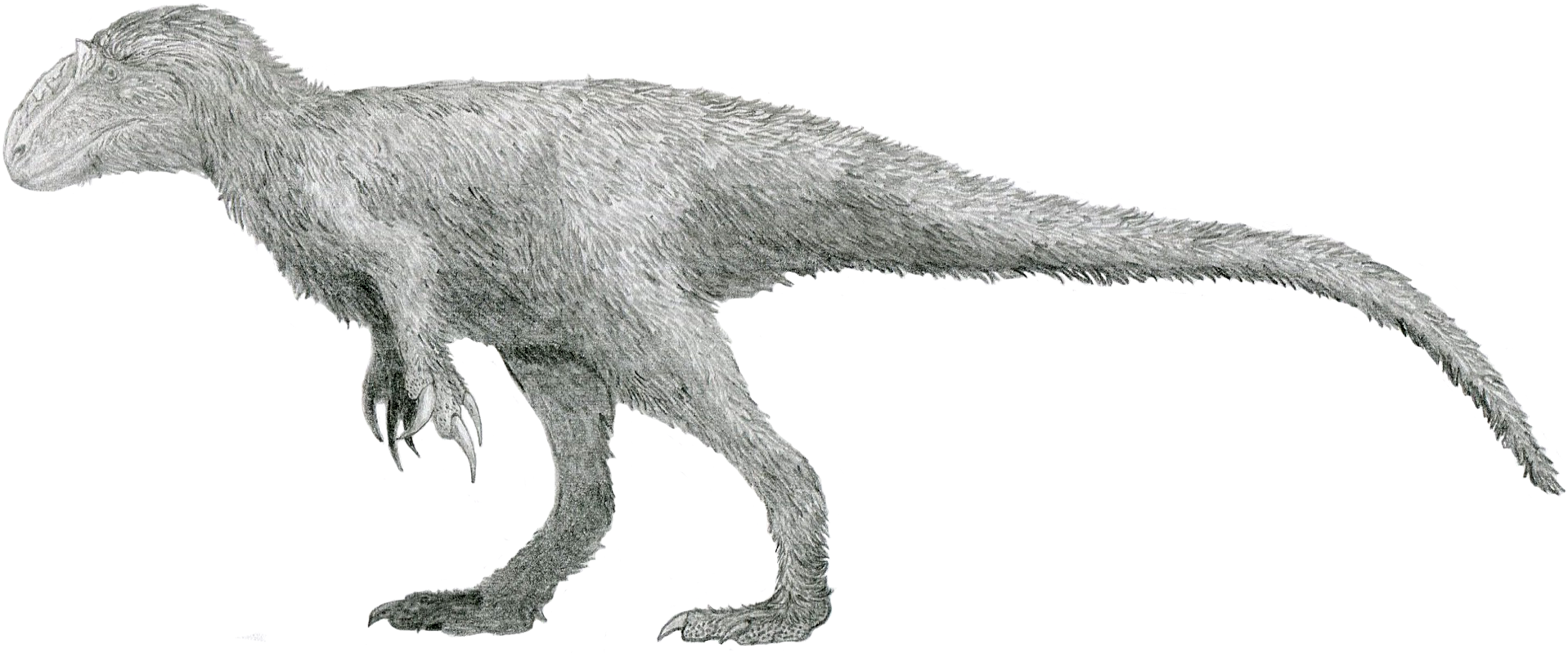
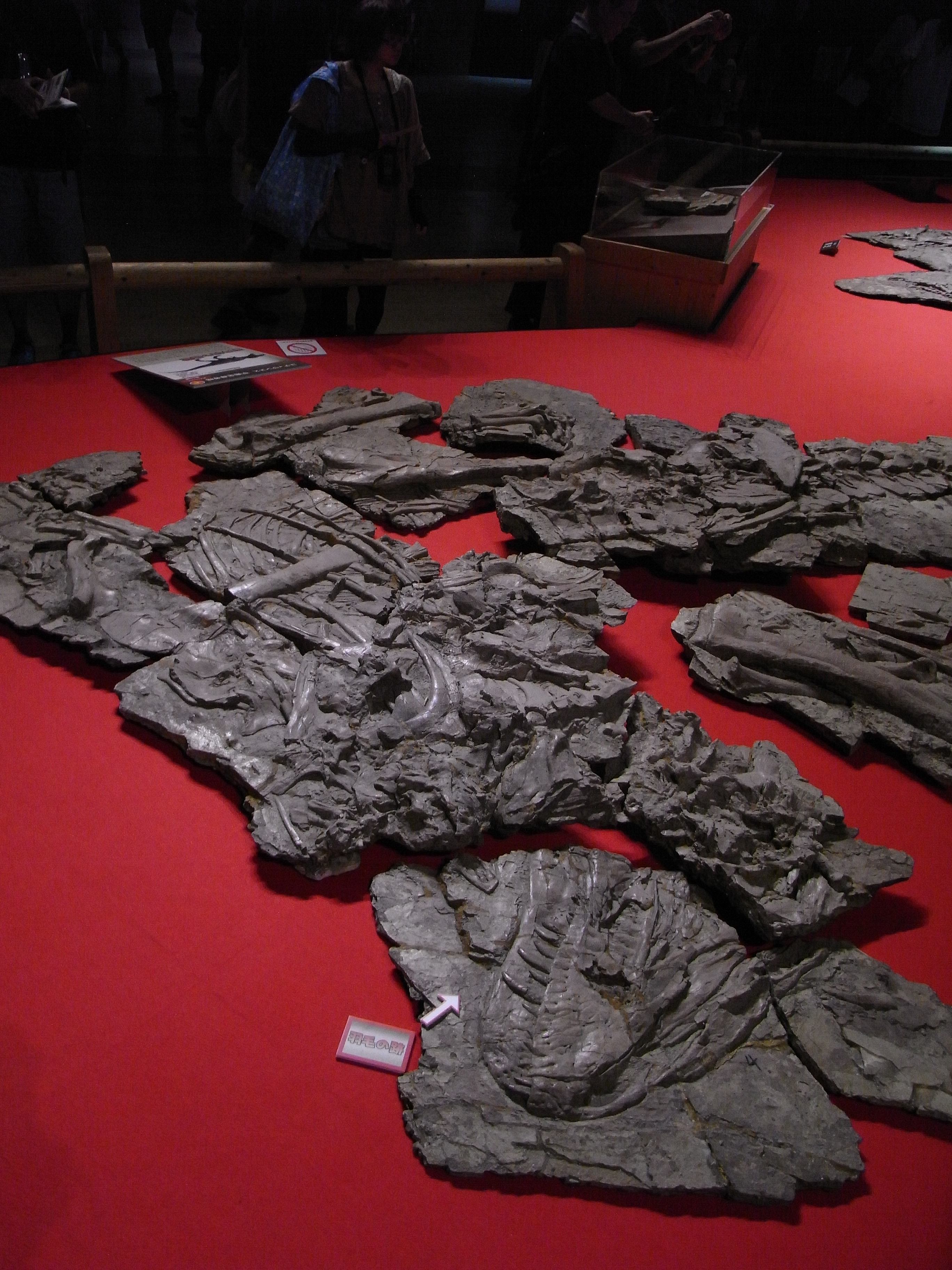
Yutyrannus huali was a giant early tyrannosauroid from the Yixian Formation of northeastern China. Three skeletons preserve patches of simple filamentous feathers on the neck, body, arms and tail, providing direct evidence that a very large non-avian dinosaur could carry an extensive feathery covering. Yutyrannus lived long before the deep-skulled, two-fingered tyrannosaurids of the Late Cretaceous and retained a longer, lower skull, three-fingered hands and comparatively long arms. Its discovery did not prove that every adult tyrannosaur was equally feathered, but it greatly widened the known body-size range of directly feathered dinosaurs.
Its fossils occur between approximately 125.8 and 124.1 million years ago. Values shown here are approximate and reflect the current curated seed dataset.
Form and function
The largest skeleton approached nine metres in length and was estimated at roughly 1.4 tonnes. Its skull carried a low midline crest and additional ridges above and in front of the eyes. The jaws held recurved serrated teeth, while each relatively long forelimb ended in three clawed fingers. Filamentous feathers reached about 15 to 20 centimetres in some preserved patches. These structures were simpler than the vaned flight feathers of birds and were probably useful for insulation and display rather than flight.
Evolutionary position
This simplified classification path shows one placement from Dinosauria to this species. Each step is clickable, and other analyses may support alternative relationships.
Open interactive positionScale
Simplified length comparison using preferred dataset estimates; body shape and posture are not represented.
Scientific record
Xing Xu and colleagues named Yutyrannus huali in 2012 from three nearly complete skeletons obtained from the same fossil-bearing horizon in western Liaoning. The holotype is ZCDM V5000; ZCDM V5001 and ELDM V1001 represent an additional adult-sized animal and a smaller individual. The fossils came from the Lower Cretaceous Yixian Formation and preserve two growth stages. Their close association is noteworthy, but the specimens alone cannot establish coordinated pack hunting or a permanent social group.
Discovery credit: Local fossil collectors and the Xu Xing research team.
Naming authors: Xing Xu, Kebai Wang, Ke Zhang and 6 coauthors.
Palaeoenvironment
The Yixian Formation records lakes, forests and volcanically active landscapes within the Jehol Biota. It preserves conifers, flowering plants, fish, amphibians, mammals, pterosaurs, birds and many feathered dinosaurs. Geochemical evidence indicates a cool temperate climate by Cretaceous standards, making insulation a plausible benefit of Yutyrannus's filamentous coat, although display may also have mattered.
Its teeth, skull and body plan identify Yutyrannus as a large terrestrial predator. The three known animals came from one quarry and horizon, but this could reflect behaviour, a shared death event or transport and burial processes. No trackway, nest or bite-mark evidence demonstrates pack hunting. The feathers probably contributed to insulation and may also have made the head crest and body outline more conspicuous during display.
Worth knowing
Fossil distribution
Western Liaoning Province, China
Yixian Formation
regional marker
Markers are deliberately approximate. They identify published fossil areas without exposing sensitive excavation coordinates.
Open interactive mapFossil specimen record
Zhucheng, Shandong, China
Repository identified in the original description for the holotype and one referred skeleton. Current public display status has not been independently verified.
Erenhot, Inner Mongolia, China
Repository identified in the original paper for the smaller referred skeleton. Current exhibition arrangements should be checked with the museum.
A research repository is not necessarily a public exhibit. Loan and display status can change, so check with the institution before visiting.
Media record
Evidence
Xing Xu, Kebai Wang, Ke Zhang and 6 coauthors · Nature 484 · 2012
Open source