Landslide Butte fossil region
Blackfeet Reservation, northwestern Montana, United States
Two Medicine Formation
regional marker
Pronunciation: ah-kee-loo-SORE-us HOR-ner-eye
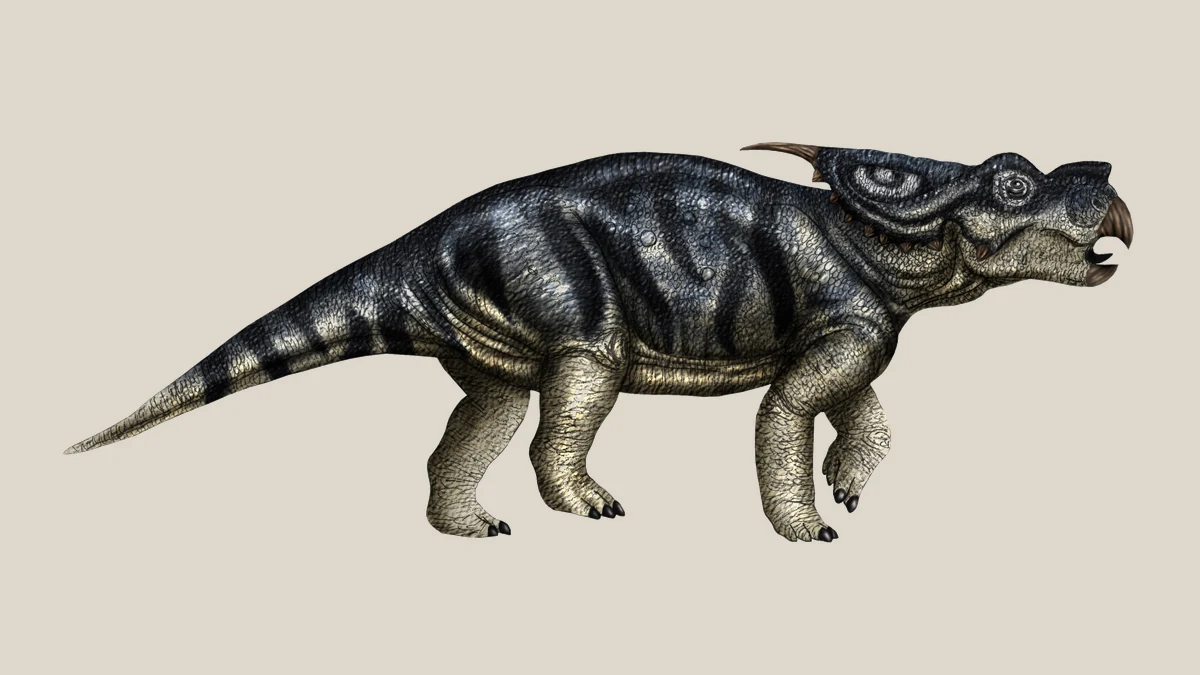
A boss-faced centrosaurine from Montana with roughened masses of bone over its nose and eyes and a pair of long, outward-curving frill spikes.
Last updated 28 July 2026
Field guide
Achelousaurus horneri lived on the inland plains represented by the upper Two Medicine Formation during the Late Campanian. Mature animals replaced the prominent nasal and brow horns seen in many horned dinosaurs with low, roughened bosses. Behind them, the short frill carried a pair of long spikes that curved outward. Its combination of hornless facial bosses and large frill processes once made Achelousaurus look like a simple evolutionary bridge between Einiosaurus and Pachyrhinosaurus. Those genera remain close relatives, but their history was probably branching and more complicated than a single straight sequence.
Its fossils occur between approximately 75.2 and 74.5 million years ago. Values shown here are approximate and reflect the current curated seed dataset.
Form and function
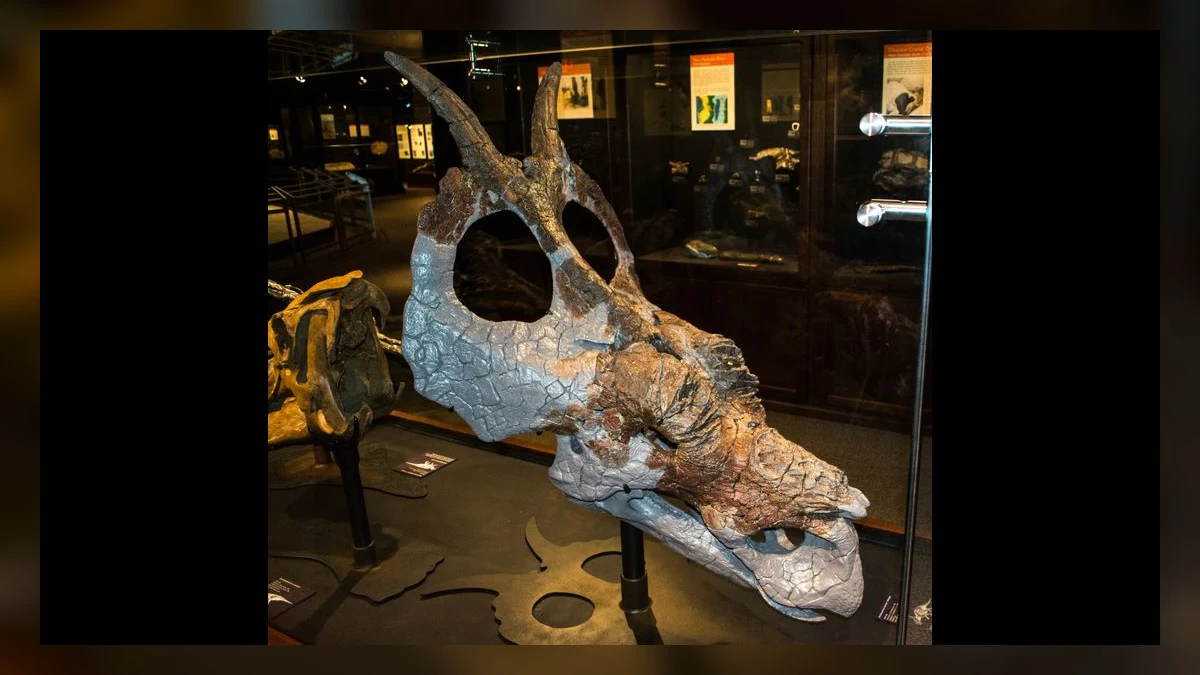
The adult holotype, MOR 485, preserves much of the skull and shows a low nasal boss, high ridged bosses above the eyes and one pair of elongated P3 processes curving sideways from the rear frill. The rough boss surfaces supported specialized skin or keratin, although the exact living shape is unknown. MOR 571 adds lower jaws, vertebrae and ribs, while the younger MOR 591 includes a partial skeleton but has sometimes been difficult to distinguish from late-growth Einiosaurus. The rest of the body follows the broad, strongly limbed ceratopsid plan, with a deep beak and dental batteries for cropping and slicing vegetation.
Evolutionary position
This simplified classification path shows one placement from Dinosauria to this species. Each step is clickable, and other analyses may support alternative relationships.
Open interactive positionScale
Simplified length comparison using preferred dataset estimates; body shape and posture are not represented.
Scientific record
Museum of the Rockies crews led by Jack Horner explored the Landslide Butte region of Montana during the 1980s. Volunteer Sidney Hofstetter discovered the holotype skull MOR 485 in 1987, and additional skull and skeletal material was collected in 1989. Scott Sampson formally named Achelousaurus horneri in 1995. The genus refers to Achelous, a shape-changing Greek river god whose horn was torn off by Heracles, while the species honours Horner’s work on the dinosaurs of the Two Medicine Formation.
Discovery credit: Sidney Hofstetter, Jack Horner and Museum of the Rockies field crews.
Naming authors: Scott D. Sampson.
Palaeoenvironment
The upper Two Medicine Formation records broad river plains east of the rising Rocky Mountains and well inland from the Western Interior Seaway. The climate was strongly seasonal, with droughts, volcanic ash falls and episodes of heavy runoff. Conifers, flowering plants, ferns and horsetails supported diverse herbivores. Achelousaurus occurs higher in the formation than the best Einiosaurus bonebeds, but the rock sequence spans time and the two should not automatically be pictured sharing one herd or habitat at the same moment.
Achelousaurus cropped vegetation with its beak and sliced it with dental batteries. The coarse nasal and brow bosses probably carried thickened skin or keratin and may have contributed to display or physical interaction, but neither head-butting nor a particular horn sheath is directly preserved. Several individuals are known from the same wider region, yet they do not demonstrate permanent herding. The large frill spikes changed the animal’s appearance and may have served several functions at once.
Worth knowing
Fossil distribution
Blackfeet Reservation, northwestern Montana, United States
Two Medicine Formation
regional marker
Markers are deliberately approximate. They identify published fossil areas without exposing sensitive excavation coordinates.
Open interactive mapFossil specimen record
Bozeman, United States
Repository of the holotype MOR 485 and the principal referred material, including MOR 571 and MOR 591. Specimens and reconstructions can rotate between research and display.
A research repository is not necessarily a public exhibit. Loan and display status can change, so check with the institution before visiting.
Media record
Evidence
John P. Wilson, John B. Scannella · Acta Palaeontologica Polonica 66(4), 797–814 · 2021
Open sourceMuseum of the Rockies
Open sourceScott D. Sampson · Journal of Vertebrate Paleontology 15(4), 743–760 · 1995
Open source