Ojo Alamo fossil region
San Juan Basin, northwestern New Mexico, United States
Naashoibito Member, Ojo Alamo Formation
regional marker
Pronunciation: AL-ah-moh-SORE-us san-WAHN-en-sis
A giant armoured titanosaur from the final few million years of the Cretaceous, widespread across the southwestern United States.
Last updated 2 August 2026
Field guide
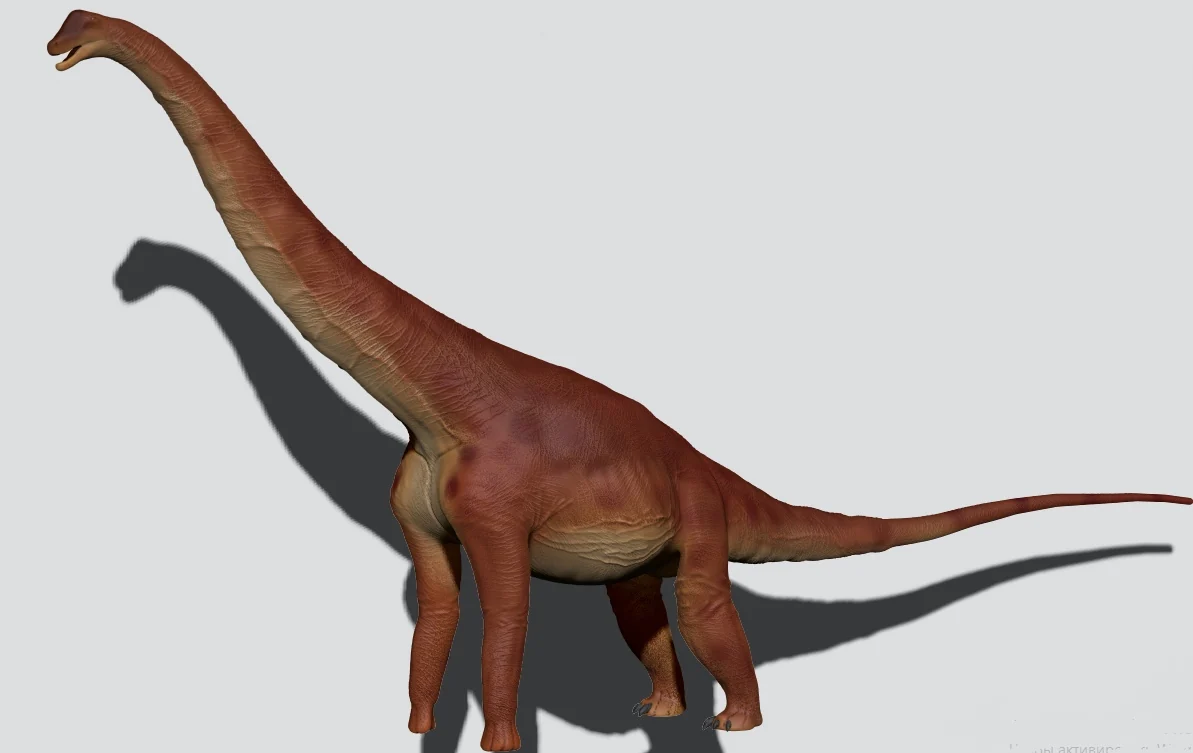
Alamosaurus sanjuanensis was the dominant giant sauropod of latest-Cretaceous southwestern North America. Its fossils occur from New Mexico and Texas into Utah, showing that enormous long-necked herbivores returned to the continent after a long gap in the local sauropod record. Charles Gilmore named it in 1922 from a left shoulder blade and a right ischium collected near Ojo Alamo, New Mexico. Later discoveries added articulated neck vertebrae, limbs, pelvis, tail, skull fragments and small armour plates. These remains reveal a broad-bodied titanosaur roughly 20 to 26 metres long, although the largest isolated bones sometimes assigned to Alamosaurus could indicate still bigger animals. Because those giant bones do not always overlap the diagnostic type material, the most extreme estimates remain uncertain.
Its fossils occur between approximately 70 and 66 million years ago. Values shown here are approximate and reflect the current curated seed dataset.
Form and function
Alamosaurus had the column-like limbs, wide torso and long neck typical of titanosaurs. Articulated cervical vertebrae from Big Bend preserve extensive internal air spaces that lightened the neck, while the shoulder and pelvic bones were built to support great mass. Referred skull elements indicate a relatively small head with narrow teeth suited to cropping vegetation. Small bony osteoderms occurred in the skin. The animal is reconstructed from multiple individuals because no complete articulated skeleton is known.
Evolutionary position
This simplified classification path shows one placement from Dinosauria to this species. Each step is clickable, and other analyses may support alternative relationships.
Open interactive positionScale
Simplified length comparison using preferred dataset estimates; body shape and posture are not represented.
Scientific record
Geologist John B. Reeside Jr. collected the type shoulder blade and nearby paratype ischium from Barrel Spring Arroyo, about one mile south of Ojo Alamo in San Juan County, New Mexico, in June 1921. Smithsonian palaeontologist Charles W. Gilmore described Alamosaurus sanjuanensis the following year. Later finds from the Javelina and Black Peaks formations of Big Bend, Texas, greatly expanded knowledge of the neck and body, while additional remains across the Southwest established Alamosaurus as a characteristic latest-Cretaceous dinosaur.
Discovery credit: John B. Reeside Jr..
Naming authors: Charles W. Gilmore.
Palaeoenvironment
Alamosaurus occupied coastal plains, river systems and seasonally dry inland habitats across the southwestern United States near the end of the Cretaceous. In the San Juan Basin and Big Bend region it lived among hadrosaurs, ceratopsids, ankylosaurs, tyrannosaurids and giant azhdarchid pterosaurs. The map marker represents the broad Ojo Alamo type region rather than the precise arroyo exposure.
As a giant herbivore, Alamosaurus probably cropped large quantities of vegetation and relied on gut fermentation rather than chewing. Its long neck expanded the feeding area available without moving the entire body. Trackways or nesting sites have not been securely assigned to the species, so herd structure, migration and parental behaviour remain unknown. The small osteoderms may have provided limited protection or stored minerals, but their precise function is unresolved.
Worth knowing
Fossil distribution
San Juan Basin, northwestern New Mexico, United States
Naashoibito Member, Ojo Alamo Formation
regional marker
Markers are deliberately approximate. They identify published fossil areas without exposing sensitive excavation coordinates.
Open interactive mapFossil specimen record
Washington, D.C., United States
Repository of holotype USNM 10486, the nearly complete left scapula collected near Ojo Alamo in 1921, and paratype USNM 10487, a right ischium from the same horizon.
A research repository is not necessarily a public exhibit. Loan and display status can change, so check with the institution before visiting.
Media record
Evidence
Charles W. Gilmore · Smithsonian Miscellaneous Collections 72(14) · 1922
Open sourceRonald S. Tykoski, Anthony R. Fiorillo · Journal of Systematic Palaeontology 15(5), 339-364 · 2017
Open sourceSmithsonian National Museum of Natural History
Open source