Manyberries fossil region
Southeastern Alberta, Canada
Oldman Formation
regional marker
Pronunciation: al-BER-tah-SER-ah-tops NEZ-moh-eye
An early centrosaurine from Alberta whose long brow horns contrast with its low nasal ornament and short, hook-edged frill.
Last updated 28 July 2026
Field guide
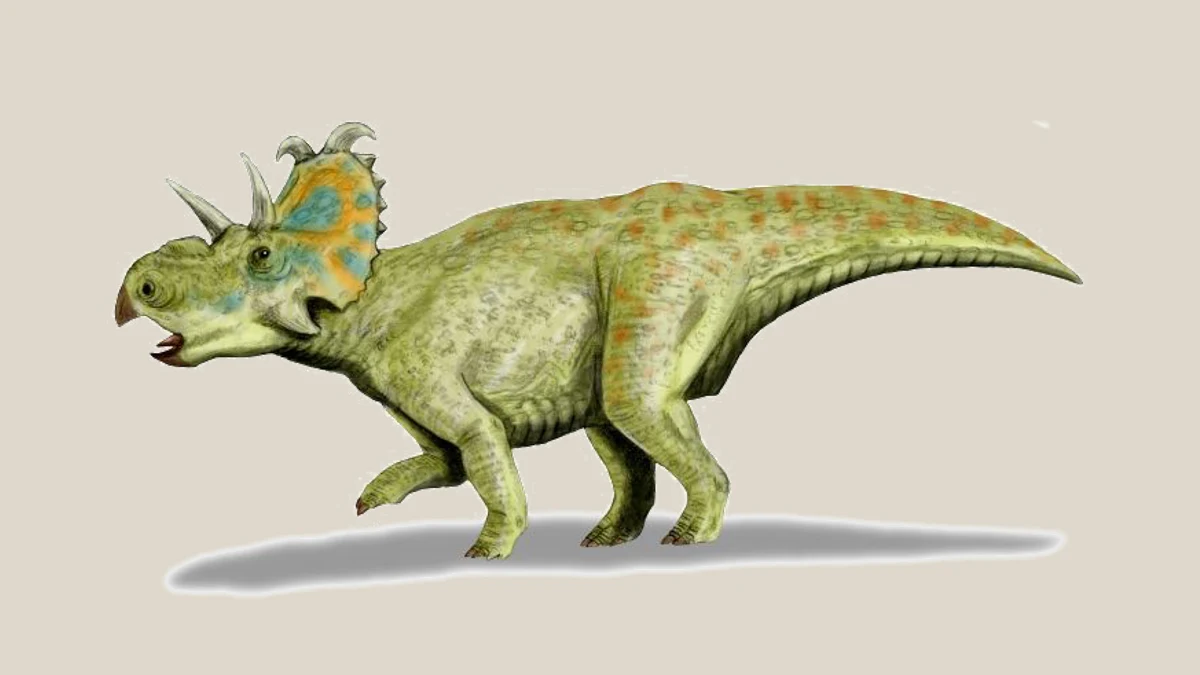
Albertaceratops nesmoi lived in southeastern Alberta about 77.5 million years ago. Its skull combines extremely long brow horns—more familiar in long-frilled chasmosaurines—with a short centrosaurine frill and a low ornament over the nose. That mosaic helped demonstrate that the characteristic small brow horns of later centrosaurines were not present throughout the group’s history. The species is founded on an unusually informative skull, but its body is much less completely known, so whole-animal dimensions remain estimates based partly on related ceratopsids.
Its fossils occur between approximately 77.6 and 77.4 million years ago. Values shown here are approximate and reflect the current curated seed dataset.
Form and function
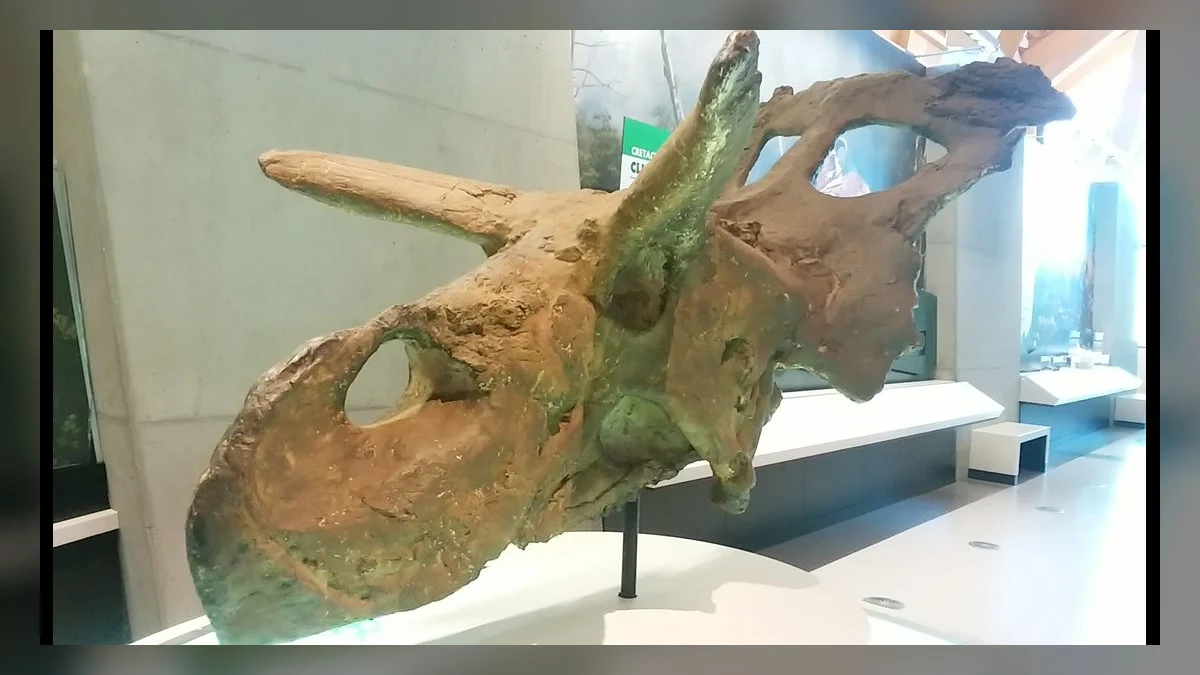
Holotype TMP 2001.26.1 preserves an almost complete skull. Long horncores rise above the eyes and project outward, while the nasal bones form a low, roughened ridge rather than a tall horn. The short frill bears enlarged hook-like processes near its rear corners and smaller ornaments along the margin. A toothless beak and closely packed dental batteries formed the standard ceratopsid plant-processing system. Material once assigned to Albertaceratops from a Montana bonebed was later separated as Medusaceratops, so it should not be used casually to complete the Alberta animal’s skeleton.
Evolutionary position
This simplified classification path shows one placement from Dinosauria to this species. Each step is clickable, and other analyses may support alternative relationships.
Open interactive positionScale
Simplified length comparison using preferred dataset estimates; body shape and posture are not represented.
Scientific record
Michael Ryan found the holotype during fieldwork in the Pinhorn region of southeastern Alberta in August 2001. A field crew excavated the large skull and transferred it to the Royal Tyrrell Museum of Palaeontology, where it is catalogued as TMP 2001.26.1. Ryan described Albertaceratops nesmoi in 2007. The genus refers to Alberta, while the species honours Manyberries rancher Cecil Nesmo for his long support of palaeontological work in the area.
Discovery credit: Michael J. Ryan and field crew.
Naming authors: Michael J. Ryan.
Palaeoenvironment
The Oldman Formation records river channels, floodplains and well-drained inland environments on western Laramidia. Seasonal rainfall and periodic floods shaped a warm landscape of conifers, flowering plants, ferns and other low vegetation. Albertaceratops shared the broader formation with hadrosaurs, armoured dinosaurs, small herbivores and tyrannosaurid predators, although the formation covers enough time that its complete species list was not one simultaneous community.
Its beak cropped plants and its dental batteries sliced them before swallowing. The long brow horns and hooked frill ornaments made conspicuous visual structures and could also have been useful in defence or contests, but the fossil does not reveal a specific display or fighting style. One main individual cannot establish herd size, sex differences or growth changes. The rough nasal ridge probably supported keratin or specialized skin whose exact form is unknown.
Worth knowing
Fossil distribution
Southeastern Alberta, Canada
Oldman Formation
regional marker
Markers are deliberately approximate. They identify published fossil areas without exposing sensitive excavation coordinates.
Open interactive mapFossil specimen record
Drumheller, Canada
Repository of the nearly complete holotype skull. Only a small portion of the museum’s collection is displayed at any one time, so visitors should confirm current gallery arrangements.
Wembley, Canada
A reconstructed Albertaceratops skull has been photographed in the museum’s horned-dinosaur displays; exhibition arrangements can change.
A research repository is not necessarily a public exhibit. Loan and display status can change, so check with the institution before visiting.
Media record
Evidence
Michael J. Ryan · Journal of Paleontology 81(2), 376–396 · 2007
Open sourceNatural History Museum, London
Open source