La Amarga stream type region
Neuquén Province, Argentina
La Amarga Formation, Puesto Antigual Member
regional marker
Pronunciation: ah-MAR-gah-SORE-us kaz-OW-eye
A small, short-necked Patagonian sauropod whose paired cervical neural spines formed one of the most extraordinary silhouettes in dinosaur evolution.
Last updated 16 July 2026
Field guide
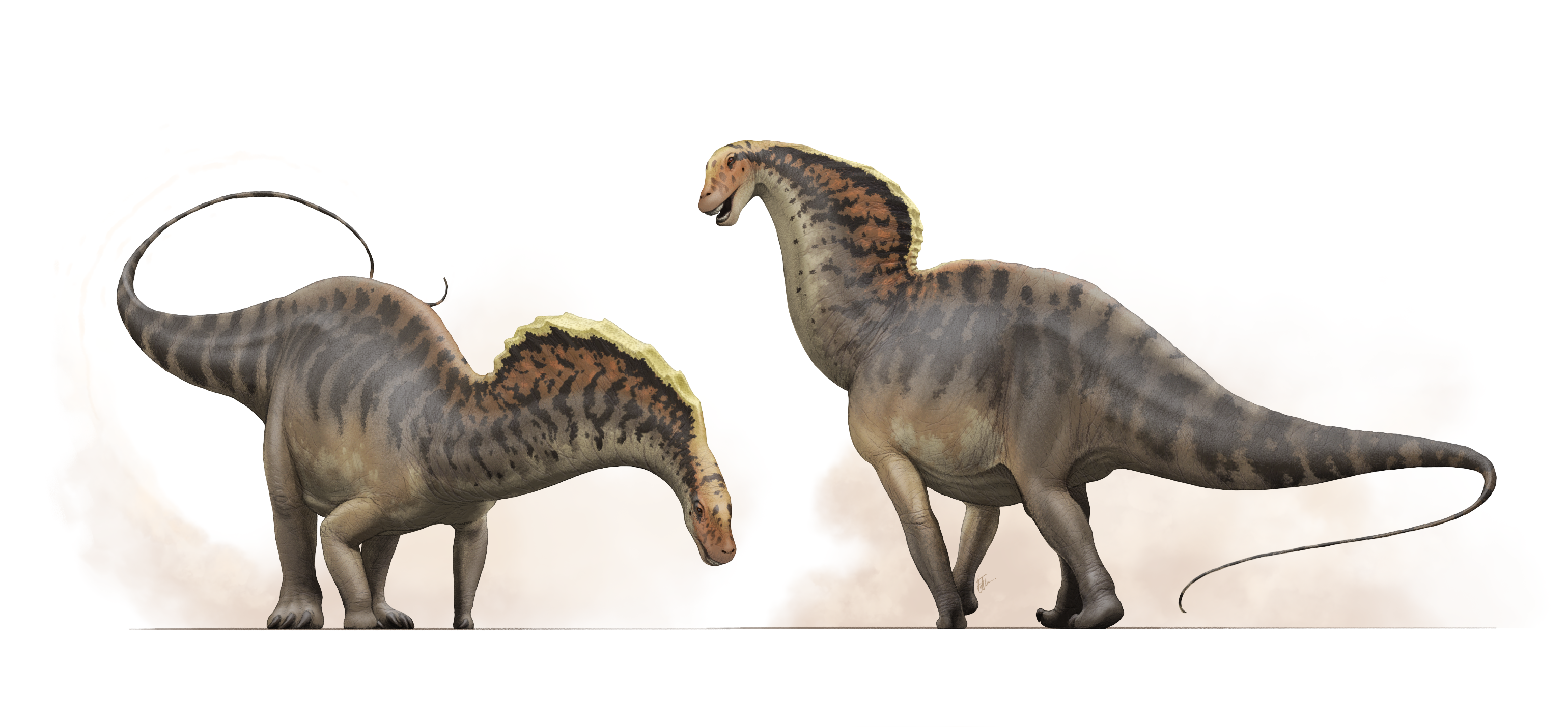
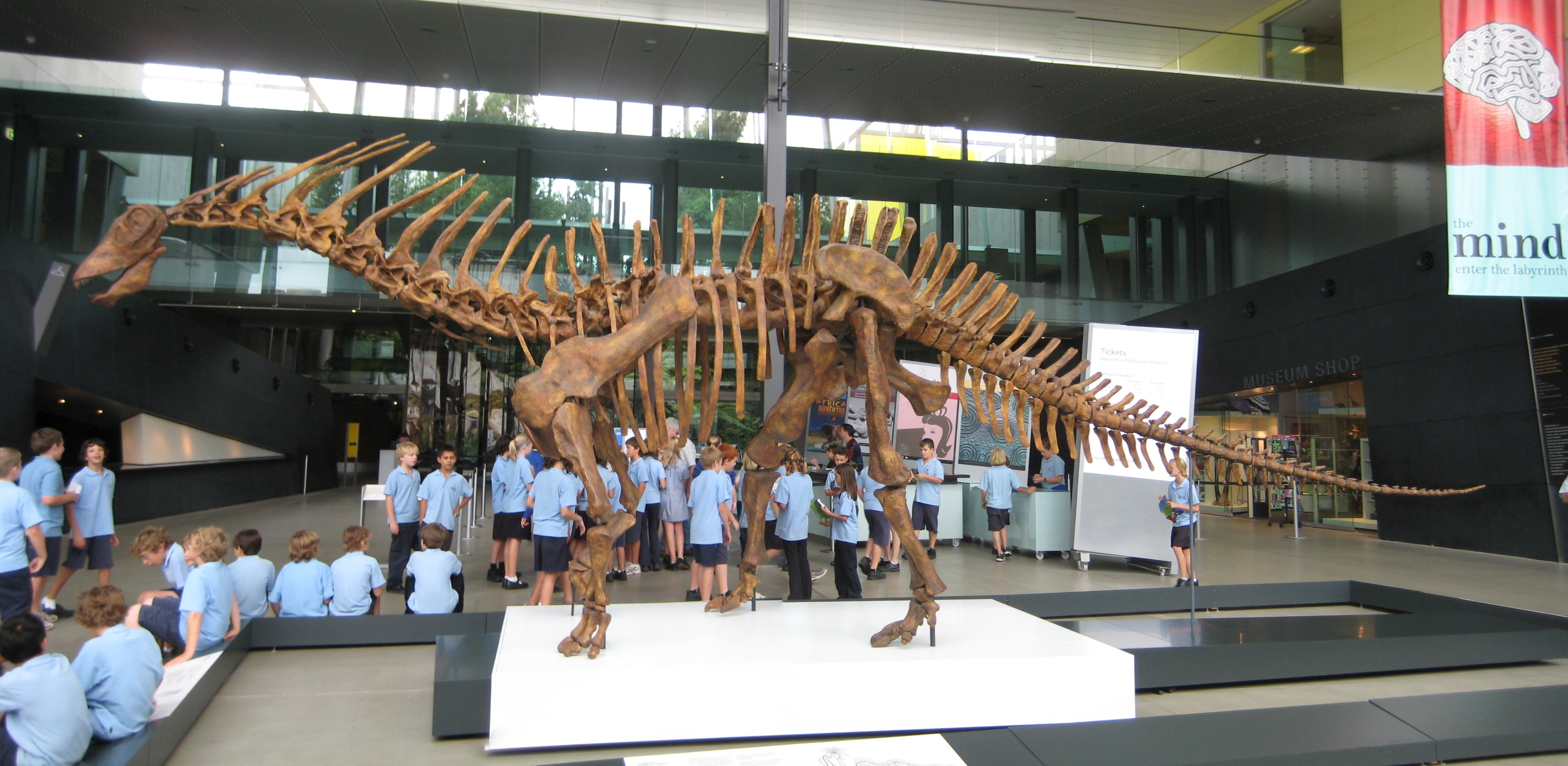
Amargasaurus cazaui was a dicraeosaurid sauropod from the Early Cretaceous of Neuquén Province, Argentina. At roughly nine metres long it was modest beside giant sauropods, with a relatively short neck, low skull and compact body. Its paired neural spines lengthened dramatically along the neck and front of the back, in some positions reaching about four times the height of the vertebral centrum. Those bones certainly supported substantial soft tissue, but fossils do not preserve the living outline, leaving competing reconstructions as two sails, a single padded crest or another continuous covering.
Its fossils occur between approximately 130 and 123 million years ago. Values shown here are approximate and reflect the current curated seed dataset.
Form and function
Holotype MACN PV N15 preserves part of the skull, a nearly continuous articulated series of 22 vertebrae before the sacrum, the sacrum, part of the tail, shoulder and pelvic elements, and portions of all four limbs. The skull was low and horse-like, with pencil-shaped teeth concentrated toward the front of the jaws. Each neck vertebra carried paired, deeply divided neural spines that became extremely tall and inclined backward. The back also bore elongated paired spines, while the neck itself was shorter and the body smaller than in most familiar sauropods.
Evolutionary position
This simplified classification path shows one placement from Dinosauria to this species. Each step is clickable, and other analyses may support alternative relationships.
Open interactive positionScale
Simplified length comparison using preferred dataset estimates; body shape and posture are not represented.
Scientific record
Geologist Luis Cazau alerted José Bonaparte's team to the fossil potential of the La Amarga Formation. During a February 1984 expedition led by Bonaparte, Guillermo Rougier discovered the associated skeleton near La Amarga stream at the foot of China Muerta hill. Leonardo Salgado and Bonaparte formally named Amargasaurus cazaui in 1991, honouring both the formation and Cazau. An informal 1984 mention used the name Amargasaurus groeberi, but it was not a valid published species name. The holotype remains the principal source for the animal's anatomy.
Discovery credit: Guillermo Rougier, José F. Bonaparte, Luis Cazau.
Naming authors: Leonardo Salgado, José F. Bonaparte.
Palaeoenvironment
The lower La Amarga Formation records braided rivers, lakes, floodplains and developing soils in the Neuquén Basin. Seasonal conditions supported conifers, cycads, ferns and other vegetation. The wider fauna included several kinds of sauropod, the small theropod Ligabueino, crocodyliforms and the mammal Vincelestes. Finds distributed through different members of the formation did not all live at exactly the same time.
The narrow teeth and relatively small skull indicate selective cropping rather than oral grinding; swallowed vegetation was processed in the digestive system. Tall paired spines almost certainly made the neck visually prominent and may have supported display tissue, but no fossil reveals colour, sex differences or display behaviour. Bone microstructure published in 2022 does not support simply treating each spine as the core of a long independent keratin horn. Defensive use, thermoregulation and species recognition remain possibilities rather than demonstrated functions.
Worth knowing
Fossil distribution
Neuquén Province, Argentina
La Amarga Formation, Puesto Antigual Member
regional marker
Markers are deliberately approximate. They identify published fossil areas without exposing sensitive excavation coordinates.
Open interactive mapFossil specimen record
Buenos Aires, Argentina
Repository of the original partial skull and associated skeleton that define Amargasaurus cazaui. This entry identifies the research collection and does not claim that the fragile holotype is currently mounted for public display.
A research repository is not necessarily a public exhibit. Loan and display status can change, so check with the institution before visiting.
Media record
Evidence
Leonardo Salgado, José F. Bonaparte · Ameghiniana 28(3–4) · 1991
Open sourceIgnacio A. Cerda, Fernando E. Novas, José Luis Carballido, Leonardo Salgado · Journal of Anatomy 240(6) · 2022
Open sourceMACN-CONICET
Open source