Carnegie Quarry
Utah, United States
Morrison Formation
approximate site marker
Pronunciation: ah-PAT-oh-SORE-us loo-EE-say
A powerfully built Late Jurassic diplodocid known from the nearly complete Carnegie Quarry skeleton CM 3018, with an exceptionally thick neck, stout limbs and a long tapering tail.
Last updated 13 July 2026
Field guide
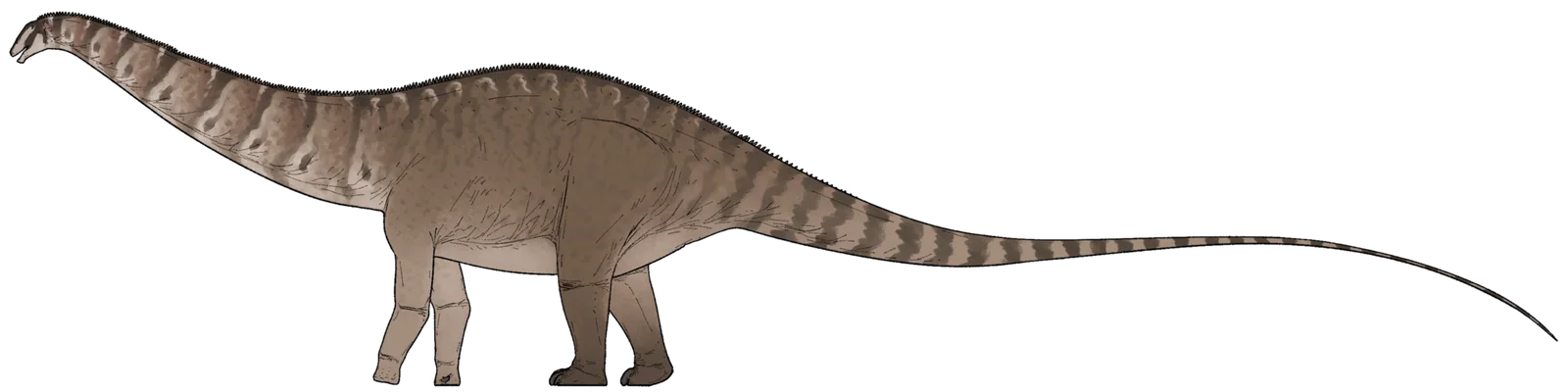
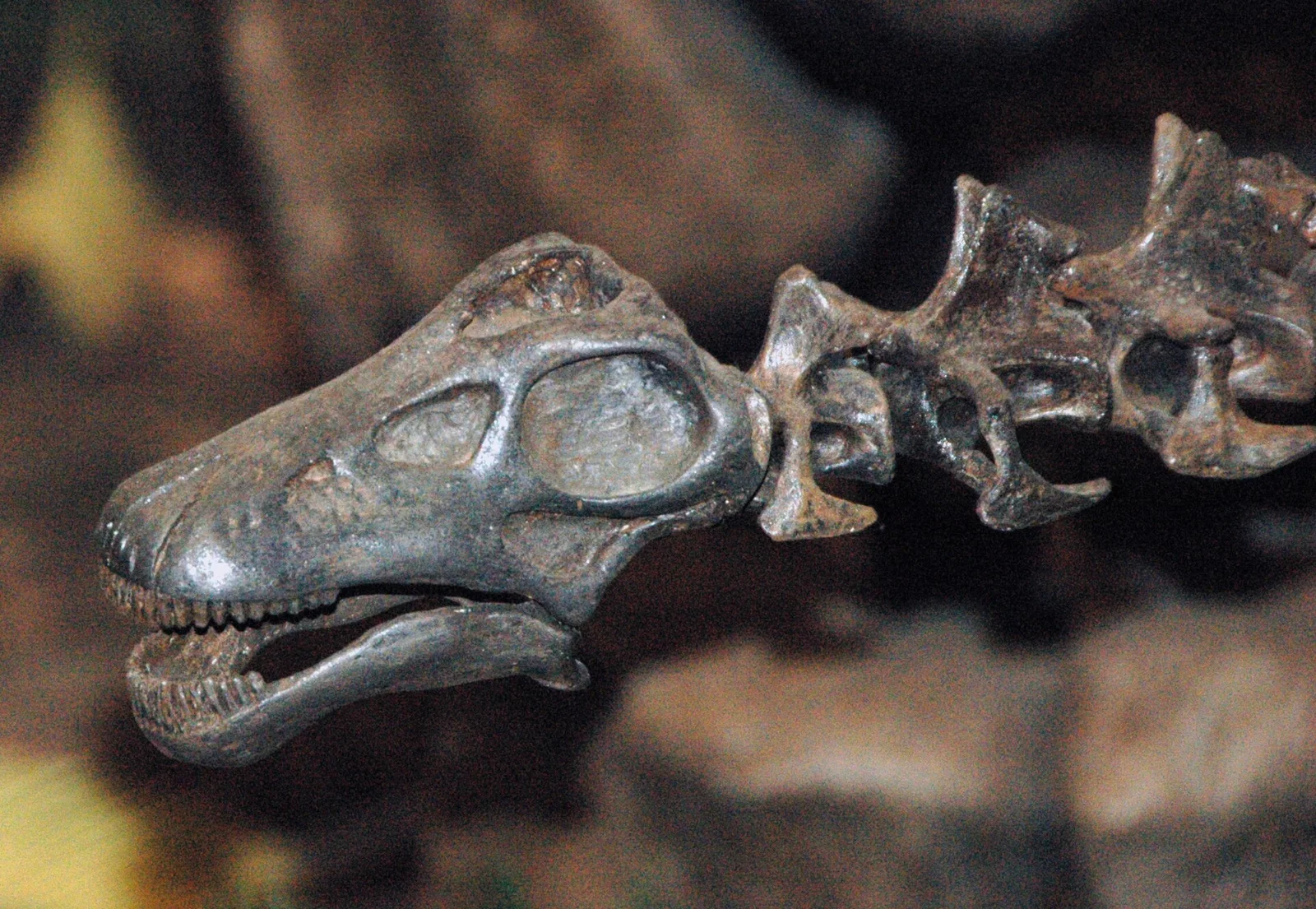
Apatosaurus louisae was a massive diplodocid sauropod from the upper Morrison Formation of Utah. Compared with the more lightly built Diplodocus, it had a deeper torso, unusually robust limb bones and an extremely broad, muscular neck. Holotype CM 3018 preserves an articulated vertebral series from the atlas to near the tail tip, much of the rib cage and most of the limbs. A delicate, low skull found close to the neck helped overturn the long-standing museum image of Apatosaurus with a boxy Camarasaurus-like head. The species is one of the best-known sauropods anatomically, but the precise association of the nearby skull and the limits between Apatosaurus and Brontosaurus continue to be tested in specimen-level studies.
Its fossils occur between approximately 152 and 151 million years ago. Values shown here are approximate and reflect the current curated seed dataset.
Form and function
The neck vertebrae were short, deep and heavily reinforced, producing the exceptionally thick neck characteristic of apatosaurines. Air-filled chambers lightened the vertebrae without making them mechanically flimsy. The body was carried on four stout, columnar limbs; the forefeet bore one enlarged inner claw and the hind feet had three principal claws. The small skull was long and low, with narrow pencil-like teeth concentrated at the front of the jaws. A very long series of progressively smaller tail vertebrae formed a flexible, whip-like tail, although its exact range of movement and use cannot be read directly from the bones.
Evolutionary position
This simplified classification path shows one placement from Dinosauria to this species. Each step is clickable, and other analyses may support alternative relationships.
Open interactive positionScale
Simplified length comparison using preferred dataset estimates; body shape and posture are not represented.
Scientific record
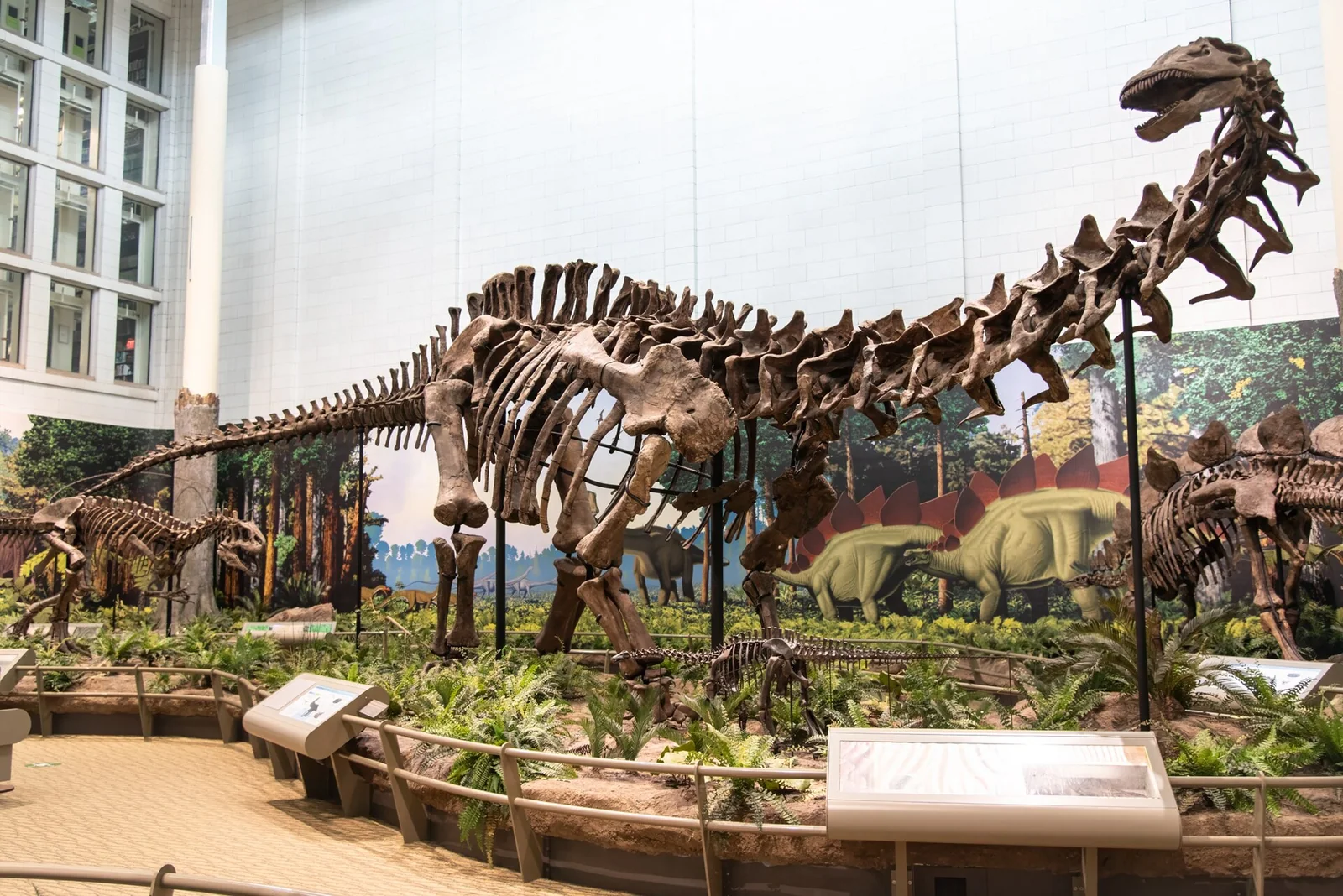
On 17 August 1909, Carnegie Museum collector Earl Douglass found eight connected tail vertebrae weathering from a ridge near Jensen, Utah. Excavation exposed the remarkably complete skeleton now catalogued as CM 3018 and launched the Carnegie Quarry, later protected within Dinosaur National Monument. William J. Holland named Apatosaurus louisae in a 1915 paper, honouring Louise Carnegie. The Pittsburgh mount opened without a head, received a Camarasaurus-style skull in 1932, and finally gained a cast of the narrow associated Apatosaurus skull in 1979 after David Berman and John McIntosh's detailed 1978 study. The fragile original skull remains off public display.
Discovery credit: Earl Douglass.
Naming authors: William J. Holland.
Palaeoenvironment
The Carnegie Quarry formed on a Late Jurassic river floodplain near the western margin of the vast Morrison depositional basin. Seasonal streams crossed open ground carrying conifers, cycads, tree ferns, horsetails and low ferns. Floods concentrated carcasses and transported bones into sand-rich channel deposits. Apatosaurus shared this landscape with Diplodocus, Camarasaurus, Barosaurus and other sauropods, plus Stegosaurus, Camptosaurus and predators including Allosaurus and Ceratosaurus.
Apatosaurus was a terrestrial quadrupedal herbivore. Its small head and front-loaded pencil teeth were suited to cropping or stripping vegetation rather than chewing it; food would have been swallowed for processing in the gut. The broad neck and robust forequarters distinguish it mechanically from more slender diplodocids, but they do not reveal one habitual neck pose. Low-to-middle browsing is plausible, and a long neck enlarged the feeding envelope without requiring the whole body to move. Claims of herd living, combat with the neck or supersonic tail cracking remain hypotheses rather than behaviours directly preserved for A. louisae.
Worth knowing
Fossil distribution
Utah, United States
Morrison Formation
approximate site marker
Markers are deliberately approximate. They identify published fossil areas without exposing sensitive excavation coordinates.
Open interactive mapFossil specimen record
Pittsburgh, United States
Original, nearly complete holotype CM 3018 mounted as a major museum exhibit. The narrow skull on the mount is a cast; the fragile original associated skull is held off display. The museum also holds the small juvenile specimen CM 566 shown in this gallery.
Jensen, United States
The public hall encloses the remnant of the Carnegie Quarry where CM 3018 was discovered. The holotype itself was removed to Pittsburgh, so the in-place fossil wall and discovery-bone interpretation document its locality rather than display the type skeleton.
A research repository is not necessarily a public exhibit. Loan and display status can change, so check with the institution before visiting.
Media record
Evidence
Emanuel Tschopp, Octávio Mateus, Roger B. J. Benson · PeerJ · 2015
Open sourceCarnegie Museum of Natural History
Open sourceWilliam J. Holland · Annals of the Carnegie Museum · 1915
Open sourceDavid S. Berman, John S. McIntosh · Bulletin of Carnegie Museum of Natural History · 1978
Open sourceDinosaur National Monument, National Park Service
Open sourceNational Park Service
Open sourceDinosaur National Monument, National Park Service
Open source