Plaza Huincul fossil region
Neuquén Province, Argentina
Huincul Formation
regional marker
Pronunciation: ar-jen-TEE-noh-SORE-us win-koo-LEN-sis
An immense but very incompletely known titanosaur from Argentina's Huincul Formation. Its enormous back vertebrae and partial sacrum establish gigantic size, while most familiar full-body proportions remain reconstructed from relatives.
Last updated 14 July 2026
Field guide
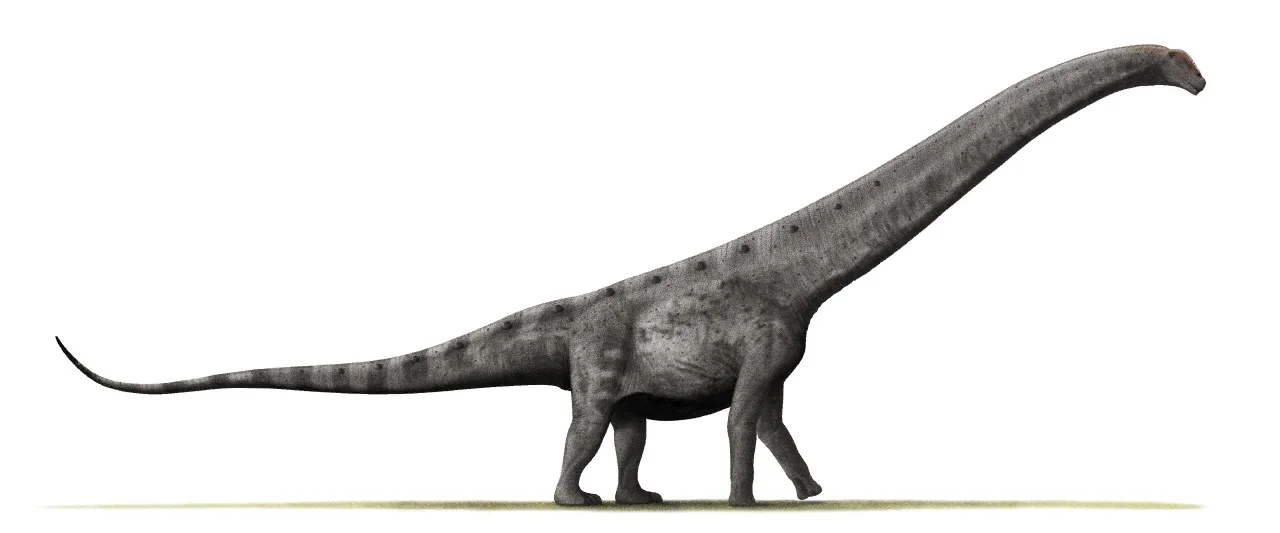
Argentinosaurus huinculensis is one of the strongest candidates for the largest land animals known, but it is also one of the least complete famous dinosaurs. The holotype represents a single individual and consists principally of giant dorsal vertebrae, part of the sacrum, a rib fragment and a slender lower-leg bone now interpreted as a fibula. No skull, teeth, neck, tail, complete limb or foot is known. Estimates near 30-35 metres and roughly 60-90 tonnes are reasonable working ranges, not direct measurements of a complete skeleton.
Its fossils occur between approximately 97 and 93.5 million years ago. Values shown here are approximate and reflect the current curated seed dataset.
Form and function
The best anatomical evidence comes from the trunk. Several dorsal vertebrae have broad, tall neural arches, extensive internal air spaces and unusually enlarged accessory hyposphene-hypantrum articulations that reinforced adjacent vertebrae without making the back rigid. One reconstructed anterior dorsal vertebra reaches about 1.59 metres high. The preserved sacral region has strongly reduced central bodies surrounded by large internal chambers, and the rib fragment is hollow. The 1.55-metre limb bone described in 1993 as a tibia was subsequently reidentified as a slender fibula. Every other major body region in a full reconstruction is inferred from better-known titanosaurs.
Evolutionary position
This simplified classification path shows one placement from Dinosauria to this species. Each step is clickable, and other analyses may support alternative relationships.
Open interactive positionScale
Simplified length comparison using preferred dataset estimates; body shape and posture are not represented.
Scientific record
Rancher Guillermo Heredia reported a giant bone at Las Overas, about eight kilometres east of Plaza Huincul in Neuquen Province. Museo Carmen Funes personnel recovered the first limb bone, and a Jose Bonaparte-led expedition excavated the associated vertebral and sacral material in the summer of 1989. Jose F. Bonaparte and Rodolfo A. Coria named Argentinosaurus huinculensis in 1993. The holotype, MCF-PVPH 1, remains in the vertebrate palaeontology collection of the Museo Municipal Carmen Funes.
Discovery credit: Guillermo Heredia, Museo Carmen Funes field team, Jose F. Bonaparte.
Naming authors: Jose F. Bonaparte, Rodolfo A. Coria.
Palaeoenvironment
The Huincul Formation records river channels, floodplains, wind-worked sediment and developing soils in the Neuquen Basin. The original description noted medium-energy fluvial deposits and abundant fossil tree trunks near equivalent levels. Argentinosaurus shared the broader formation with other sauropods and large theropods including Mapusaurus, but formation-level association does not prove that any named predator encountered the holotype individual.
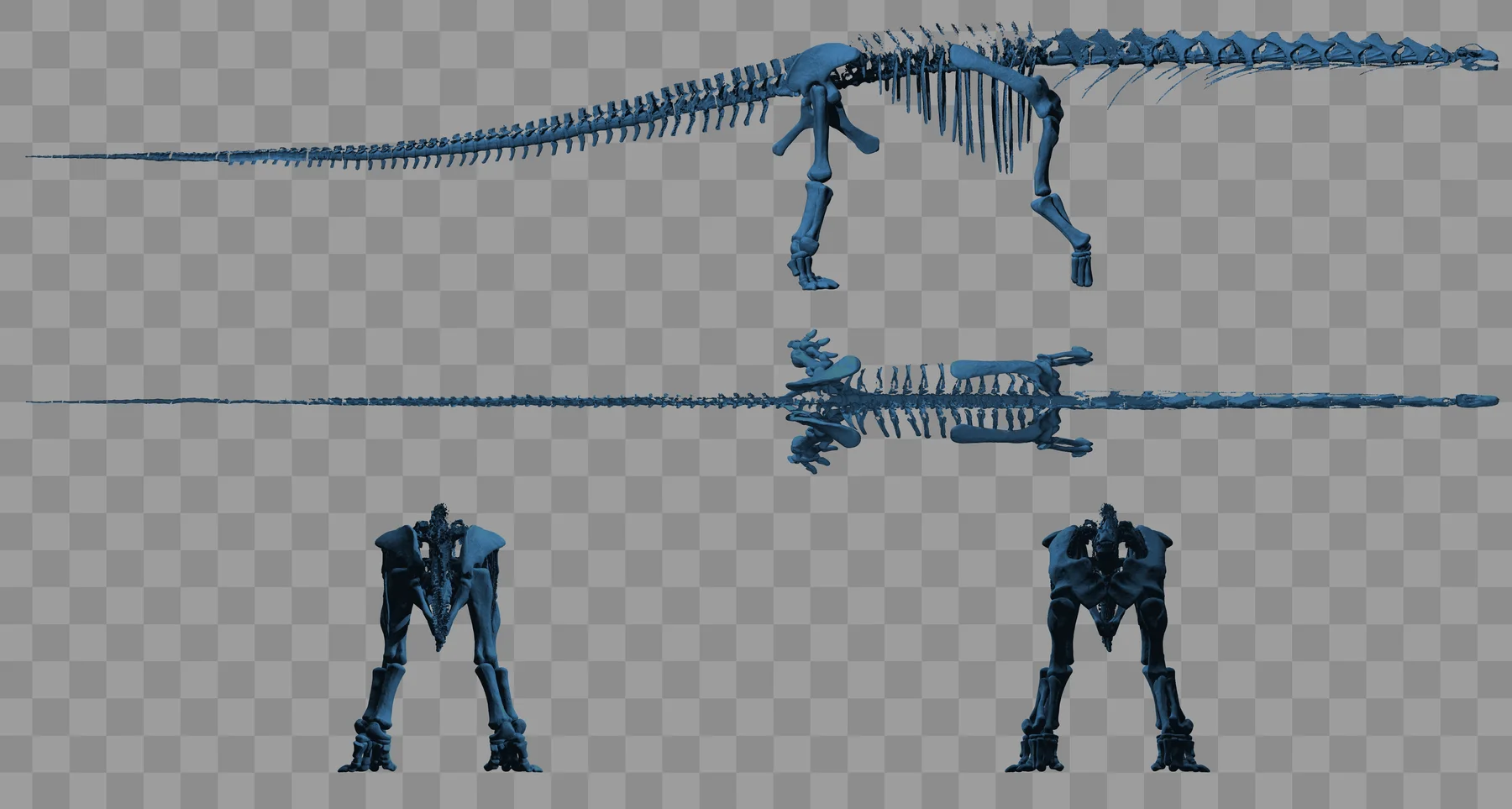
As a titanosaur, Argentinosaurus was a four-legged herbivore that probably stripped vegetation with a small head and swallowed it with little oral processing. Its huge, air-filled skeleton would have reduced mass relative to solid bone, while columnar limbs and a restricted joint range supported slow, stable terrestrial locomotion. A 2013 computer simulation produced a plausible walking gait for an 83-tonne museum reconstruction, but the result tests that reconstructed model rather than a complete Argentinosaurus skeleton. No trackway, nest, herd accumulation or feeding trace is directly assigned to the species.
Worth knowing
Fossil distribution
Neuquén Province, Argentina
Huincul Formation
regional marker
Markers are deliberately approximate. They identify published fossil areas without exposing sensitive excavation coordinates.
Open interactive mapFossil specimen record
Plaza Huincul, Argentina
Repository of holotype MCF-PVPH 1. Provincial museum information confirms that original Argentinosaurus pieces are displayed; the surrounding full-sized skeleton is a reconstruction and should not be read as a complete fossil individual.
Atlanta, United States
Permanent full-scale Argentinosaurus skeletal reconstruction displayed with Giganotosaurus in the Great Hall. Fernbank explicitly identifies all fossils in this scene as cast replicas; the original Argentinosaurus bones remain in Argentina.
A research repository is not necessarily a public exhibit. Loan and display status can change, so check with the institution before visiting.
Media record
Evidence
Jose F. Bonaparte, Rodolfo A. Coria · Ameghiniana 30(3) · 1993
Open sourceGerardo V. Mazzetta, Per Christiansen, Richard A. Farina · Historical Biology 16(2-4) · 2004
Open sourceWilliam I. Sellers, Lee Margetts, Rodolfo A. Coria, Phillip L. Manning · PLOS ONE 8(10) · 2013
Open sourceNatural History Museum, London
Open sourceGovernment of Neuquen Province · 2019
Open sourceFernbank Museum of Natural History
Open sourceNicolas E. Campione, David C. Evans · Biological Reviews 95(6) · 2020
Open source