Carnegie Quarry fossil region
Dinosaur National Monument, Uintah County, Utah, United States
Morrison Formation
regional marker
Pronunciation: BAIR-oh-SORE-us LEN-tus
A rare, exceptionally long-necked diplodocid from the Late Jurassic Morrison Formation, best known from spectacular museum skeletons assembled from partial remains.
Last updated 2 August 2026
Field guide
Barosaurus lentus was a giant diplodocid sauropod from the Late Jurassic Morrison Formation of the western United States. It shared the long, low body plan of Diplodocus but carried an even more elongated neck and a proportionally shorter tail. The vertebrae were extensively hollowed by air spaces, reducing the weight of the enormous neck, while sturdy limbs supported the body. No skull has been securely associated with Barosaurus, so every mounted or illustrated head is reconstructed from related diplodocids. The species is comparatively rare, yet several partial skeletons together reveal much of its body and support an adult length of roughly 24 to 27 metres.
Its fossils occur between approximately 155 and 150 million years ago. Values shown here are approximate and reflect the current curated seed dataset.
Form and function
The neck consisted of highly elongated, air-filled vertebrae supported by complex bony struts and extensive soft tissues. The torso was compact for such a long animal, and the forelimbs were somewhat longer and more slender than those of Diplodocus. A long tail balanced the front of the body, although it was proportionally shorter than in Diplodocus. Forked chevrons hung beneath many tail vertebrae. The narrow, peg-toothed head shown in reconstructions is inferred from close relatives because a Barosaurus skull remains unknown.
Evolutionary position
This simplified classification path shows one placement from Dinosauria to this species. Each step is clickable, and other analyses may support alternative relationships.
Open interactive positionScale
Simplified length comparison using preferred dataset estimates; body shape and posture are not represented.
Scientific record
The first Barosaurus fossils were collected from the Morrison Formation of South Dakota in 1889 and consisted chiefly of tail vertebrae. Othniel Charles Marsh named Barosaurus lentus in 1890. Later skeletons from Dinosaur National Monument supplied much more of the neck, trunk and limbs. One of these individuals, nicknamed Gordo, remained partly unrecognized in the Royal Ontario Museum's collections until staff assembled its bones into Canada's largest mounted dinosaur. The American Museum of Natural History created its famous rearing group from casts representing material held by several institutions rather than one complete individual.
Naming authors: Othniel Charles Marsh.
Palaeoenvironment
Barosaurus lived on the broad river floodplains and seasonally dry woodland mosaics recorded by the Morrison Formation. Ferns, horsetails, cycads and conifers supplied vegetation at many heights. It shared these environments with other giant sauropods, stegosaurs and ornithopods, while Allosaurus and other large theropods were potential predators. The map marker represents the public Carnegie Quarry region at Dinosaur National Monument, not a precise fossil coordinate.
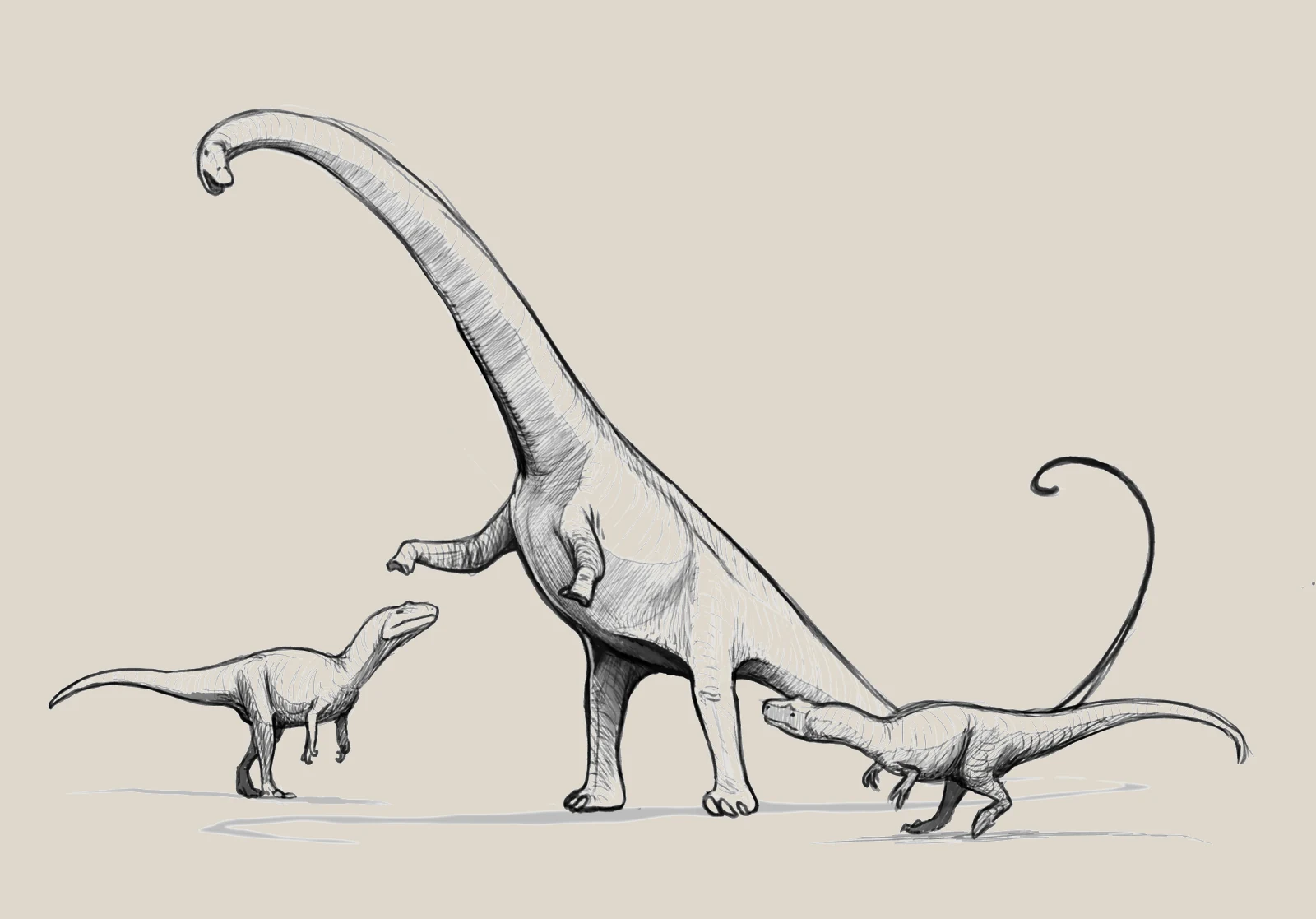
Its long neck allowed Barosaurus to reach vegetation across a wide feeding envelope while moving its heavy body less often. How high it normally held the neck remains debated. Rearing on the hind limbs, as shown in famous museum mounts and the selected artwork, is mechanically conceivable but has not been observed and cannot be established as routine behaviour from fossils. No direct evidence reveals herd structure, mating displays or parental care.
Worth knowing
Fossil distribution
Dinosaur National Monument, Uintah County, Utah, United States
Morrison Formation
regional marker
Markers are deliberately approximate. They identify published fossil areas without exposing sensitive excavation coordinates.
Open interactive mapFossil specimen record
Toronto, Ontario, Canada
A largely original partial skeleton from Dinosaur National Monument mounted as Canada's largest displayed dinosaur. The specimen includes a limb bone with an associated skin impression; missing portions, including the unknown skull, are reconstructed.
New York City, New York, United States
The world's tallest freestanding dinosaur mount presents an adult Barosaurus rearing to protect a juvenile. It is a scientifically informed reconstruction made with casts of real bones from multiple collections, not one complete original skeleton.
A research repository is not necessarily a public exhibit. Loan and display status can change, so check with the institution before visiting.
Media record
Evidence
Dinosaur National Monument, U.S. National Park Service
Open sourceRoyal Ontario Museum
Open sourceAmerican Museum of Natural History
Open sourceNatural History Museum, London
Open source