Dinosaur Provincial Park bonebed region
Red Deer River badlands, Alberta, Canada
Dinosaur Park Formation
regional marker
Pronunciation: SEN-troh-SORE-us ah-PER-tus
A short-frilled horned dinosaur from Alberta, famous for its long nasal horn, hooked frill ornaments and enormous mass-death bonebeds.
Last updated 16 July 2026
Field guide
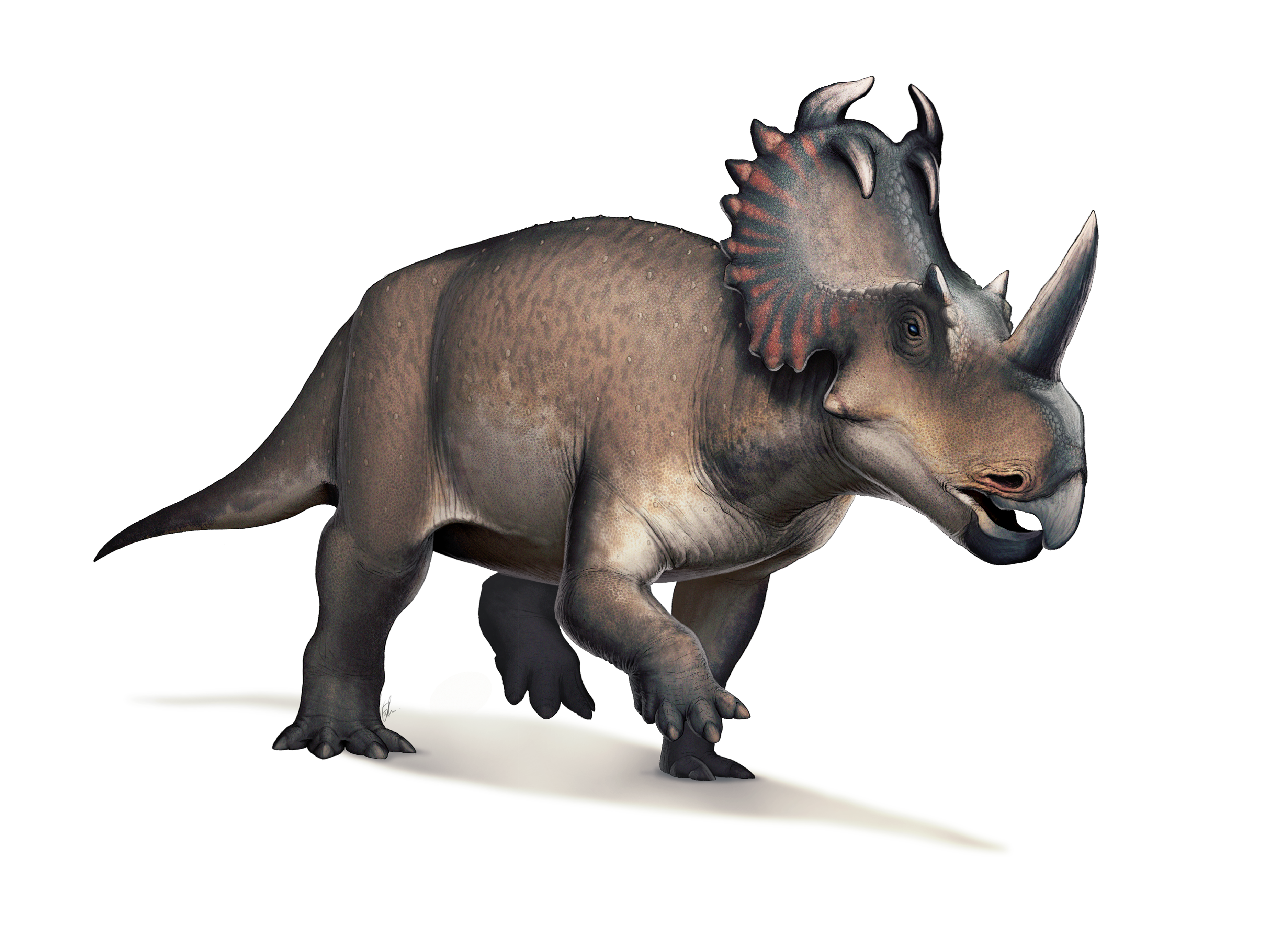
Centrosaurus apertus was one of the most abundant large herbivores in the Dinosaur Park Formation of Alberta. It carried a single prominent nasal horn above the beak, small brow horns and a short frill ornamented with hook-like processes. Dozens of dense bonebeds contain remains from juveniles through adults, making Centrosaurus exceptionally important for reconstructing ceratopsid growth, population structure and mass-death events. Those deposits show that large numbers gathered at least occasionally, but they do not prove that every individual lived permanently in one enormous herd.
Its fossils occur between approximately 76.5 and 75.5 million years ago. Values shown here are approximate and reflect the current curated seed dataset.
Form and function
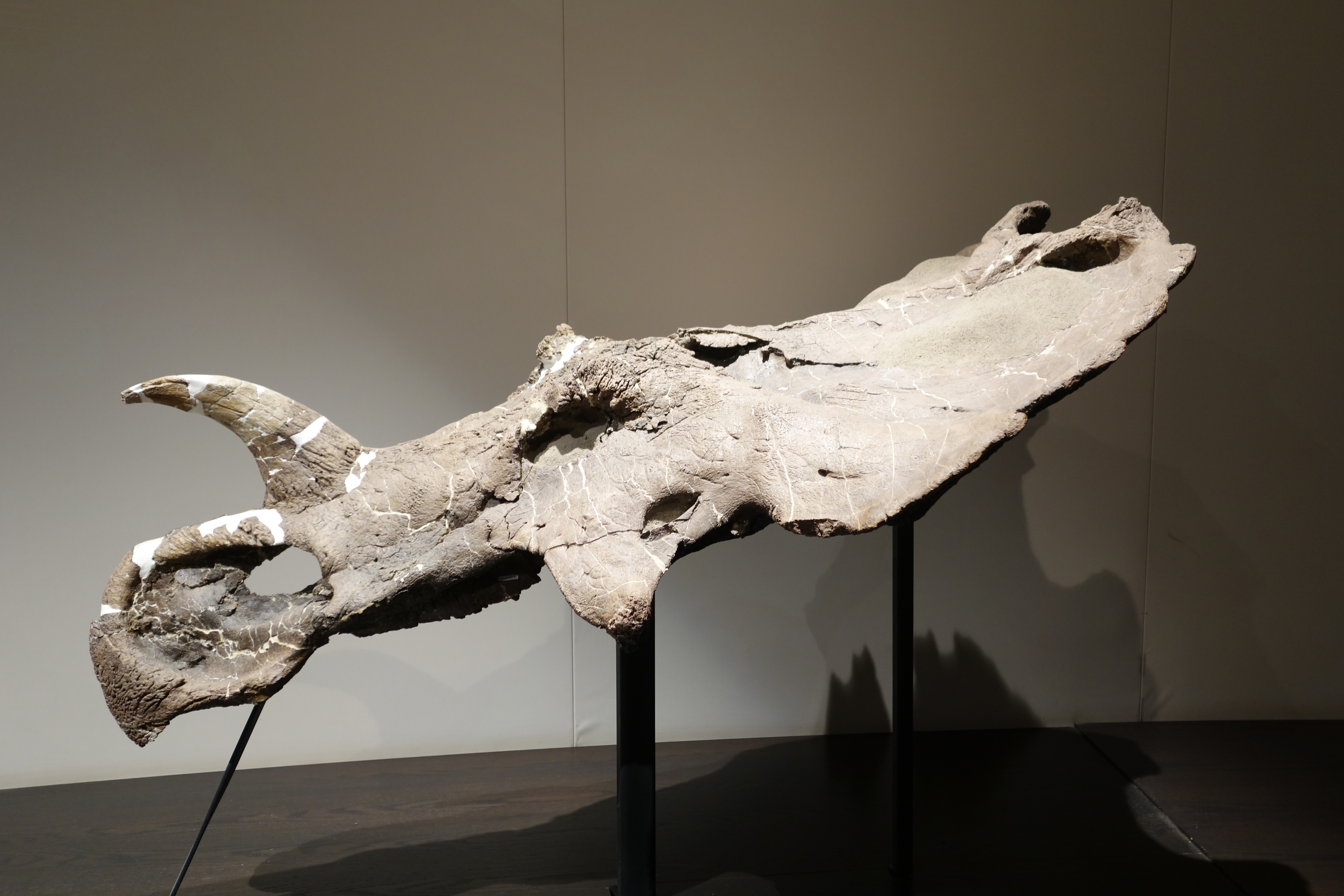
The skull was deep and narrow with a parrot-like beak, shearing dental batteries and a long nasal horn that varied in curvature between individuals and through growth. The relatively short frill had two large openings and a pair of inward-curving hooks near its rear margin, with smaller scallops around the edge. A massive neck, barrel-shaped torso and four sturdy limbs supported the head. Juveniles began with small, differently oriented ornaments; the nasal horn and frill hooks changed shape as the skull matured.
Evolutionary position
This simplified classification path shows one placement from Dinosauria to this species. Each step is clickable, and other analyses may support alternative relationships.
Open interactive positionScale
Simplified length comparison using preferred dataset estimates; body shape and posture are not represented.
Scientific record
Lawrence Lambe recognised Centrosaurus apertus in 1904 while revisiting horned-dinosaur material collected from the Red Deer River district of Alberta. A frill originally assigned to Monoclonius carried distinctive hooked processes and large openings, prompting Lambe to establish a new genus and species. Later Canadian expeditions uncovered complete skulls, skeletons and extraordinary bonebeds throughout the Dinosaur Park Formation. The type material is housed in Canada's national collection, while the Royal Tyrrell, Royal Ontario and other museums preserve extensive growth series and bonebed samples.
Discovery credit: Geological Survey of Canada Red Deer River expeditions.
Naming authors: Lawrence M. Lambe.
Palaeoenvironment
The Dinosaur Park Formation preserves river channels, vegetated floodplains, ponds and coastal wetlands beside the Western Interior Seaway. Centrosaurus browsed among flowering plants, conifers and ferns alongside hadrosaurs, armoured dinosaurs and other ceratopsids. Gorgosaurus and Daspletosaurus were the largest predators. The formation records environmental change over roughly 1.5 million years, so all named animals were not necessarily neighbours at one moment.
Monodominant bonebeds containing hundreds or thousands of animals show that Centrosaurus sometimes gathered in very large numbers. Sedimentology indicates that floods and drowning contributed to several mass-death assemblages, after which carcasses were disarticulated and transported. The horns and frill likely functioned in display, recognition and physical interaction, but specific combat styles are not preserved. Bonebeds establish aggregation during particular events, not permanent herd size, migration routes or family structure.
Worth knowing
Fossil distribution
Red Deer River badlands, Alberta, Canada
Dinosaur Park Formation
regional marker
Southeastern Alberta, Canada
Lower Dinosaur Park Formation
regional marker
Markers are deliberately approximate. They identify published fossil areas without exposing sensitive excavation coordinates.
Open interactive mapFossil specimen record
Gatineau, Quebec, Canada
Research repository of the original frill material on which Centrosaurus apertus was established. The collections facility is not a public gallery, so this entry does not imply exhibition.
Drumheller, Alberta, Canada
Holds and displays original Centrosaurus material from Alberta, including a skull from Sandy Point, and curates extensive research samples from southern Alberta bonebeds.
A research repository is not necessarily a public exhibit. Loan and display status can change, so check with the institution before visiting.
Media record
Evidence
Canadian Museum of Nature
Open sourceLawrence M. Lambe · The Ottawa Naturalist 18(4) · 1904
Open sourceMichael J. Ryan, Anthony P. Russell, David A. Eberth, Philip J. Currie · PALAIOS 16(5) · 2001
Open sourceJoseph A. Frederickson, Allison R. Tumarkin-Deratzian · PeerJ 2, e252 · 2014
Open sourceRoyal Tyrrell Museum of Palaeontology
Open sourceDavid A. Eberth, Donald B. Brinkman, Vaia Barkas · New Perspectives on Horned Dinosaurs · 2010