Kaladongar fossil locality
Khadir Uplift, Kachchh District, Gujarat, India
Kaladongar Formation
regional marker
Pronunciation: seh-RAT-oh-KAW-dee-ah AN-tih-kwah
A small, early macronarian sauropod from Jurassic India, known from a partial skeleton with an unusual horn-like crest on a front tail vertebra.
Last updated 23 July 2026
Field guide
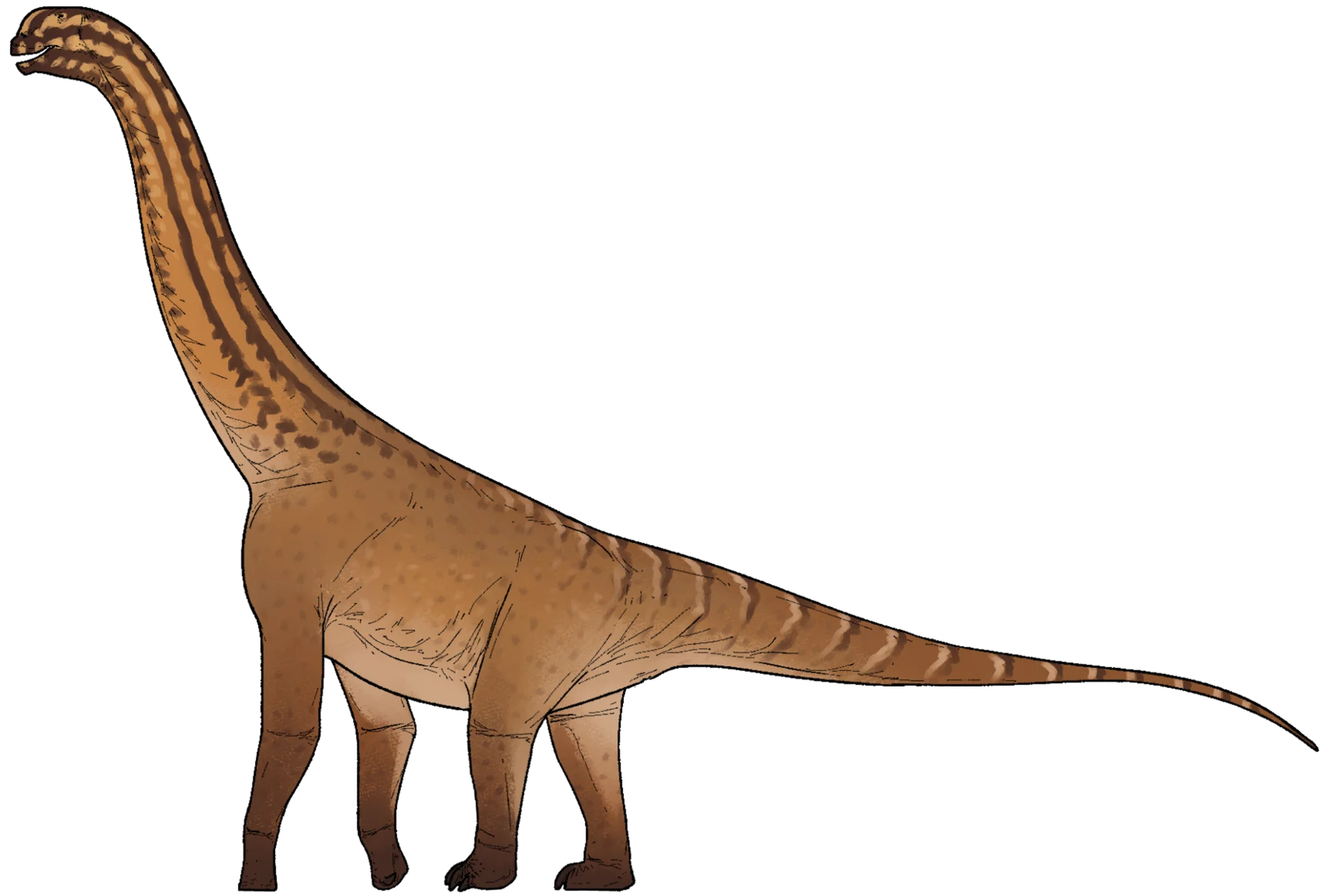
Ceratocaudia antiqua was a roughly seven-metre sauropod from the Kaladongar Formation of western India. Although small beside later macronarians, the holotype was an old individual rather than a juvenile: its long-bone tissues record advanced skeletal maturity. The describing analysis placed it near the base of Macronaria, making it one of the earliest diagnosable members of the lineage that later included brachiosaurids and titanosaurs. Its combination of great age and small adult body size raises the possibility of dwarfism, but one individual cannot establish the cause.
Its fossils occur between approximately 185 and 168 million years ago. Values shown here are approximate and reflect the current curated seed dataset.
Form and function
The holotype IITBR3–IITBR59 includes neck and tail vertebrae, a chevron, an interclavicle, forelimb and hand bones, both femora, lower-leg bones and a metatarsal. Diagnostic features include a notch on a cervical postzygapophysis, a horn-like crest on an anterior caudal neural spine, changing articular geometry along the rear tail, and distinctive shapes on the tibia and fibula. Histology and a non-traumatic bone pathology indicate that the individual was old.
Evolutionary position
This simplified classification path shows one placement from Dinosauria to this species. Each step is clickable, and other analyses may support alternative relationships.
Open interactive positionScale
Simplified length comparison using preferred dataset estimates; body shape and posture are not represented.
Scientific record
Abhishek Natarajan, Suraj Bhosale, Nibedita Rakshit and Sudipta Dasgupta named Ceratocaudia antiqua on 16 July 2026 from a partial skeleton collected in the Kaladongar Formation of the Khadir Uplift, Kachchh Basin, Gujarat. The genus combines Greek keras, horn, with Latin cauda, tail, for the crest on a tail vertebra. Antiqua means ancient and refers to its unusually early place in macronarian history.
Naming authors: Abhishek Natarajan, Suraj Bhosale, Nibedita Rakshit, Sudipta Dasgupta.
Palaeoenvironment
The Kaladongar Formation accumulated in western India during an interval that may span the later Early Jurassic into the early Middle Jurassic. The exact age and palaeoenvironment of the fossil-bearing level remain less tightly constrained than the anatomy of the skeleton, so the map deliberately marks the wider Khadir region rather than a precise excavation point.
The tail crest prompted a tentative biomechanical reconstruction in which the tail could have served as a mild deterrent, but no trace fossil or injury demonstrates how it was used. Four-legged locomotion and herbivory follow from its sauropod anatomy. Solitary or herd behaviour, preferred plants and daily activity are unknown.
Worth knowing
Fossil distribution
Khadir Uplift, Kachchh District, Gujarat, India
Kaladongar Formation
regional marker
Markers are deliberately approximate. They identify published fossil areas without exposing sensitive excavation coordinates.
Open interactive mapFossil specimen record
Mumbai, India
Repository of the partial skeleton designated as the holotype. The scientific paper establishes the collection and catalogue series; continuous public exhibition is not confirmed.
A research repository is not necessarily a public exhibit. Loan and display status can change, so check with the institution before visiting.
Media record
Evidence
Abhishek Natarajan, Suraj Bhosale, Nibedita Rakshit, Sudipta Dasgupta · Journal of Vertebrate Paleontology · 2026
Open source