Berry Creek and Dinosaur Provincial Park fossil region
Red Deer River badlands, Alberta, Canada
Dinosaur Park Formation
regional marker
Pronunciation: KAZ-moh-SORE-us BELL-eye
A classic long-frilled horned dinosaur from Alberta, known from complete skulls, articulated skeletons, skin impressions and a rare juvenile skeleton.
Last updated 16 July 2026
Field guide
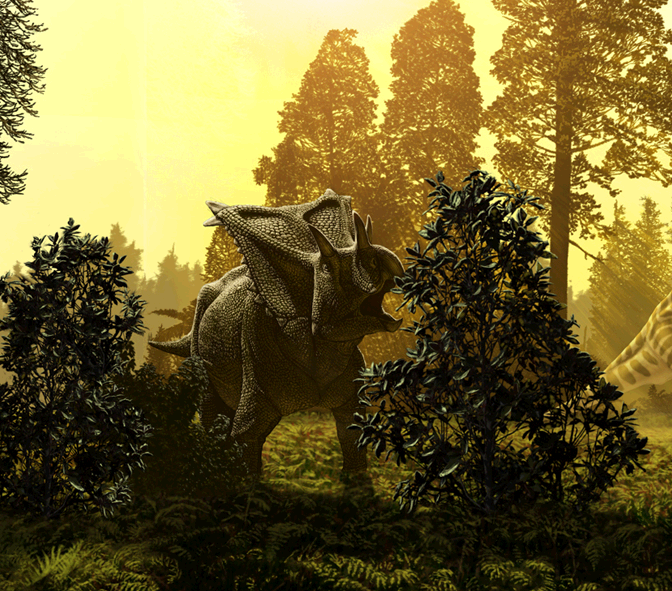
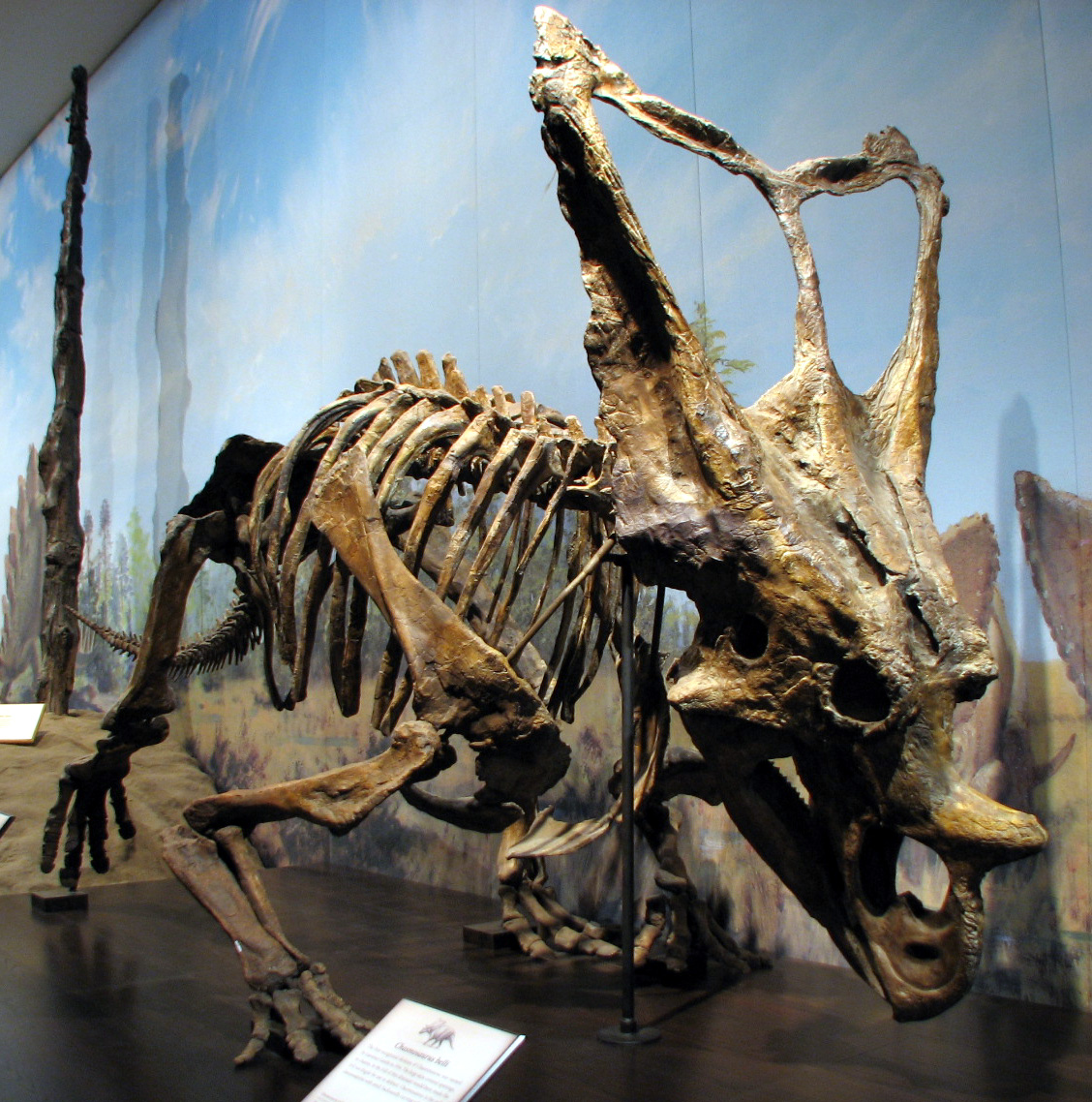
Chasmosaurus belli was a medium-sized chasmosaurine ceratopsid from the Dinosaur Park Formation of Alberta. Its long, low frill was pierced by two enormous openings, greatly reducing the weight of the skull while leaving a broad visual display surface. The species is represented by skulls, articulated skeletons and skin impressions, including CMN 2245 at about 4.7 metres long. Chasmosaurus taxonomy has a complicated history: the distinction between C. belli and material traditionally called C. russelli rests on subtle frill geometry, and several historically named species have moved to other genera.
Its fossils occur between approximately 76.5 and 75.3 million years ago. Values shown here are approximate and reflect the current curated seed dataset.
Form and function
A narrow parrot-like beak cropped vegetation, while batteries of continually replacing cheek teeth sliced it. The nasal horn was short, and brow horns ranged from modest points to strongly reduced structures in mature individuals. The long frill expanded behind the skull with two large parietal openings and small bony ornaments around its edge. Robust forelimbs, broad hands and powerful hind limbs supported a barrel-shaped quadrupedal body. Skin associated with CMN 2245 preserves non-overlapping scales of several sizes around the shoulder and pelvis.
Evolutionary position
This simplified classification path shows one placement from Dinosauria to this species. Each step is clickable, and other analyses may support alternative relationships.
Open interactive positionScale
Simplified length comparison using preferred dataset estimates; body shape and posture are not represented.
Scientific record
Lawrence Lambe collected the type frill bone, CMN 491, at Berry Creek in Alberta in 1898. In 1902 he named it Monoclonius belli, honouring collector Walter Bell. More complete skulls found by Charles H. Sternberg and his sons in 1913 showed that it belonged to a distinctive long-frilled animal. Lambe established a separate genus in 1914; an initial name, Protorosaurus, was already occupied, so he replaced it with Chasmosaurus. Later skeletons such as CMN 2245 and ROM 843 revealed nearly the whole body.
Discovery credit: Lawrence M. Lambe, Geological Survey of Canada.
Naming authors: Lawrence M. Lambe.
Palaeoenvironment
The Dinosaur Park Formation records rivers, floodplains, ponds and coastal wetlands beside the Western Interior Seaway. Chasmosaurus browsed flowering plants, conifers and ferns alongside hadrosaurs, armoured dinosaurs and short-frilled ceratopsids. Gorgosaurus and Daspletosaurus were major predators. The formation spans enough time that its full species list should not be treated as one unchanging community.
The frill and horns likely combined display, recognition and physical protection, but their exact role cannot be isolated from bone alone. Large frill openings make it unlikely that the structure functioned simply as a solid shield. Changes in brow horns and frill shape through growth show that appearance altered substantially with age. Unlike Centrosaurus, Chasmosaurus is not known from enormous single-species bonebeds, so claims of giant permanent herds are unsupported.
Worth knowing
Fossil distribution
Red Deer River badlands, Alberta, Canada
Dinosaur Park Formation
regional marker
Markers are deliberately approximate. They identify published fossil areas without exposing sensitive excavation coordinates.
Open interactive mapFossil specimen record
Gatineau, Quebec, Canada
Repository of the original partial frill that defines Chasmosaurus belli and of the nearly complete skeleton CMN 2245. The research collection is separate from the public museum galleries.
Toronto, Ontario, Canada
Repository associated with one of the best-known Chasmosaurus belli skulls and skeletons. The pictured mount has been displayed at the Royal Tyrrell Museum; ownership and display location should not be conflated.
A research repository is not necessarily a public exhibit. Loan and display status can change, so check with the institution before visiting.
Media record
Evidence
Canadian Museum of Nature
Open sourceLawrence M. Lambe · Contributions to Canadian Palaeontology 3(2) · 1902
Open sourceJames A. Campbell, Michael J. Ryan, Robert B. Holmes, Claudia J. Schröder-Adams · PLOS ONE 11(1), e0145805 · 2016
Open source