Altan Uul III fossil region
Nemegt Basin, Trans-Altai Gobi, Mongolia
Nemegt Formation
regional marker
Pronunciation: DYE-no-KY-rus mih-RIF-ih-kus
A giant, deep-bodied Mongolian ornithomimosaur with enormous arms, a toothless duck-like beak, tall back spines and a broad-footed build unlike any other known theropod.
Last updated 16 July 2026
Field guide
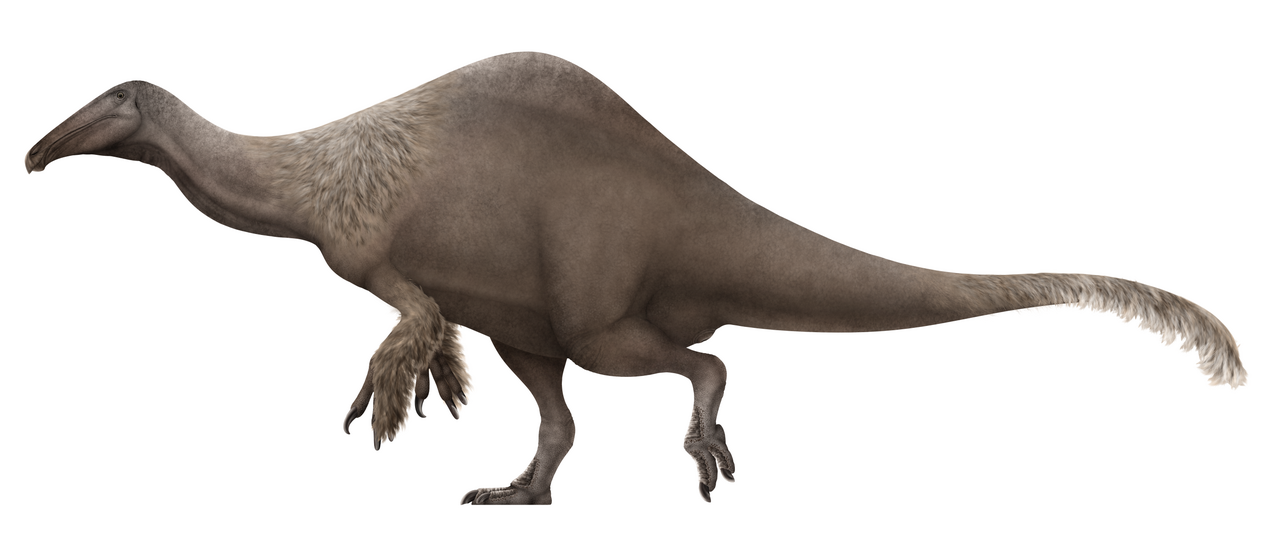
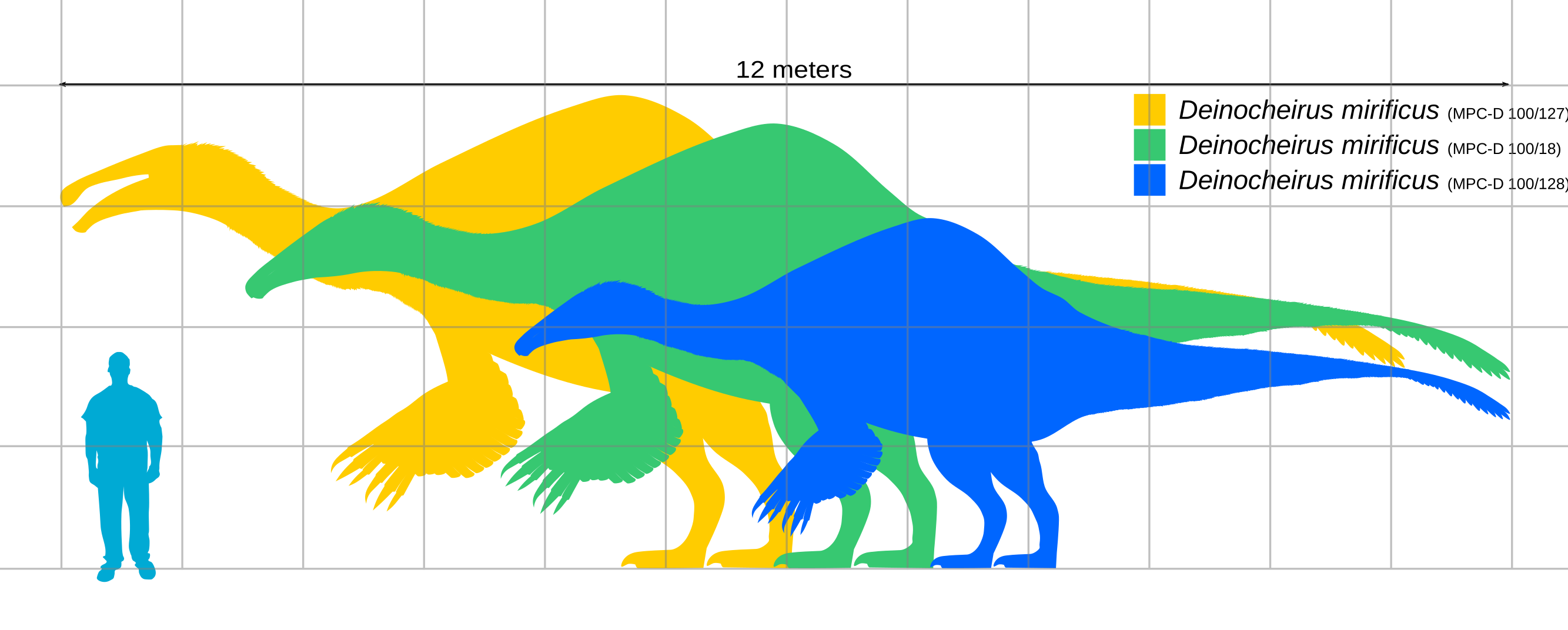
Deinocheirus mirificus transformed from one of palaeontology's great mysteries into one of its strangest well-known dinosaurs. For nearly half a century it was represented chiefly by a pair of 2.4-metre forelimbs, shoulder bones and a few ribs. Two much more complete skeletons revealed an approximately eleven-metre ornithomimosaur with a deep belly, broad hips, unusually short lower legs, wide feet, tall neural spines and a toothless expanded snout. It was not a giant predator built like Tyrannosaurus: stomach-region fish remains, gastroliths and its beak instead indicate an opportunistic omnivore living in the wet environments of the Nemegt Formation.
Its fossils occur between approximately 72 and 69 million years ago. Values shown here are approximate and reflect the current curated seed dataset.
Form and function
The long forelimbs ended in three large but relatively blunt claws. Its skull was low and elongated, with a broad, toothless beak and a deep lower jaw; the huge lower-jaw opening helped keep this expanded structure light. Tall neural spines rose above the trunk and pelvis and supported a high-backed soft-tissue profile, although whether that outline resembled a hump or a sail cannot be determined from bone alone. The pelvis was broad, the lower legs were short, and the feet were unusually wide for a theropod, suggesting a heavy animal adapted for steady movement over soft, wet ground. Fused vertebrae at the tail tip formed a pygostyle-like structure that may have supported a fan of feathers, but no feathers are directly preserved with Deinocheirus.
Evolutionary position
This simplified classification path shows one placement from Dinosauria to this species. Each step is clickable, and other analyses may support alternative relationships.
Open interactive positionScale
Simplified length comparison using preferred dataset estimates; body shape and posture are not represented.
Scientific record
Zofia Kielan-Jaworowska's Polish-Mongolian expedition found the holotype ZPAL MgD-I/6 at Altan Uul III in 1965. Halszka Osmolska and Ewa Roniewicz named Deinocheirus mirificus in 1970 from its spectacular arms. Decades later, Mongolian-Korean teams recovered the more complete MPC-D 100/127 and MPC-D 100/128 from the Nemegt Basin. Parts of one skeleton had been poached and dispersed through the fossil trade; a skull, hands and feet were identified in Europe, reunited with the Mongolian skeleton and repatriated in 2014. The combined specimens finally allowed Lee and colleagues to publish a near-whole-body reconstruction in Nature.
Discovery credit: Polish-Mongolian Palaeontological Expedition, Zofia Kielan-Jaworowska.
Naming authors: Halszka Osmolska, Ewa Roniewicz.
Palaeoenvironment
The Nemegt Formation preserves large river channels, floodplains, ponds and seasonally wet lowlands in the Gobi region. Deinocheirus shared this landscape with the tyrannosaurid Tarbosaurus, the ornithomimosaur Gallimimus, hadrosaurs, titanosaurs, turtles, crocodile-line reptiles and abundant freshwater animals. Wide feet and short lower legs are consistent with moving across soft substrates, but they do not demonstrate a fully aquatic lifestyle.
A cluster of more than 1,400 gastroliths and fish remains in the abdominal region of one specimen provide unusually direct dietary evidence. Deinocheirus probably cropped soft vegetation with its beak, ground food with swallowed stones and also consumed aquatic prey or carrion when available. Its claws may have gathered branches or helped with defence, but their exact function is not preserved. No nest, trackway or mass assemblage currently establishes its social organisation, reproductive behaviour or swimming ability.
Worth knowing
Fossil distribution
Nemegt Basin, Trans-Altai Gobi, Mongolia
Nemegt Formation
regional marker
Nemegt Basin, Trans-Altai Gobi, Mongolia
Nemegt Formation
regional marker
Markers are deliberately approximate. They identify published fossil areas without exposing sensitive excavation coordinates.
Open interactive mapFossil specimen record
Warsaw, Poland
Repository of the original enormous forelimbs, shoulder girdle and associated bones collected at Altan Uul III. The specimen is a research collection object; continuous public display is not confirmed.
Ulaanbaatar, Mongolia
Repository of the two specimens that revealed most of the body. Recovered poached elements were reunited with MPC-D 100/127 and returned to Mongolia; public display of the originals is not guaranteed.
A research repository is not necessarily a public exhibit. Loan and display status can change, so check with the institution before visiting.
Media record
Evidence
Halszka Osmolska, Ewa Roniewicz · Palaeontologia Polonica 21 · 1970
Open sourceYuong-Nam Lee, Rinchen Barsbold, Philip J. Currie and 5 coauthors · Nature 515 · 2014
Open sourceHokkaido University · 2014
Open source