Last Chance Creek fossil region
Grand Staircase–Escalante, southern Utah, United States
Wahweap Formation, Last Chance Creek Member
regional marker
Pronunciation: dee-AB-loh-SER-ah-tops ee-TOH-nye
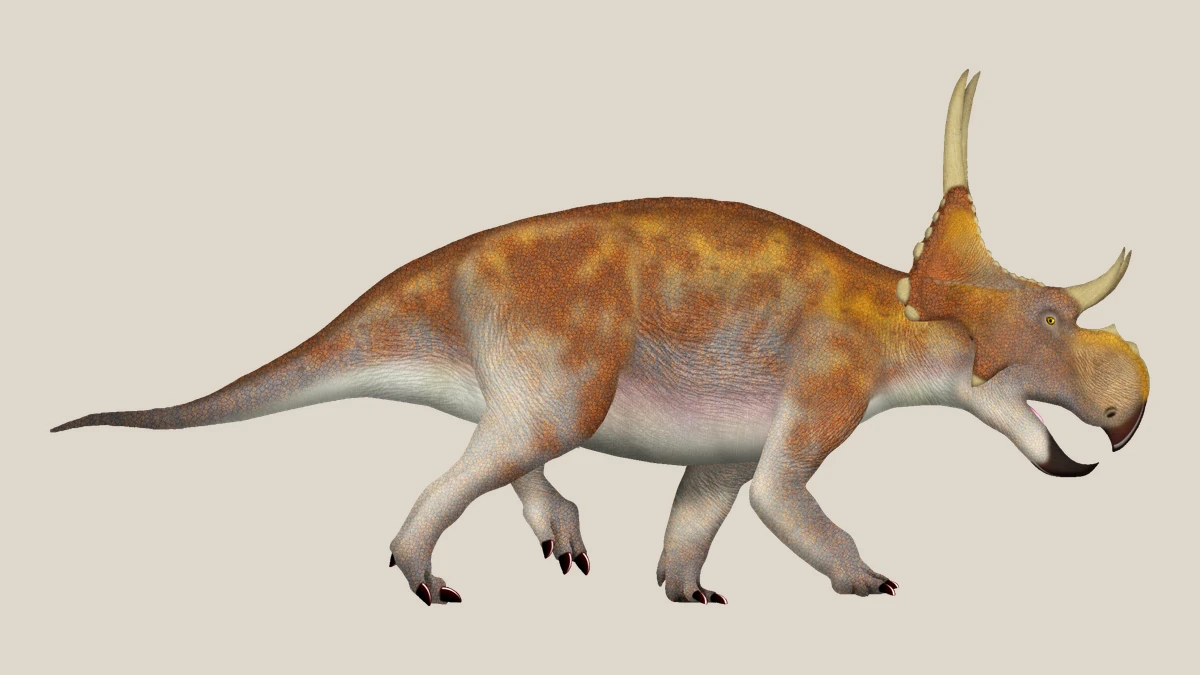
An early centrosaurine from Utah known from a remarkably complete skull with long brow horns and a pair of towering, curved frill spikes.
Last updated 28 July 2026
Field guide
Diabloceratops eatoni lived in southern Utah early in the Campanian, about 81.3 million years ago. It is one of the oldest well-diagnosed members of Centrosaurinae and helps show that this branch of horned dinosaurs had already developed elaborate skull ornamentation before later forms such as Centrosaurus and Styracosaurus appeared. Its deep face, small nasal ornament, long brow horns and pair of large curved spikes at the back of the frill create an unusual mixture of features. Almost everything distinctive about the species comes from one skull, so the body shown in reconstructions is inferred from related ceratopsids.
Its fossils occur between approximately 81.42 and 81.01 million years ago. Values shown here are approximate and reflect the current curated seed dataset.
Form and function
The approximately 1.4-metre skull was short and deep at the snout. A low paired ornament sat over the nose, while substantial brow horncores projected above the eyes. The frill narrowed toward its rear and carried many small marginal ornaments plus two very long, curved spikes. Broad cheek horns projected sideways. The toothless beak and rows of continually replaced cheek teeth identify it as a plant eater. No complete body skeleton is known; a four-legged, heavy-bodied reconstruction follows other ceratopsids rather than direct Diabloceratops evidence.
Evolutionary position
This simplified classification path shows one placement from Dinosauria to this species. Each step is clickable, and other analyses may support alternative relationships.
Open interactive positionScale
Simplified length comparison using preferred dataset estimates; body shape and posture are not represented.
Scientific record
Utah Geological Survey palaeontologist Donald DeBlieux found the holotype skull, UMNH VP 16699, near Last Chance Creek in Grand Staircase–Escalante National Monument in 2002. Preparation took more than 800 hours because much of the skull remained embedded in sandstone. James Kirkland and DeBlieux named Diabloceratops eatoni in 2010, honouring palaeontologist Jeffrey Eaton. Another partial Wahweap skull, UMNH VP 16704, was initially referred to the genus but may represent a more derived centrosaurine, so this profile counts only the holotype as secure.
Discovery credit: Donald D. DeBlieux.
Naming authors: James I. Kirkland, Donald D. DeBlieux.
Palaeoenvironment
The Wahweap Formation records rivers, floodplains, lakes and coal-forming wetlands on southern Laramidia, west of the Western Interior Seaway. The climate was warm and seasonally wet, and flowering plants were becoming increasingly diverse alongside conifers, ferns and other vegetation. Diabloceratops shared the wider formation with hadrosauroids, armoured dinosaurs, small theropods and large tyrannosaurids. Not every Wahweap animal occurs at exactly the same level as the holotype.
Its beak cropped plants and its dental batteries sliced vegetation before swallowing. The striking horns and frill may have combined visual display, recognition, defence and physical interaction, but one skull cannot reveal which role was most important. No bonebed, trackway or nesting site securely assigned to Diabloceratops documents herd size, combat or parental care.
Worth knowing
Fossil distribution
Grand Staircase–Escalante, southern Utah, United States
Wahweap Formation, Last Chance Creek Member
regional marker
Markers are deliberately approximate. They identify published fossil areas without exposing sensitive excavation coordinates.
Open interactive mapFossil specimen record
Salt Lake City, Utah, United States
Repository of holotype UMNH VP 16699. A cast of the skull is displayed in the museum; individual objects can rotate, so visitors should confirm current gallery arrangements.
A research repository is not necessarily a public exhibit. Loan and display status can change, so check with the institution before visiting.
Media record
Evidence
James I. Kirkland, Donald D. DeBlieux · New Perspectives on Horned Dinosaurs: The Royal Tyrrell Museum Ceratopsian Symposium · 2010
Open sourcePalaeogeography, Palaeoclimatology, Palaeoecology · 2022
Open sourceNatural History Museum of Utah
Open sourceUtah Geological Survey
Open source