Tendaguru fossil region
Lindi Region, Tanzania
Tendaguru Formation
regional marker
Pronunciation: die-KRAY-oh-SORE-us han-seh-MAN-eye
A compact, unusually short-necked diplodocoid from Tanzania with tall forked vertebral spines and one of the best skeletons known for its family.
Last updated 2 August 2026
Field guide
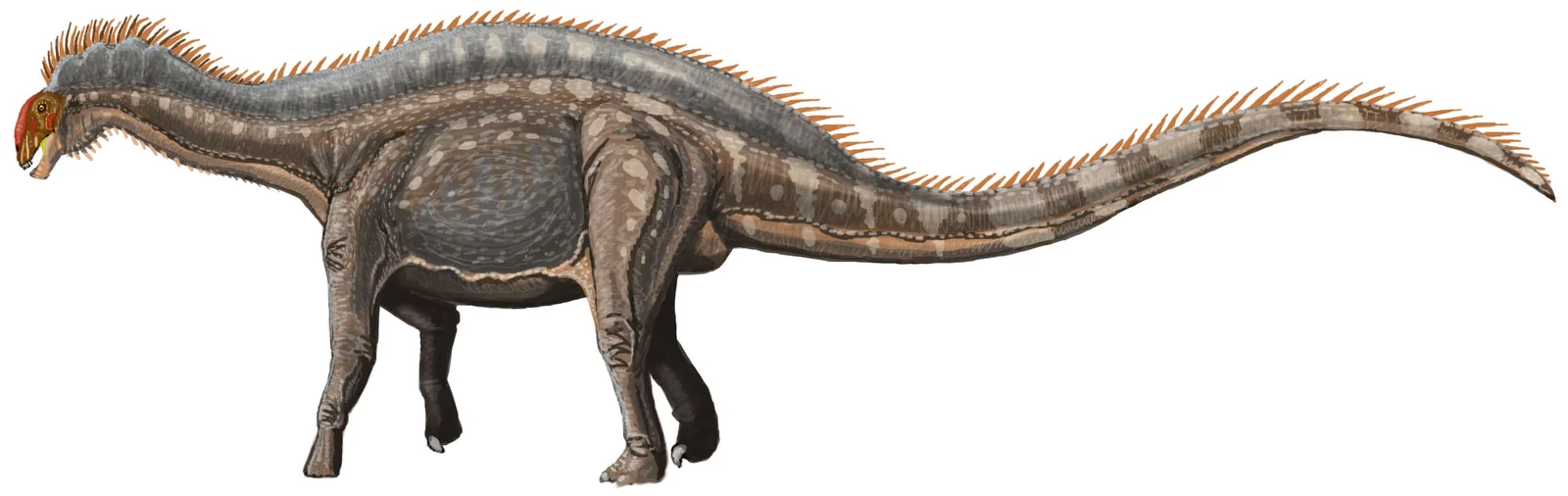
Dicraeosaurus hansemanni was a medium-sized sauropod from the Late Jurassic Tendaguru ecosystem of southern Tanzania. Unlike the extremely long-necked diplodocids, it carried a relatively short, muscular neck above a compact body and long tail. Tall neural spines split into paired prongs along the neck and back, giving the genus its name and anchoring powerful ligaments and muscles. Material collected during the German Tendaguru Expedition includes the exceptionally informative partial skeleton known as 'm', together with additional bones that make Dicraeosaurus one of the best-understood dicraeosaurids. The original fossils remain mounted in Berlin, while ongoing work is re-evaluating whether all Tendaguru material assigned to two Dicraeosaurus species is truly distinct.
Its fossils occur between approximately 155 and 150 million years ago. Values shown here are approximate and reflect the current curated seed dataset.
Form and function
The skull was small and low, with peg-like teeth concentrated toward the front of the jaws. The neck was short for a sauropod and supported by deeply forked neural spines, which continued along the front of the back. A relatively high shoulder region, stout columnar limbs and compact trunk supported the body, while the long tapering tail balanced it. The exact outline of soft tissue above the split spines is unknown; they probably anchored ligaments and muscles rather than a tall sail.
Evolutionary position
This simplified classification path shows one placement from Dinosauria to this species. Each step is clickable, and other analyses may support alternative relationships.
Open interactive positionScale
Simplified length comparison using preferred dataset estimates; body shape and posture are not represented.
Scientific record
Fossils assigned to Dicraeosaurus were excavated around Tendaguru Hill during the German Tendaguru Expedition of 1909-1913, when Tanzania was under German colonial rule. Werner Janensch named D. hansemanni in 1914 and honoured pathologist David Paul von Hansemann, whose support helped launch the expedition. The Museum für Naturkunde Berlin later mounted the best-preserved skeleton 'm'. Modern research is digitally scanning the skull, neck and shoulder and reassessing the historic species diagnoses, while the museum also documents the collection's colonial history and Tanzanian restitution claims.
Discovery credit: German Tendaguru Expedition field teams.
Naming authors: Werner Janensch.
Palaeoenvironment
The Tendaguru Formation records coastal plains, river channels, lagoons and seasonally dry environments near the Jurassic coast of eastern Africa. Dicraeosaurus shared this landscape with Giraffatitan, Tornieria, Kentrosaurus, Dysalotosaurus and theropod predators. The displayed map point represents the broad Tendaguru fossil region, not an individual excavation trench.
Dicraeosaurus was a low-to-middle browser that cropped vegetation with narrow teeth and swallowed it with little oral processing. Its shorter neck probably favoured a different feeding envelope from the taller Giraffatitan living in the same formation. Biomechanical work continues to test how far the neck could move. Direct evidence for herd size, nesting, migration or defensive behaviour is not known.
Worth knowing
Fossil distribution
Lindi Region, Tanzania
Tendaguru Formation
regional marker
Markers are deliberately approximate. They identify published fossil areas without exposing sensitive excavation coordinates.
Open interactive mapFossil specimen record
Berlin, Germany
Mounted skeleton incorporating the original 'm' fossil material, described by the museum as the best-preserved and most complete dicraeosaurid find. Reconstructed portions complete the display.
A research repository is not necessarily a public exhibit. Loan and display status can change, so check with the institution before visiting.
Media record
Evidence
Holger Stoecker, Michael Ohl · Taxonomies at Tendaguru: How the Berlin Dinosaurs Got Their Names · 2024
Open sourceMuseum für Naturkunde Berlin
Open sourceMuseum für Naturkunde Berlin
Open source