Sheep Creek fossil area
Wyoming, United States
Morrison Formation
regional marker
Pronunciation: dih-PLOD-oh-kus kar-NEG-ee-eye
A long, lightly built Morrison Formation sauropod with peg-like front teeth and an extraordinarily long tail. Its famous Carnegie skeleton—and casts sent around the world—made Diplodocus a global museum icon.
Last updated 13 July 2026
Field guide
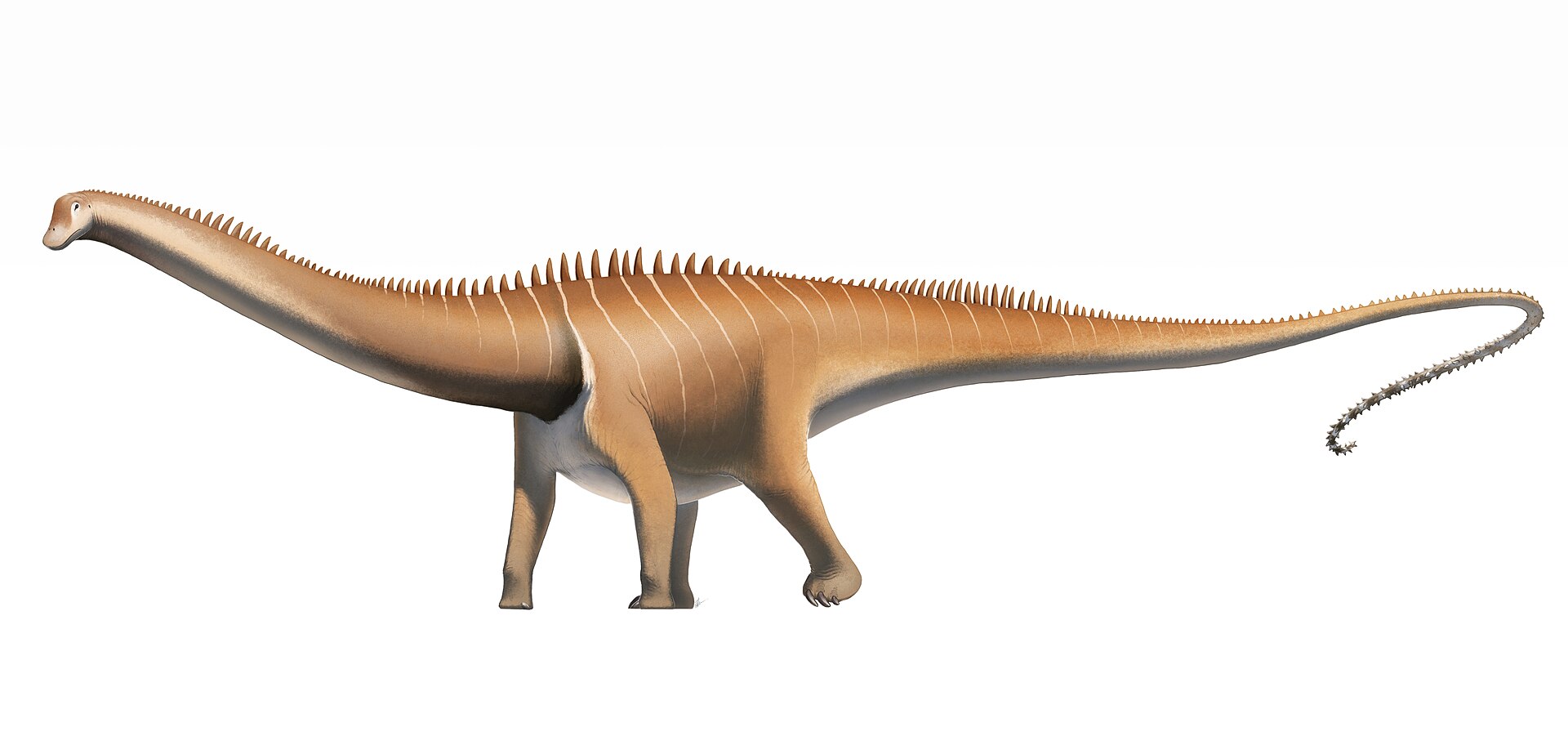
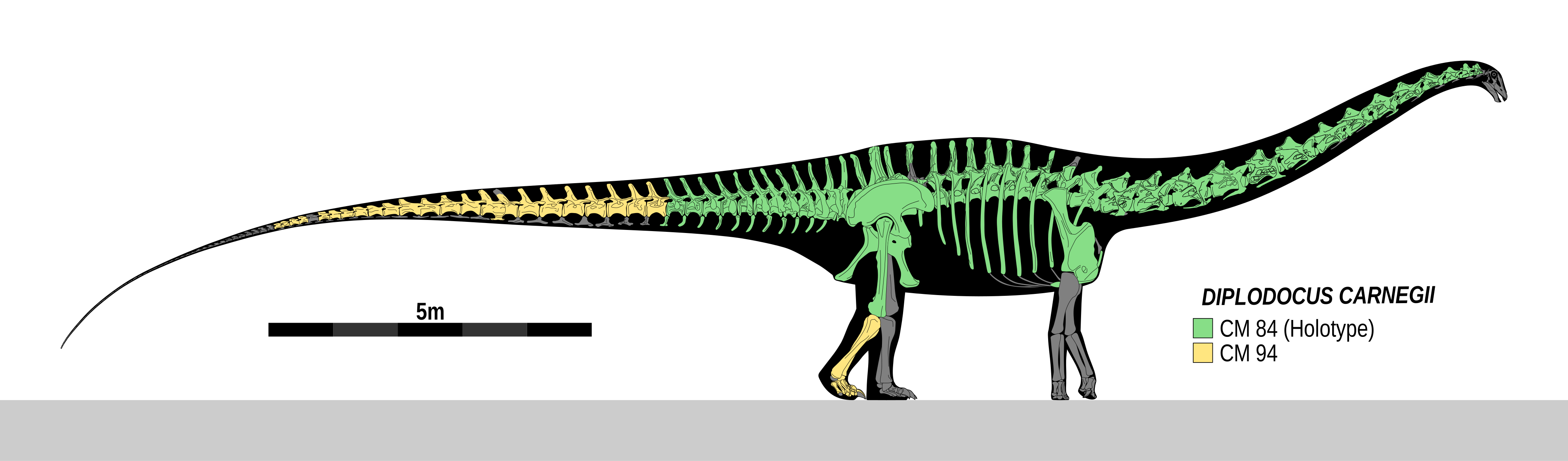
Diplodocus carnegii was a large diplodocid sauropod from the Late Jurassic Morrison Formation of Wyoming. It combined a small head, a long pneumatic neck, a deep but relatively slender torso and an extremely long tapering tail. Peg-like teeth were concentrated at the front of a broad muzzle and were replaced throughout life. The species is best represented by Carnegie Museum specimens CM 84 and CM 94. Their mounted reconstruction, popularly called Dippy, became one of the most widely reproduced dinosaur skeletons in history, but modern documentation shows that both the Pittsburgh mount and its casts combine original, cast and sculpted elements from several specimens.
Its fossils occur between approximately 154 and 152 million years ago. Values shown here are approximate and reflect the current curated seed dataset.
Form and function
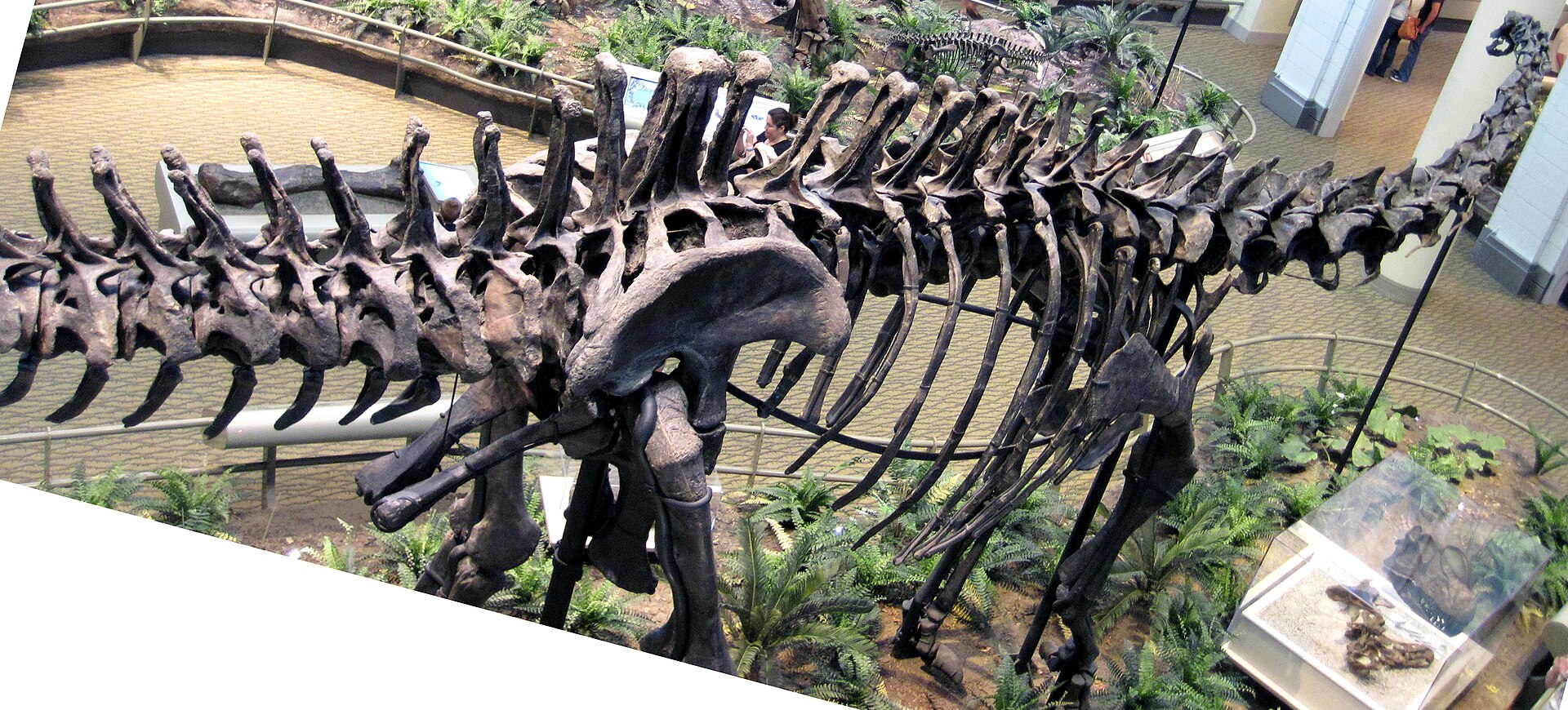
Holotype CM 84 preserves much of the neck, trunk, pelvis, tail and hind limbs but lacks a skull and several limb elements. Paratype CM 94 and other diplodocids informed missing portions of the historic mount. A 2025 specimen-by-specimen audit measured the current Pittsburgh mount at about 26.1 metres and identified original fossils, casts and sculptures throughout it. Diplodocus had paired, beam-like chevrons beneath many tail vertebrae, the feature that inspired the genus name 'double beam'. Air-filled spaces within the vertebrae reduced skeletal weight.
Evolutionary position
This simplified classification path shows one placement from Dinosauria to this species. Each step is clickable, and other analyses may support alternative relationships.
Open interactive positionScale
Simplified length comparison using preferred dataset estimates; body shape and posture are not represented.
Scientific record
Carnegie Museum crews working around Sheep Creek, Wyoming, located Diplodocus material in 1898. The skeleton catalogued as CM 84 was excavated in 1899 by a field crew that included Arthur Coggeshall, Jacob L. Wortman, William H. Reed and W. C. Reed. A second partial skeleton, CM 94, was collected from the same quarry in 1900. John Bell Hatcher described both in the first Memoirs of the Carnegie Museum in July 1901 and named D. carnegii for Andrew Carnegie. The original mount opened in Pittsburgh in 1907 and was scientifically remounted in 2007.
Discovery credit: Arthur Coggeshall, Jacob L. Wortman, William H. Reed, W. C. Reed.
Naming authors: John Bell Hatcher.
Palaeoenvironment
The Morrison Formation records broad river floodplains, seasonal streams, ponds and drier open areas under a strongly seasonal climate. Conifers, tree ferns, cycads, horsetails and low ferns supplied vegetation. Diplodocus shared this landscape with other sauropods such as Apatosaurus, Brontosaurus, Camarasaurus and Brachiosaurus, as well as Stegosaurus, smaller herbivores and predators including Allosaurus and Ceratosaurus.
The broad muzzle and dental microwear of diplodocoids support non-selective cropping, probably often at low or middle heights, while biomechanical work rejects some forceful bark-stripping scenarios. The long neck enlarged the feeding area without requiring the whole animal to move for every bite. Rearing and high browsing were physically possible in some models but are not directly demonstrated. Tail-whip functions, herd structure, mating displays and precise neck posture remain debated. Bone histology indicates rapid growth; paratype CM 94 was at least about 24 years old despite its enormous size.
Worth knowing
Fossil distribution
Wyoming, United States
Morrison Formation
regional marker
Markers are deliberately approximate. They identify published fossil areas without exposing sensitive excavation coordinates.
Open interactive mapFossil specimen record
Pittsburgh, United States
The original Carnegie Dippy mount, centred on holotype CM 84 and supplemented with fossils or casts from CM 94, CM 307 and other sauropods plus sculpted missing elements. It is a scientifically documented composite, remounted in 2007, rather than one complete skeleton.
A research repository is not necessarily a public exhibit. Loan and display status can change, so check with the institution before visiting.
Media record
Evidence
John Bell Hatcher · Memoirs of the Carnegie Museum · 1901
Open sourceEmanuel Tschopp, Octávio Mateus, Roger B. J. Benson · PeerJ · 2015
Open sourceJohn A. Whitlock · PLOS ONE · 2011
Open sourceMark T. Young, Emily J. Rayfield, Casey M. Holliday and 4 coauthors · Naturwissenschaften · 2012
Open sourceD. Cary Woodruff, Denver W. Fowler, John R. Horner · Palaeontologia Electronica · 2017
Open sourceMichael P. Taylor, Amy Henrici, Linsly Church and 2 coauthors · Annals of the Carnegie Museum · 2025
Open sourceCarnegie Mellon University Libraries
Open sourceCarnegie Museum of Natural History
Open source