Canyon Bonebed, MOR locality TM-046
Blackfeet Reservation, northwestern Montana, United States
Two Medicine Formation
regional marker
Pronunciation: EYE-nee-oh-SORE-us pro-KUR-vih-KOR-nis
A centrosaurine from Montana known from two multi-individual bonebeds, with a strongly forward-curving nasal horn and paired spikes on its frill.
Last updated 23 July 2026
Field guide
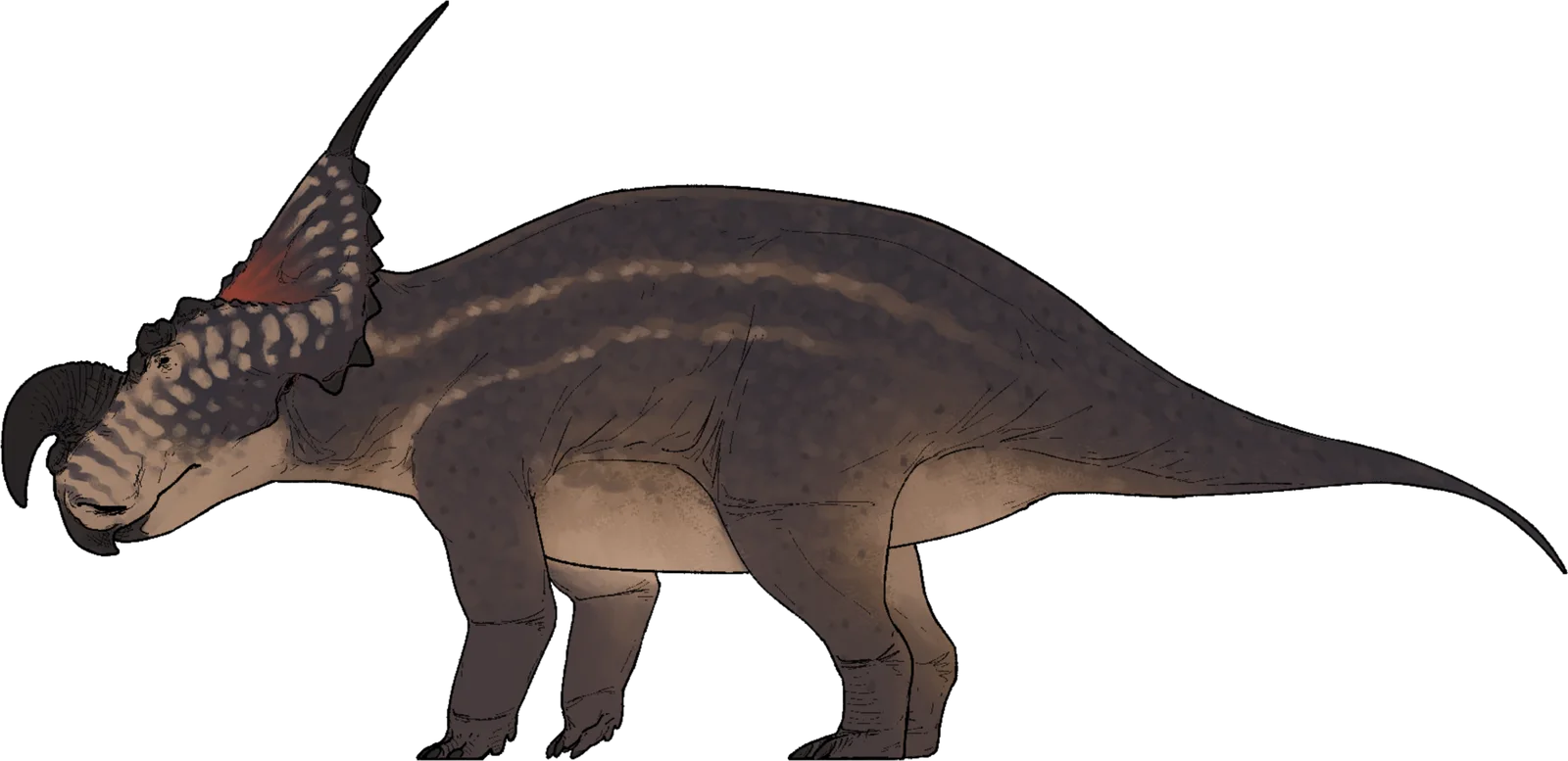
Einiosaurus procurvicornis was a short-frilled ceratopsid from the upper Two Medicine Formation of Montana. At least fifteen individuals from two bonebeds preserve juveniles, subadults and adults, making it possible to study how its elaborate skull ornament changed during growth. Mature animals developed a long nasal horn that curved strongly forward, rounded masses of bone above the eyes and a pair of long rear frill processes. Younger individuals began with a more upright, backward-curving nasal horn and small pointed brow horns.
Its fossils occur between approximately 75.5 and 74.5 million years ago. Values shown here are approximate and reflect the current curated seed dataset.
Form and function
A deep beak and dental batteries sliced tough vegetation. The adult nasal horncore was elongated and bent forward, while the brow region carried rounded bosses rather than tall horns. The short parietal frill bore a pair of long, mostly straight P3 processes projecting backward and smaller marginal ornaments. Growth studies show that the frill approached adult size before the face and its ornaments finished changing. A powerful neck, broad trunk and columnar limbs supported the heavy skull and quadrupedal body.
Evolutionary position
This simplified classification path shows one placement from Dinosauria to this species. Each step is clickable, and other analyses may support alternative relationships.
Open interactive positionScale
Simplified length comparison using preferred dataset estimates; body shape and posture are not represented.
Scientific record
Museum of the Rockies teams led by Jack Horner and Carrie Ancell discovered the Canyon Bonebed and Dino Ridge Quarry in the upper Two Medicine Formation during the 1980s. Scott Sampson formally described Einiosaurus procurvicornis in 1995, selecting the adult skull MOR 456 8-9-6-1 from Canyon Bonebed as the holotype. The name combines eini, a Blackfeet word for bison, with Greek sauros, lizard; procurvicornis refers to the adult's forward-curving nasal horn.
Discovery credit: Carrie Ancell, Jack Horner.
Naming authors: Scott D. Sampson.
Palaeoenvironment
The upper Two Medicine Formation records inland river plains east of the growing Rocky Mountains. The climate was strongly seasonal, with periodic droughts, volcanic ash falls and episodes of heavy runoff. Einiosaurus shared the region with hadrosaurs, ankylosaurs, small theropods and larger tyrannosaurids. Both principal bonebeds lie on the Blackfeet Reservation, and DinoTree deliberately uses broad map markers rather than sensitive excavation coordinates.
The presence of many Einiosaurus individuals in two single-species bonebeds is consistent with groups gathering or moving together, but transport and repeated mortality can concentrate remains without preserving normal herd structure. Horns and frill ornaments probably contributed to visual signalling as well as physical interactions. Their dramatic change during growth supports a signalling role, but sex differences and exact behaviours remain unknown.
Worth knowing
Fossil distribution
Blackfeet Reservation, northwestern Montana, United States
Two Medicine Formation
regional marker
Northwestern Montana, United States
Two Medicine Formation
regional marker
Markers are deliberately approximate. They identify published fossil areas without exposing sensitive excavation coordinates.
Open interactive mapFossil specimen record
Bozeman, United States
Repository of the holotype and the principal Canyon Bonebed and Dino Ridge Quarry Einiosaurus material. Individual fossils may rotate between research and exhibition.
A research repository is not necessarily a public exhibit. Loan and display status can change, so check with the institution before visiting.
Media record
Evidence
Scott D. Sampson · Journal of Vertebrate Paleontology 15(4), 743–760 · 1995
Open sourceJohn P. Wilson, John B. Scannella · Acta Palaeontologica Polonica 66(4), 797–814 · 2021
Open sourceMuseum of the Rockies
Open source