Langenberg Quarry fossil region
Oker, Lower Saxony, Germany
Süntel Formation
regional marker
Pronunciation: yoo-ROH-pah-SORE-us HOL-gur-eye
An island-dwarf macronarian sauropod from Late Jurassic Germany, known from an exceptional growth series that includes skulls and mature small adults.
Last updated 2 August 2026
Field guide
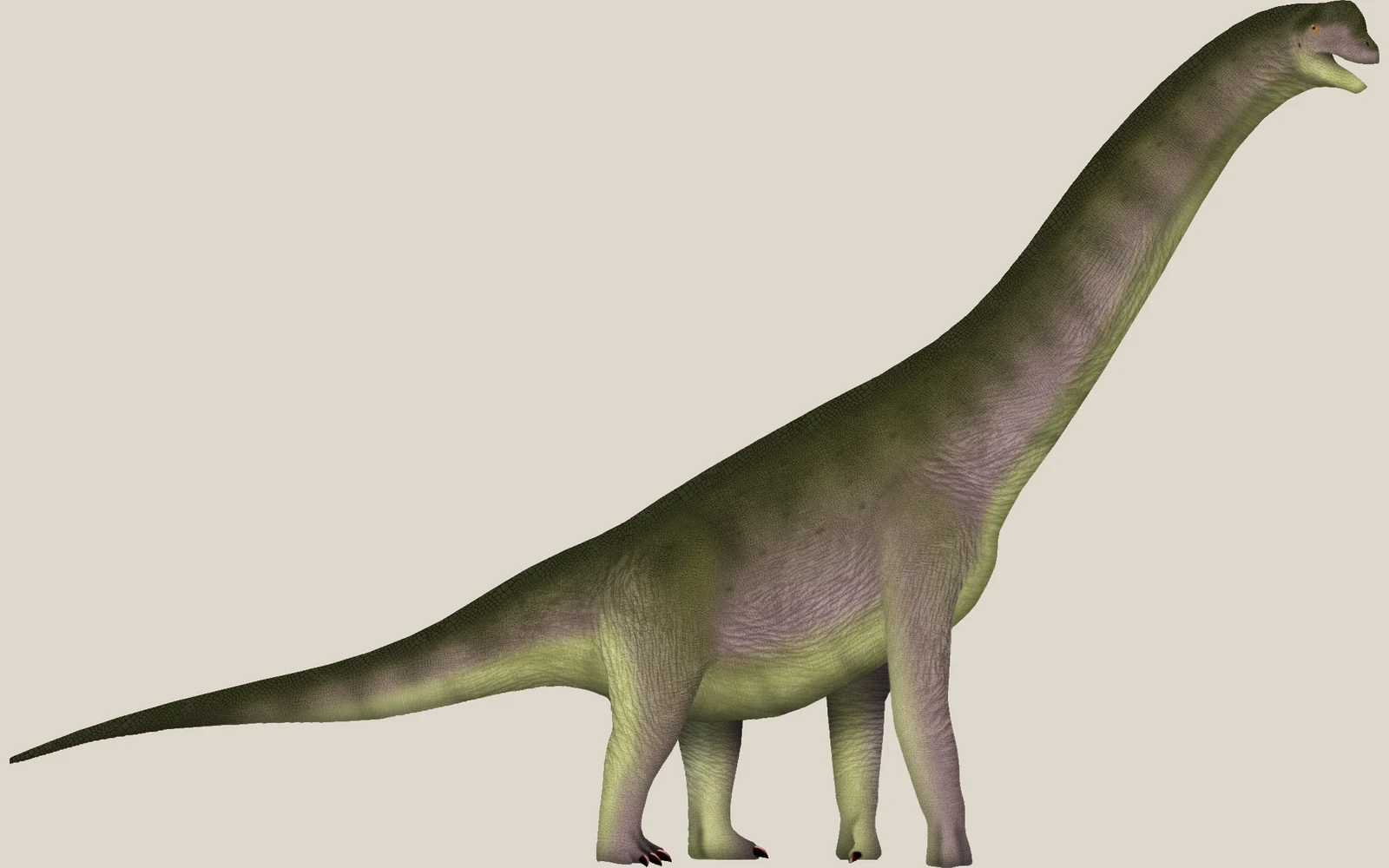
Europasaurus holgeri was a remarkably small macronarian sauropod from the Late Jurassic Süntel Formation of northern Germany. Its fossils represent juveniles through fully grown individuals approximately 1.7 to 6.2 metres long. Microscopic growth records in the limb bones show that the largest animals had reached skeletal maturity, demonstrating that they were genuine dwarfs rather than young members of a giant species. The population lived on an island in the European archipelago, where limited land and food probably favoured a slower growth rate and smaller adult body. Abundant cranial and postcranial remains make Europasaurus unusually informative for a sauropod, especially across different growth stages.
Its fossils occur between approximately 154 and 151 million years ago. Values shown here are approximate and reflect the current curated seed dataset.
Form and function
Europasaurus retained the classic sauropod plan of a small head, elongated neck, deep body, columnar limbs and long tail, but on a much smaller scale than most close relatives. The skull was relatively short and high, with broad-crowned, spoon-like teeth suited to cropping plants. Teeth were replaced continually, and recent work suggests that strong connective tissue may have stabilized and partly covered the tooth rows. Air spaces lightened the neck and trunk vertebrae. Proportions changed with age, while bone histology records increasingly slow growth toward adult size.
Evolutionary position
This simplified classification path shows one placement from Dinosauria to this species. Each step is clickable, and other analyses may support alternative relationships.
Open interactive positionScale
Simplified length comparison using preferred dataset estimates; body shape and posture are not represented.
Scientific record
Holger Lüdtke found the first tooth in 1998 in the Langenberg Quarry near Oker, Lower Saxony. Systematic excavation began the following year and recovered disarticulated remains from numerous individuals in a narrow fossil-bearing layer. P. Martin Sander, Octávio Mateus, Thomas Laven and Nils Knötschke named Europasaurus holgeri in 2006. The genus refers to Europe and the species honours Lüdtke. Although the bones occur in marine limestone, the animals lived on nearby land and their remains were transported into the shallow sea.
Discovery credit: Holger Lüdtke.
Naming authors: P. Martin Sander, Octávio Mateus, Thomas Laven, Nils Knötschke.
Palaeoenvironment
Europasaurus inhabited one of the subtropical islands surrounding the Late Jurassic Lower Saxony Basin. Vegetation on the limited land probably included conifers, cycads, ferns and other low-growing plants. Carcasses and isolated bones were washed or carried into a shallow marine setting at the Langenberg Quarry, where rapid burial in limestone preserved a mixed-age population. The map marker represents the generalized quarry region rather than an excavation coordinate.
Its broad teeth and long neck indicate selective browsing across a useful feeding envelope. The unusually rich growth series shows slow, extended development compared with giant sauropods, but does not reveal herd structure or parental care. Multiple individuals in one deposit may reflect a social group, repeated transport into the same basin or concentration by currents; these alternatives cannot yet be separated confidently.
Worth knowing
Fossil distribution
Oker, Lower Saxony, Germany
Süntel Formation
regional marker
Markers are deliberately approximate. They identify published fossil areas without exposing sensitive excavation coordinates.
Open interactive mapFossil specimen record
Rehburg-Loccum, Lower Saxony, Germany
The park's preparation and research centre cares for original Europasaurus material from the Langenberg Quarry and presents a life-sized reconstruction of the dwarf sauropod.
A research repository is not necessarily a public exhibit. Loan and display status can change, so check with the institution before visiting.
Media record
Evidence
P. Martin Sander, Octávio Mateus, Thomas Laven, Nils Knötschke · Nature 441, 739-741 · 2006
Open sourceNatural History Museum, London
Open sourceMuseumsverband Niedersachsen und Bremen
Open sourceVerena Régent, Kayleigh Wiersma-Weyand, Oliver Wings and 2 coauthors · PeerJ 12:e17764 · 2024
Open source