Nemegt Basin fossil region
Trans-Altai Gobi, Mongolia
Nemegt Formation
regional marker
Pronunciation: GAL-ih-MY-mus bull-AH-tus
A large, toothless Mongolian ornithomimid with a small head, long neck and powerful running legs, known from several skeletons spanning different growth stages.
Last updated 16 July 2026
Field guide
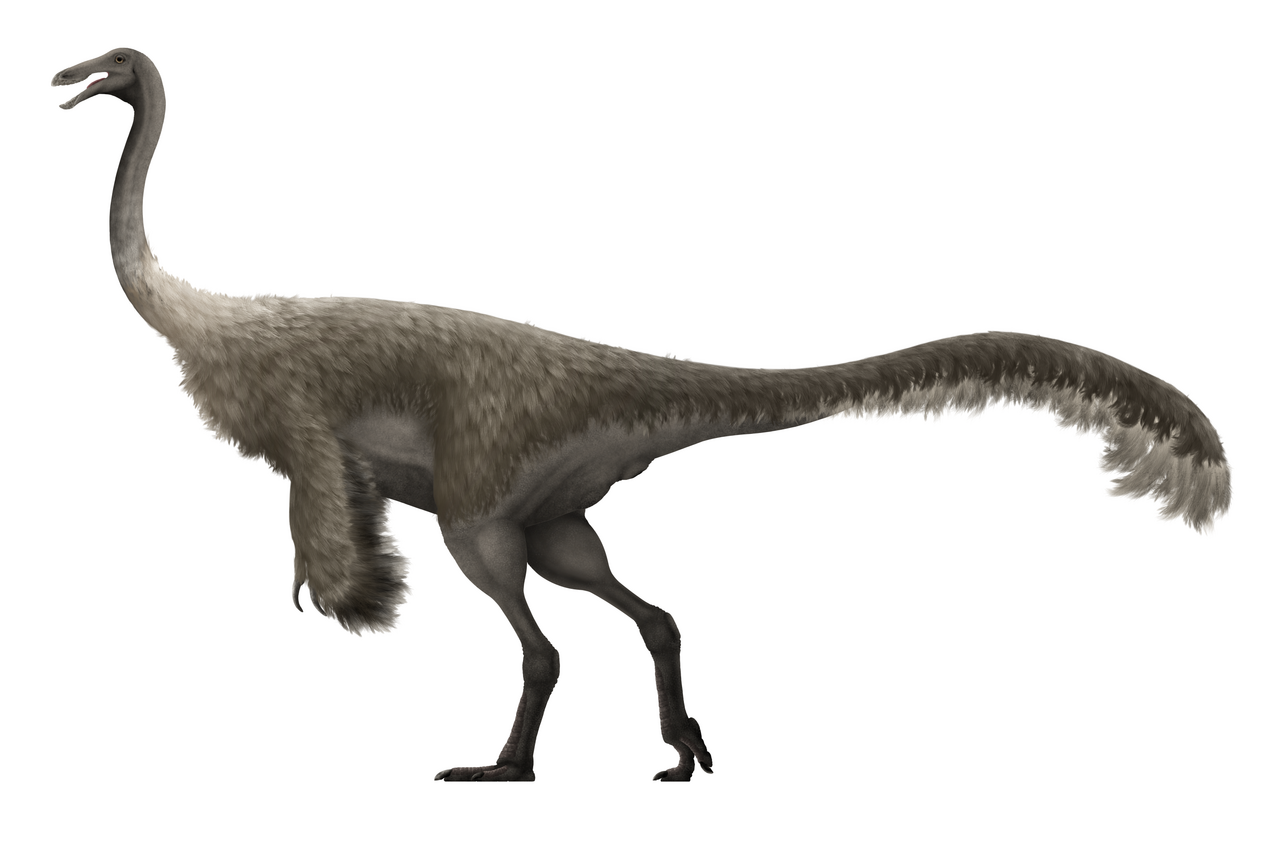
Gallimimus bullatus is one of the largest and best-known ornithomimids. Several Nemegt Formation skeletons preserve a toothless beak, long flexible neck, compact body and elongated hind limbs, producing the familiar ostrich-like outline. The nearly complete holotype makes its basic proportions unusually secure for a dinosaur, although neither feathers nor stomach contents are preserved. Its exact diet remains unsettled because the beak and slender skull could support selective plant feeding, small prey capture or a mixed strategy.
Its fossils occur between approximately 72 and 69 million years ago. Values shown here are approximate and reflect the current curated seed dataset.
Form and function
Holotype MPC-D 100/11, originally catalogued G.I. No. DPS 100/11, is a nearly complete adult skeleton with a skull. The head is small with large eye openings and a broad toothless beak. A long neck connects to a lightly built torso, short forelimbs and a stiff balancing tail. The hind limbs have a tibia longer than the femur and an arctometatarsalian foot in which the central metatarsal narrows toward the ankle. Large eyes do not by themselves prove nocturnal activity.
Evolutionary position
This simplified classification path shows one placement from Dinosauria to this species. Each step is clickable, and other analyses may support alternative relationships.
Open interactive positionScale
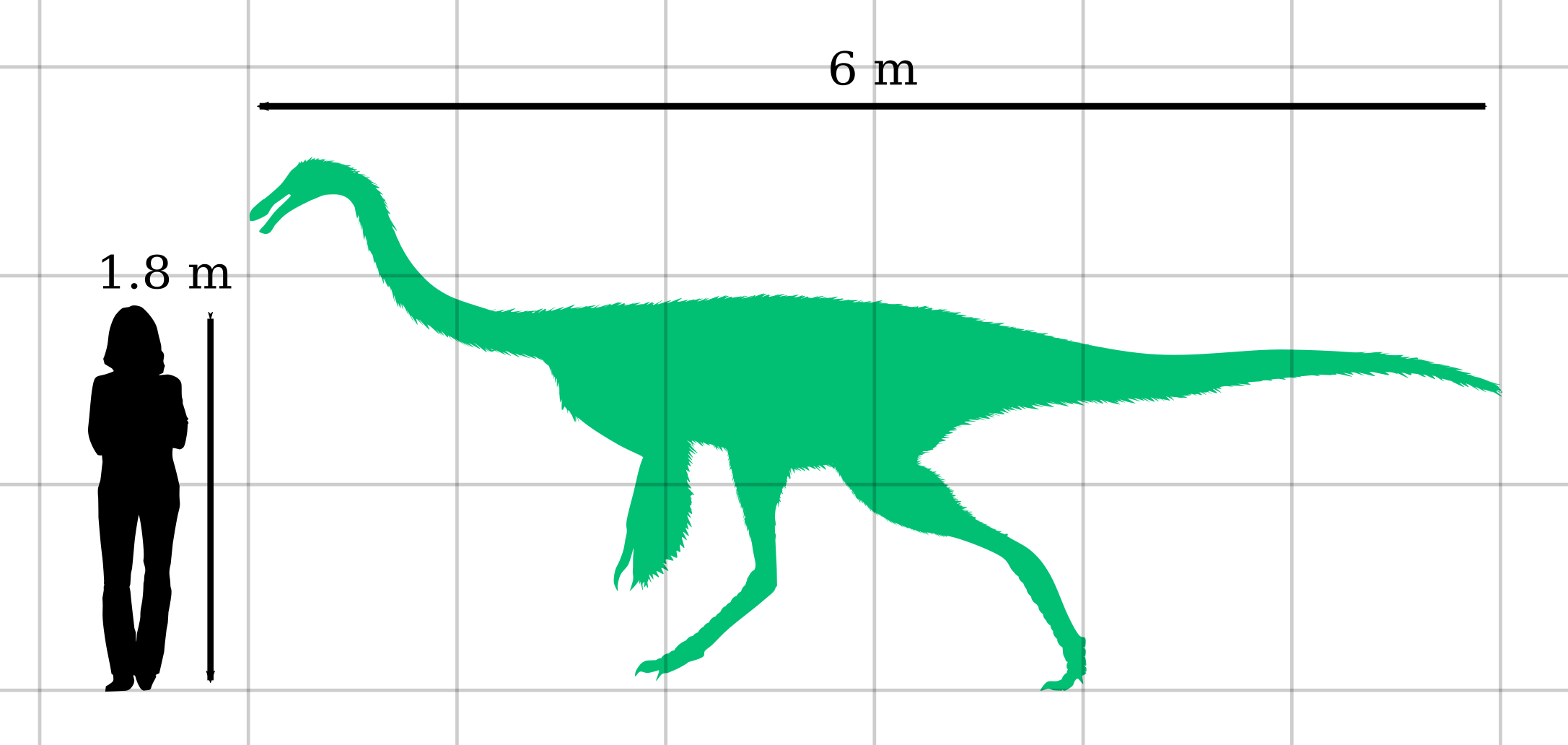
Simplified length comparison using preferred dataset estimates; body shape and posture are not represented.
Scientific record
Polish-Mongolian expeditions recovered Gallimimus skeletons from several Nemegt Formation localities during the 1960s. The adult holotype was found at Tsaagan Khushuu in 1964. Halszka Osmolska, Ewa Roniewicz and Rinchen Barsbold named it in 1972. Gallimimus combines Latin gallus, chicken, with Greek mimos, mimic, referring to similarities in the front of the neck. Bullatus refers to a bulla, a capsule worn by Roman youths, evoking a bulbous structure beneath the braincase.
Discovery credit: Polish-Mongolian Palaeontological Expedition.
Naming authors: Halszka Osmolska, Ewa Roniewicz, Rinchen Barsbold.
Palaeoenvironment
The Nemegt Formation records large river channels, sandy bars, muddy floodplains and vegetated wetlands in a strongly seasonal environment. Gallimimus fossils occur at several localities across the basin and in more than one growth stage. Tarbosaurus, hadrosaurs, sauropods and other theropods are known from the same broad formation, but not every animal occupied the same place or moment.
Long lower legs and a compact arctometatarsalian foot support efficient running, but no defensible maximum speed can be calculated from the skeleton alone. The toothless beak and slender jaw have prompted herbivorous, omnivorous and filter-feeding interpretations; filter feeding is no longer a necessary explanation, and direct dietary evidence is absent. Feathers are reconstructed from close ornithomimid relatives, not preserved on Gallimimus itself.
Worth knowing
Fossil distribution
Trans-Altai Gobi, Mongolia
Nemegt Formation
regional marker
Markers are deliberately approximate. They identify published fossil areas without exposing sensitive excavation coordinates.
Open interactive mapFossil specimen record
Ulaanbaatar, Mongolia
Permanent research repository of the nearly complete adult type skeleton, historically catalogued as G.I. No. DPS 100/11. Continuous public display is not confirmed.
A research repository is not necessarily a public exhibit. Loan and display status can change, so check with the institution before visiting.
Media record
Evidence
Halszka Osmolska, Ewa Roniewicz, Rinchen Barsbold · Palaeontologia Polonica 27 · 1972
Open sourceYoshitsugu Kobayashi, Rinchen Barsbold · Journal of the Paleontological Society of Korea 22 · 2006
Open source