Kaiparowits Plateau fossil region
Grand Staircase–Escalante National Monument, southern Utah, United States
Kaiparowits Formation
regional marker
Pronunciation: KAZ-moh-SAIR-ah-tops RICH-ard-sohn-eye
A spectacularly ornamented chasmosaurine from southern Utah, with a short broad frill edged by ten curved hooks and spikes.
Last updated 25 July 2026
Field guide
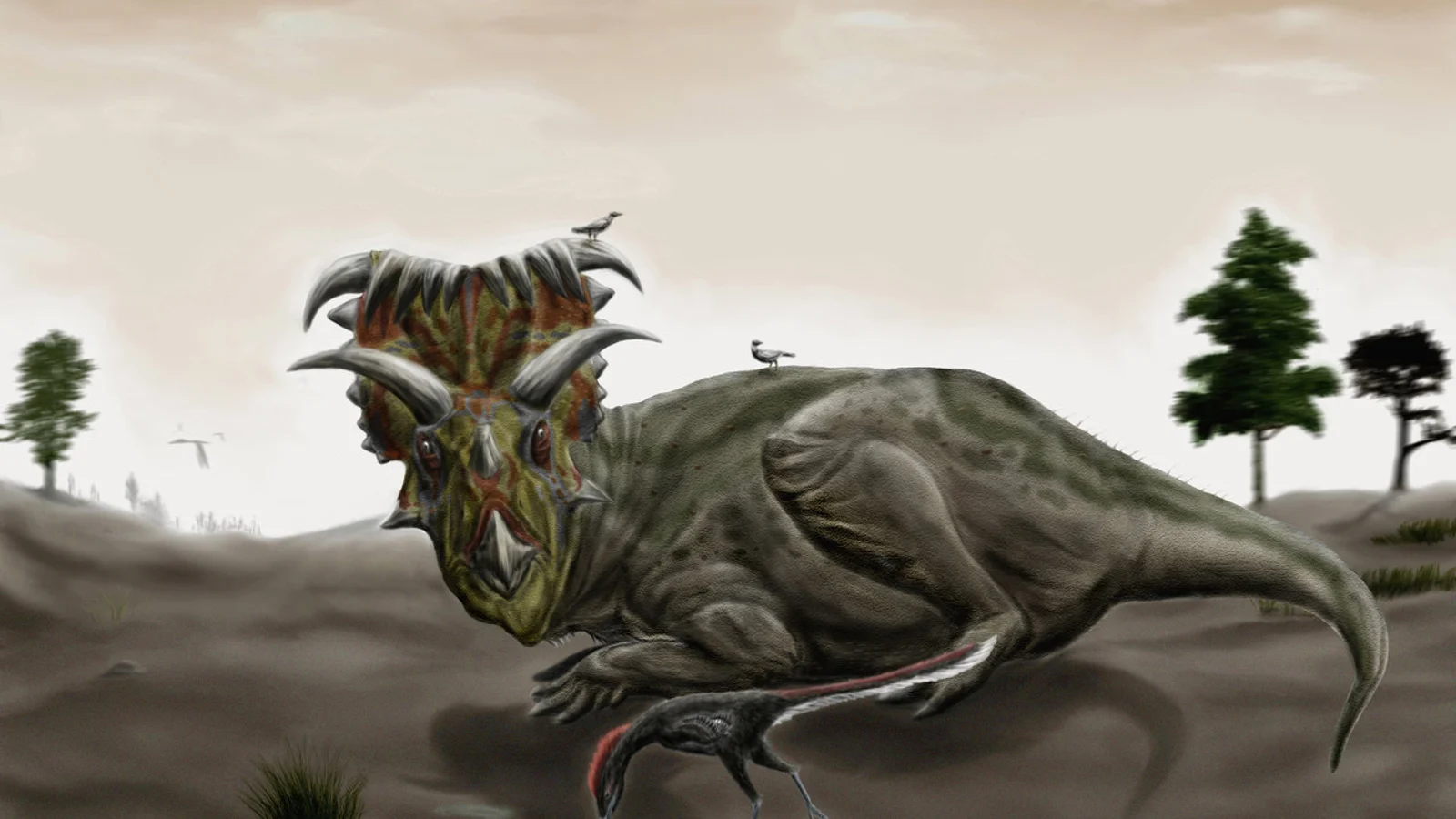
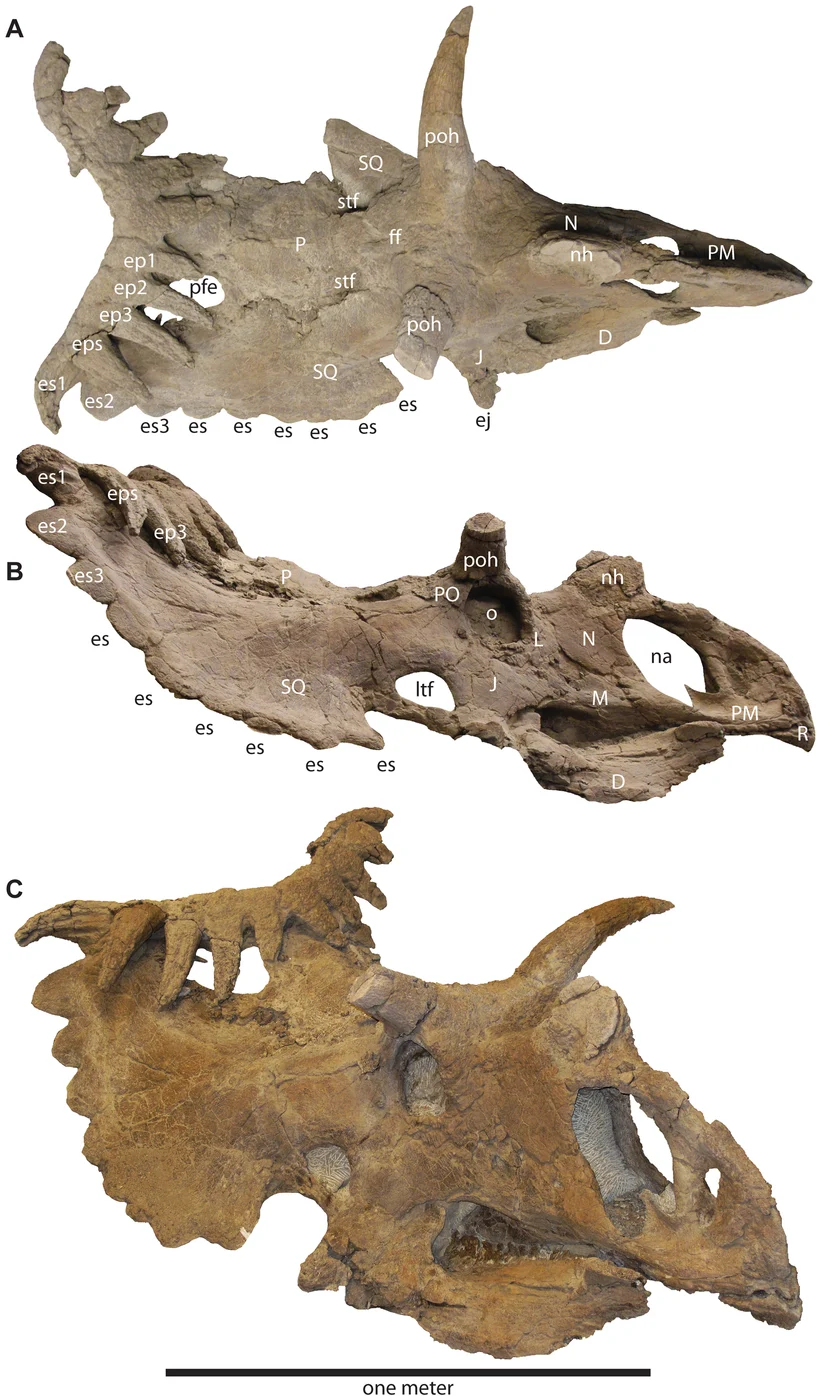
Kosmoceratops richardsoni was a medium-sized horned dinosaur from the late Campanian Kaiparowits Formation of southern Utah. Its nearly complete skull is one of the most elaborate known among dinosaurs: a blade-like nasal horn, sideways-projecting brow horns, cheek horns and ten curved ornaments around the short broad frill produce the often-quoted total of fifteen horns and spikes. A substantial partial skeleton accompanies the skull, making the animal far better known than many other recently named ceratopsids.
Its fossils occur between approximately 76.4 and 75.5 million years ago. Values shown here are approximate and reflect the current curated seed dataset.
Form and function
The skull approached two metres in length and carried a low blade-like nasal horn. The brow horns projected outward and downward rather than forward, while the cheek horns pointed laterally. Its frill was unusually short and wide for a chasmosaurine, with a row of ten hook-like epiossifications curving across and around its margin. The beaked jaws and closely packed dental batteries cropped and shredded plants. A heavy quadrupedal body, columnar limbs and a short tail are preserved or inferred from the associated skeleton and close relatives.
Evolutionary position
This simplified classification path shows one placement from Dinosauria to this species. Each step is clickable, and other analyses may support alternative relationships.
Open interactive positionScale
Simplified length comparison using preferred dataset estimates; body shape and posture are not represented.
Scientific record
Natural History Museum of Utah and Bureau of Land Management volunteer Scott Richardson found the first material in Grand Staircase–Escalante National Monument in 2006. Museum field crews excavated the fossils and prepared them in Salt Lake City. Scott Sampson and colleagues named Kosmoceratops richardsoni in 2010 from holotype UMNH VP 17000 and referred material. The genus combines Greek kosmos, ornamented, with ceratops, horned face; the species honours Richardson.
Discovery credit: Scott Richardson, Natural History Museum of Utah crews.
Naming authors: Scott D. Sampson, Mark A. Loewen, Andrew A. Farke and 4 coauthors.
Palaeoenvironment
The Kaiparowits Formation preserves humid coastal-plain rivers, ponds, wetlands and forests on southern Laramidia, the western landmass of Late Cretaceous North America. Kosmoceratops lived alongside Utahceratops, the hadrosaur Gryposaurus monumentensis, the tyrannosaur Teratophoneus and smaller theropods including Talos. The map marker represents the broad fossil-bearing plateau rather than a protected quarry coordinate.
Kosmoceratops was a low-browsing herbivore that cropped vegetation with a beak and processed it with dental batteries. Its elaborate frill and horns probably played an important visual role in recognizing species or signalling to other individuals; defence and physical competition are also possible. Their exact colours, sex differences and use in combat are unknown. No direct evidence demonstrates herd size or parental care.
Worth knowing
Fossil distribution
Grand Staircase–Escalante National Monument, southern Utah, United States
Kaiparowits Formation
regional marker
Markers are deliberately approximate. They identify published fossil areas without exposing sensitive excavation coordinates.
Open interactive mapFossil specimen record
Salt Lake City, United States
The museum houses holotype UMNH VP 17000 and the other described Kosmoceratops material; a reconstruction is displayed in the Past Worlds gallery.
A research repository is not necessarily a public exhibit. Loan and display status can change, so check with the institution before visiting.
Media record
Evidence
Scott D. Sampson, Mark A. Loewen, Andrew A. Farke and 4 coauthors · PLOS ONE 5(9), e12292 · 2010
Open sourceNatural History Museum of Utah
Open source