Hechuan type region
Hechuan District, Chongqing, China
Upper Shaximiao Formation
regional marker
Pronunciation: mah-MEN-chee-SORE-us hoh-chwan-EN-sis
A nearly complete Chinese sauropod famous for a neck about 9.5 metres long, an exceptional cervical series and a small fused structure at the end of its tail.
Last updated 16 July 2026
Field guide
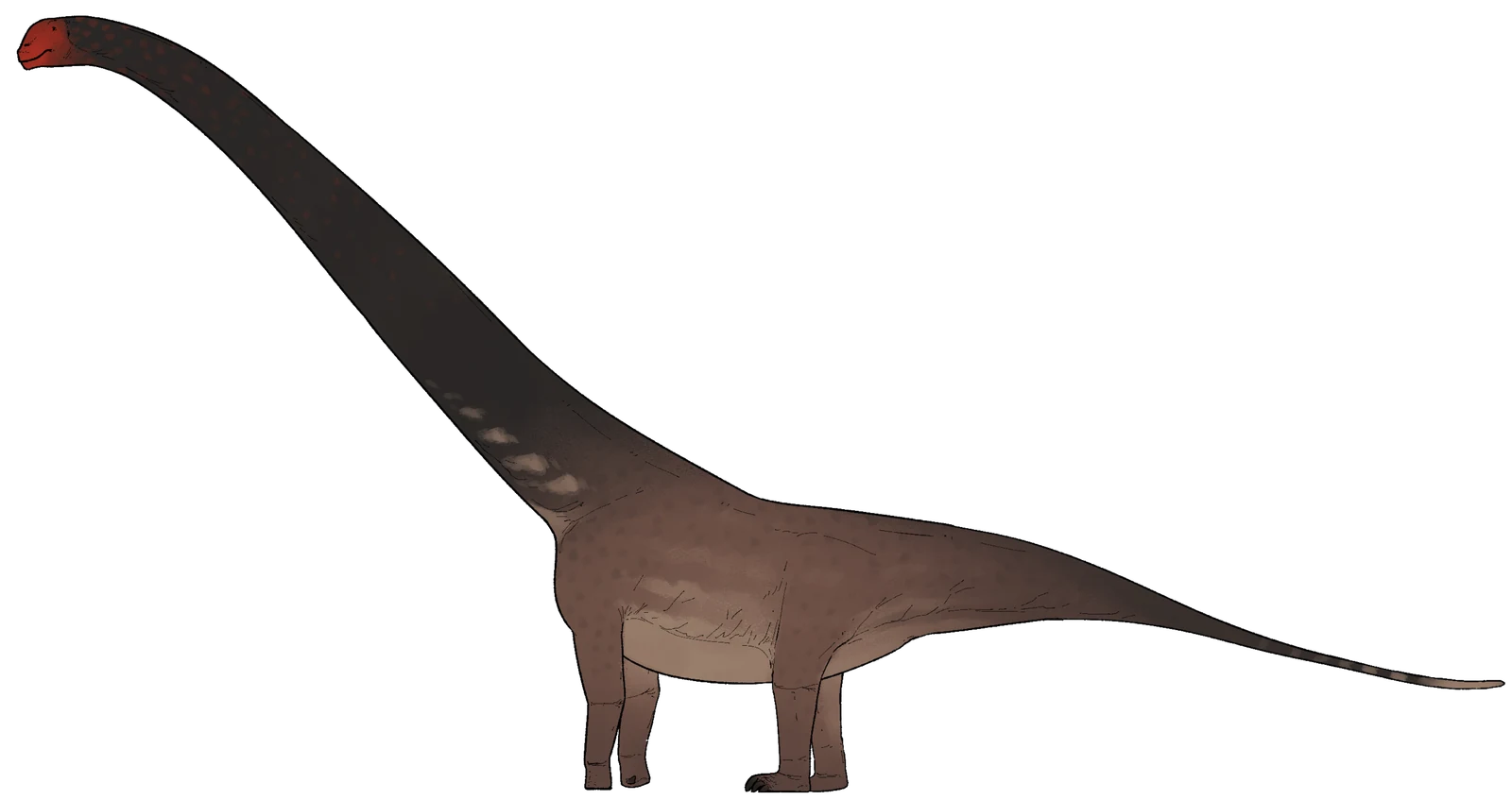
Mamenchisaurus hochuanensis was a very long-necked sauropod from the Upper Shaximiao Formation of southwestern China. Its holotype preserves an almost continuous articulated vertebral column and much of the limbs and girdles, making it far more informative than the fragmentary type species of Mamenchisaurus. The neck alone approached half the animal's total length. Although traditionally placed in the same genus, modern analyses warn that Mamenchisaurus has accumulated several anatomically different species and may require revision; M. hochuanensis nevertheless remains a well-defined and exceptionally complete animal in its own right.
Its fossils occur between approximately 159 and 150 million years ago. Values shown here are approximate and reflect the current curated seed dataset.
Form and function
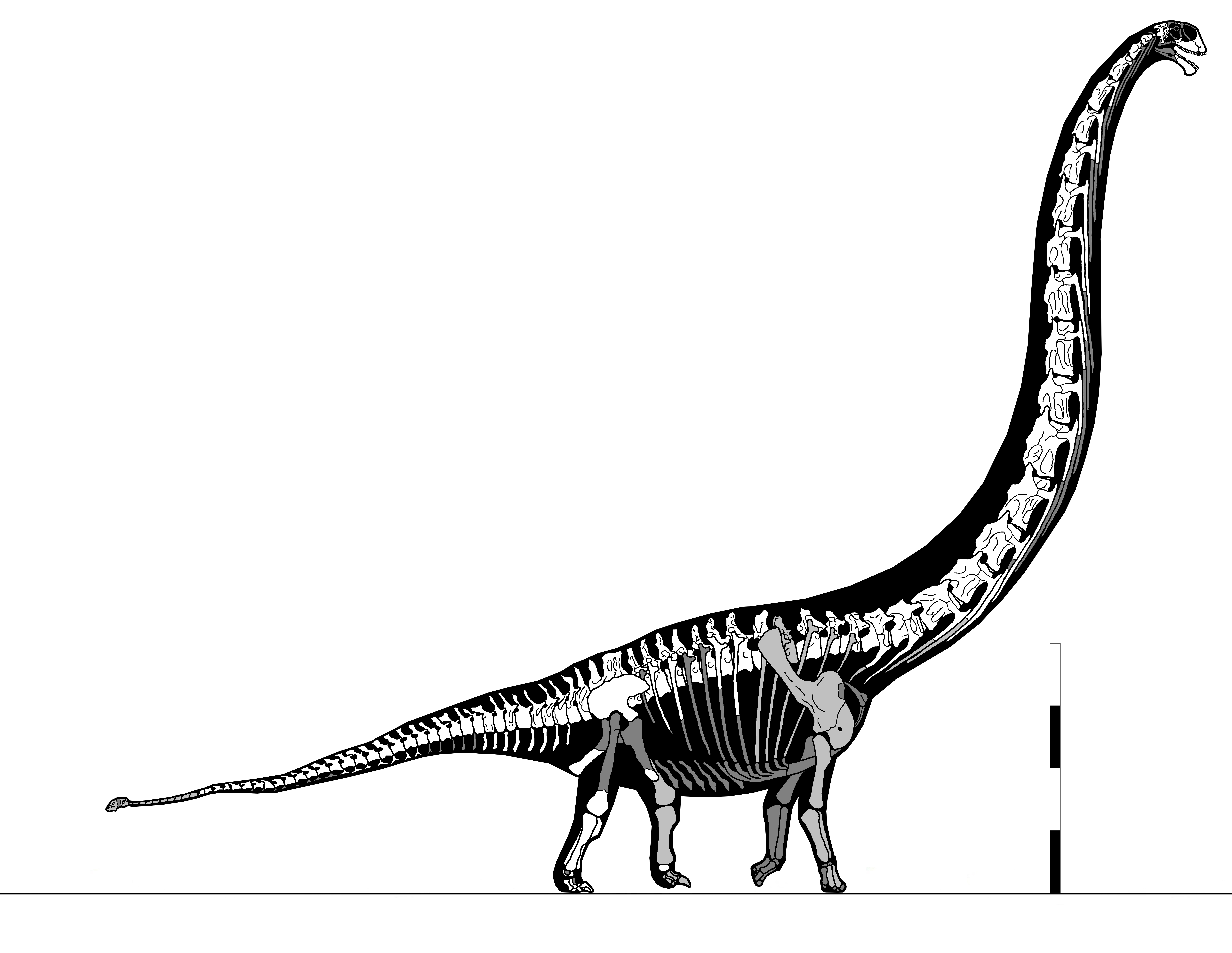
Holotype CCG V 20401 is a nearly complete skeleton lacking the skull and some extremities. Young and Zhao counted 19 elongated cervical vertebrae and estimated a neck about 9.3 to 9.5 metres long, although later researchers have questioned whether the final element should instead be the first dorsal vertebra. Air spaces lightened the neck bones, while extremely long overlapping cervical ribs helped brace the neck. The torso was compact beside the neck, the limbs were columnar, and the tail ended in four fused vertebrae with expanded arches that have often been called a small tail club.
Evolutionary position
This simplified classification path shows one placement from Dinosauria to this species. Each step is clickable, and other analyses may support alternative relationships.
Open interactive positionScale
Simplified length comparison using preferred dataset estimates; body shape and posture are not represented.
Scientific record
Local people had noticed bones on a slope above the Fu River near Taihe village in Hechuan, but they remained exposed until a Sichuan Provincial Museum team began excavation in 1957. Preparation and mounting were completed in 1965. C. C. Young and Xijin Zhao formally named Mamenchisaurus hochuanensis in 1972, using the older spelling Hochuan for today's Hechuan District. Additional material from the Upper Shaximiao Formation near Zigong includes another nearly complete skeleton and has helped test the anatomy seen in the holotype.
Discovery credit: Sichuan Provincial Museum field team.
Naming authors: C. C. Young, Xijin Zhao.
Palaeoenvironment
The Upper Shaximiao Formation records river channels, floodplains and lakes within the Sichuan Basin. Seasonal rainfall crossed a warm landscape supporting conifers, cycads, ferns and other plants. The wider formation preserves a diverse dinosaur fauna including other sauropods, stegosaurs and large theropods, but its long depositional interval means the named animals were not necessarily all neighbours at one moment.
Mamenchisaurus was a plant eater that could sweep a small head through a broad feeding envelope without moving its enormous body each time. The habitual height and flexibility of the neck remain debated; the bones do not support a single rigid giraffe-like pose or a permanently horizontal one. The fused tail tip may have served in defence, but it has also been discussed as pathology or a structure with another function. No direct evidence establishes herd size, parental care or mating displays for this species.
Worth knowing
Fossil distribution
Hechuan District, Chongqing, China
Upper Shaximiao Formation
regional marker
Sichuan Province, China
Upper Shaximiao Formation
regional marker
Markers are deliberately approximate. They identify published fossil areas without exposing sensitive excavation coordinates.
Open interactive mapFossil specimen record
Katsuyama, Fukui, Japan
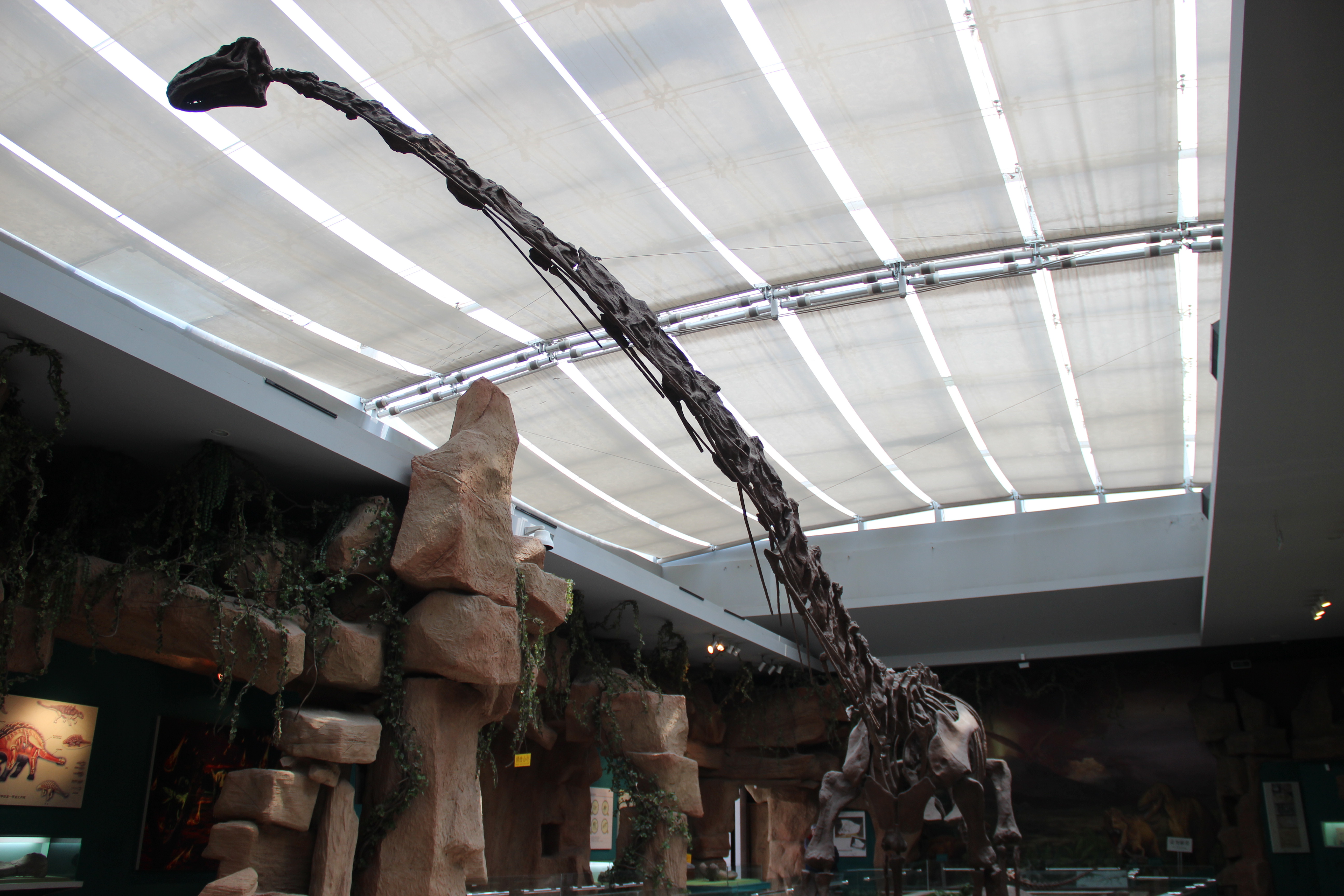
A full reconstructed mount used by the museum to explain the unusually long neck and cervical anatomy. It is a reconstruction rather than the Hechuan holotype.
A research repository is not necessarily a public exhibit. Loan and display status can change, so check with the institution before visiting.
Media record
Evidence
C. C. Young, Xijin Zhao · Institute of Vertebrate Paleontology and Paleoanthropology Monograph Series I, No. 8 · 1972
Open sourceMichael P. Taylor, Mathew J. Wedel · PeerJ 1 · 2013
Open sourceJun Wang, Mark A. Norell, Rui Pei and 2 coauthors · Cretaceous Research 104 · 2019
Open sourceFukui Prefectural Dinosaur Museum
Open source