Judith River–Missouri River fossil region
Chouteau County, central Montana, United States
Judith River Formation
regional marker
Pronunciation: mon-oh-KLOH-nee-us KRASS-us
A historically important but dubious centrosaurine name based on an incomplete frill bone from Montana and an original collection mixed from several animals.
Last updated 28 July 2026
Field guide
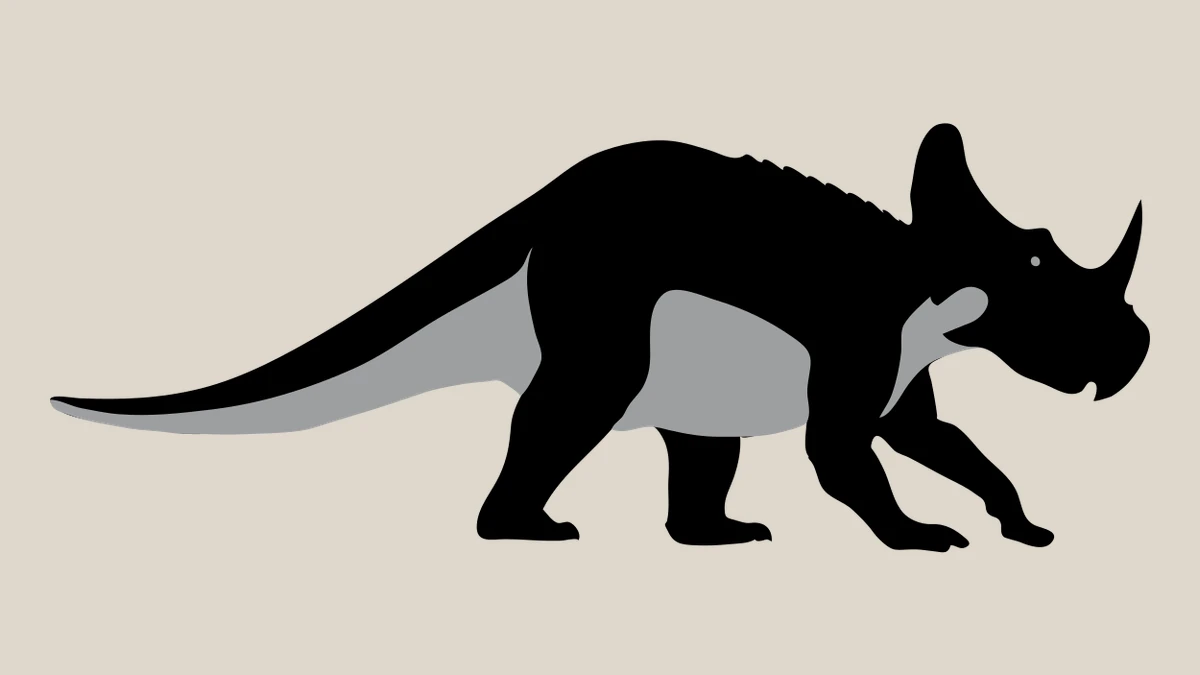
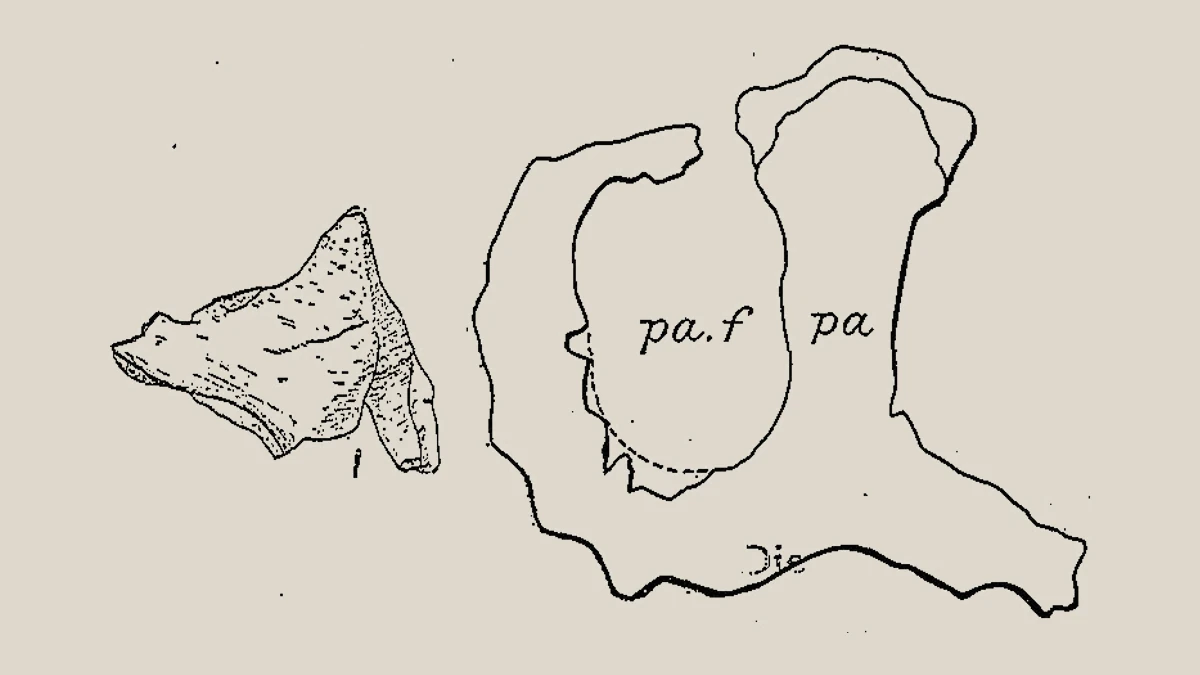
Monoclonius crassus was one of the first North American horned dinosaurs to be named, but it cannot presently be recognised as a distinct species. Edward Drinker Cope combined bones collected at several places near the Missouri and Judith rivers when he described it in 1876. Later study showed that the material represented more than one individual and that many bones could not be tied to the name-bearing specimen. The name is now anchored to a partial left parietal from the frill. That bone identifies a centrosaurine ceratopsid, but it lacks a unique combination of features that lets researchers match other skeletons to Monoclonius with confidence.
Its fossils occur between approximately 78.6 and 76.2 million years ago. Values shown here are approximate and reflect the current curated seed dataset.
Form and function
The only defensible basis for the species is an incomplete parietal, part of the bony neck frill. It is relatively thin and has a scalloped margin, but damage and incompleteness obscure potentially useful ornaments. A nasal horn base and numerous limb, pelvic and vertebral bones were historically catalogued with AMNH 3998, yet they came from a mixed collection and cannot all be shown to belong to the same animal. A complete Monoclonius skull, horn arrangement, body size and skeleton are therefore not scientifically established.
Evolutionary position
This simplified classification path shows one placement from Dinosauria to this species. Each step is clickable, and other analyses may support alternative relationships.
Open interactive positionScientific record
Edward Drinker Cope and Charles Hazelius Sternberg collected horned-dinosaur bones in Montana during the summer of 1876. Cope named Monoclonius crassus later that year, interpreting scattered bones from multiple sites as one species. The collection eventually entered the American Museum of Natural History as AMNH 3998. John Bell Hatcher re-examined it and recognised a composite of several animals; the 1907 Ceratopsia monograph selected a left parietal as the name-bearing element. Later authors debated whether it was distinct from Centrosaurus, but its limited anatomy has led most modern treatments to regard Monoclonius crassus as a nomen dubium.
Discovery credit: Edward Drinker Cope, Charles Hazelius Sternberg.
Naming authors: Edward Drinker Cope.
Palaeoenvironment
The Judith River Formation preserves river channels, floodplains, ponds and coastal lowlands west of the Western Interior Seaway. Conifers, flowering plants, ferns and other vegetation supported diverse horned dinosaurs, hadrosaurs and armoured dinosaurs, with tyrannosaurids among the large predators. Because the original Monoclonius collection mixed sites and individuals, a more precise habitat or community cannot be assigned to the name.
The lectotype preserves no direct evidence of behaviour. As a centrosaurine it almost certainly ate plants with a beak and dental batteries and walked on four limbs, but claims about herding, combat, preferred food or display patterns cannot be attached specifically to Monoclonius crassus. Historical reconstructions largely borrowed anatomy from better-known Centrosaurus specimens.
Worth knowing
Fossil distribution
Chouteau County, central Montana, United States
Judith River Formation
regional marker
Markers are deliberately approximate. They identify published fossil areas without exposing sensitive excavation coordinates.
Open interactive mapFossil specimen record
New York City, United States
Repository of the historical composite collection and the partial parietal that anchors Monoclonius crassus. It is research material and is not promised as a public gallery exhibit.
A research repository is not necessarily a public exhibit. Loan and display status can change, so check with the institution before visiting.
Media record
Evidence
John Bell Hatcher · U.S. Geological Survey Monograph 49 · 1907
Open sourceAmerican Museum of Natural History
Open sourceEdward Drinker Cope · Proceedings of the Academy of Natural Sciences of Philadelphia 28, 248–261 · 1876
Open sourceScott D. Sampson · Journal of Vertebrate Paleontology 15(4), 743–760 · 1995
Open source