Musango Concession, Lake Kariba
Mashonaland West, Zimbabwe
Pebbly Arkose Formation
regional marker
Pronunciation: moo-SANG-go mah-too-sah-doh-nah-EN-sis
A newly named, nearly grown Late Triassic sauropodomorph from Zimbabwe, known from a skull-less partial skeleton that survived a serious injury or infection.
Last updated 1 August 2026
Field guide
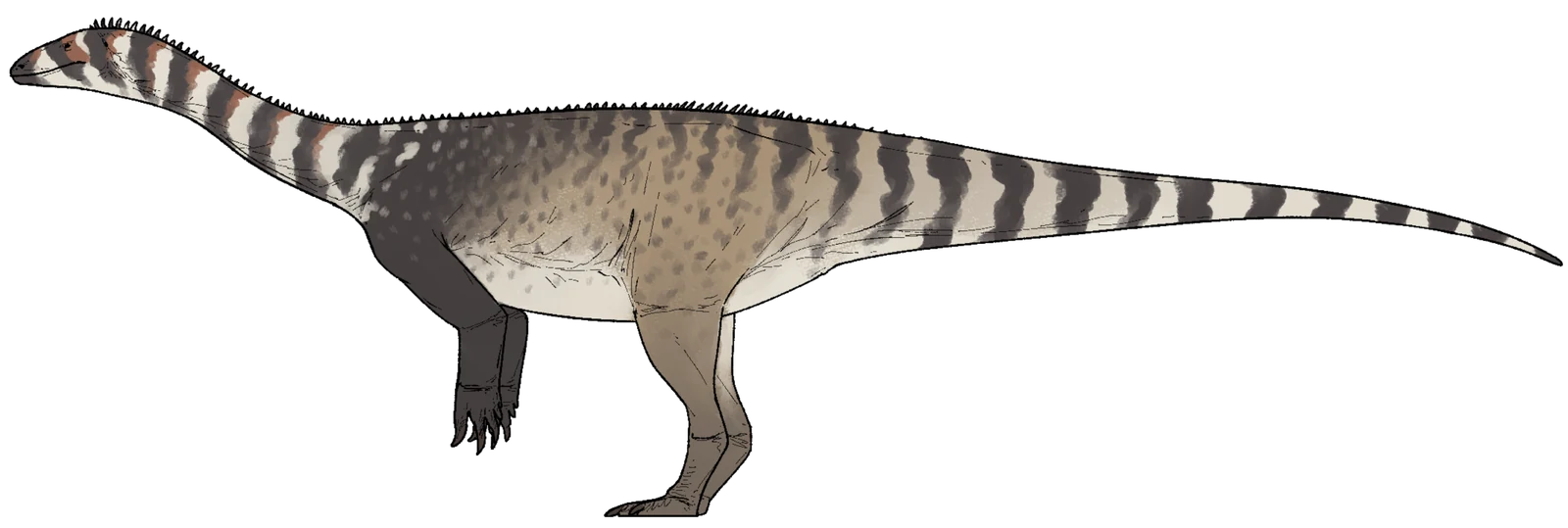
Musango matusadonaensis lived around 210 million years ago beside the rivers and streams that crossed what is now the Lake Kariba region of northern Zimbabwe. Its single known partial skeleton includes much of the spine, ribs, arms, legs and feet but no skull. The animal was about 4.5 metres long, weighed an estimated 222 kilograms and was approximately eight years old when it died. Bone growth shows it was close to adult size. Musango belonged to an early radiation of sauropodomorphs: the mostly plant-eating lineage that later produced giant, four-legged sauropods. The original study recovered it as an unaysaurid, though relationships among these early sauropodomorphs remain open to revision as new specimens and analyses appear.
Its fossils occur between approximately 211 and 209 million years ago. Values shown here are approximate and reflect the current curated seed dataset.
Form and function
The known skeleton preserves vertebrae and ribs from the trunk together with substantial parts of the forelimbs, hind limbs and feet. Its proportions indicate a long-necked animal that normally walked on two legs while retaining grasping hands. Microscopic growth evidence suggests an individual about eight years old and almost fully grown. Abnormal bone records a severe infection or injury that healed before death. Because the skull is absent, the head, teeth and precise feeding anatomy cannot be reconstructed directly from this individual.
Evolutionary position
This simplified classification path shows one placement from Dinosauria to this species. Each step is clickable, and other analyses may support alternative relationships.
Open interactive positionScale
Simplified length comparison using preferred dataset estimates; body shape and posture are not represented.
Scientific record
The partial skeleton was recovered from the Pebbly Arkose Formation in the remote Musango Concession on the shore of Lake Kariba. An international team led by Paul Barrett formally named the species in 2026. The genus uses the ChiShona word Musango, translated by the researchers as living in the bush, while the species name honours nearby Matusadona National Park. It is the fifth dinosaur species formally named from Zimbabwe.
Naming authors: Paul M. Barrett, Jennifer Botha, Lara Sciscio and 11 coauthors.
Palaeoenvironment
The Pebbly Arkose Formation preserves a Late Triassic landscape crossed by rivers and streams near the margin of the ancient Karoo basins. Musango shared this environment with lungfish, crocodile-like phytosaurs and other dinosaurs, including the Zimbabwean sauropodomorph Musankwa. The map marker represents the broad Musango and Lake Kariba region, not the exact excavation site.
Musango probably walked mainly on its hind legs and could use its hands to grasp vegetation or other food. Early sauropodomorphs are generally interpreted as predominantly plant-eating, but the missing skull means omnivory cannot be excluded for this species. No direct evidence currently establishes herd structure, nesting behaviour or display colours.
Worth knowing
Fossil distribution
Mashonaland West, Zimbabwe
Pebbly Arkose Formation
regional marker
Markers are deliberately approximate. They identify published fossil areas without exposing sensitive excavation coordinates.
Open interactive mapFossil specimen record
Bulawayo, Zimbabwe
Zimbabwe's national geology and palaeontology research collection is associated with the study. The public sources reviewed here do not provide the Musango specimen number or confirm that it is currently displayed.
A research repository is not necessarily a public exhibit. Loan and display status can change, so check with the institution before visiting.
Media record
Evidence
Paul M. Barrett, Jennifer Botha, Lara Sciscio and 11 coauthors · Journal of Systematic Palaeontology 24(2) · 2026
Open sourceNatural History Museum, London · Natural History Museum · 2026
Open sourceNatural History Museum of Zimbabwe
Open source