Ban Pha Nang Sua fossil locality
Nong Bua Rawe District, Chaiyaphum Province, Thailand
Khok Kruat Formation
regional marker
Pronunciation: NAH-gah-TIE-tan chai-yah-poom-EN-sis
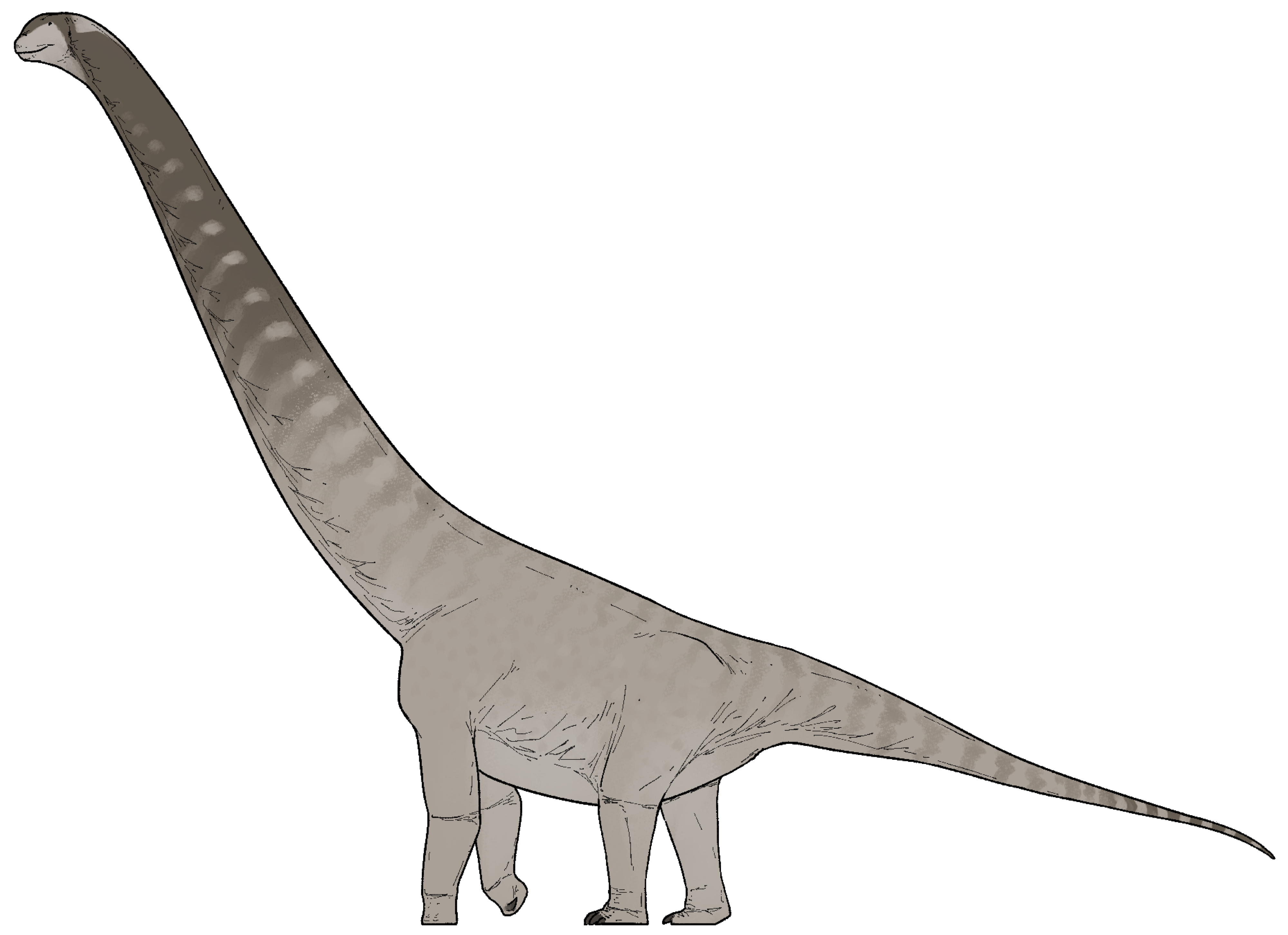
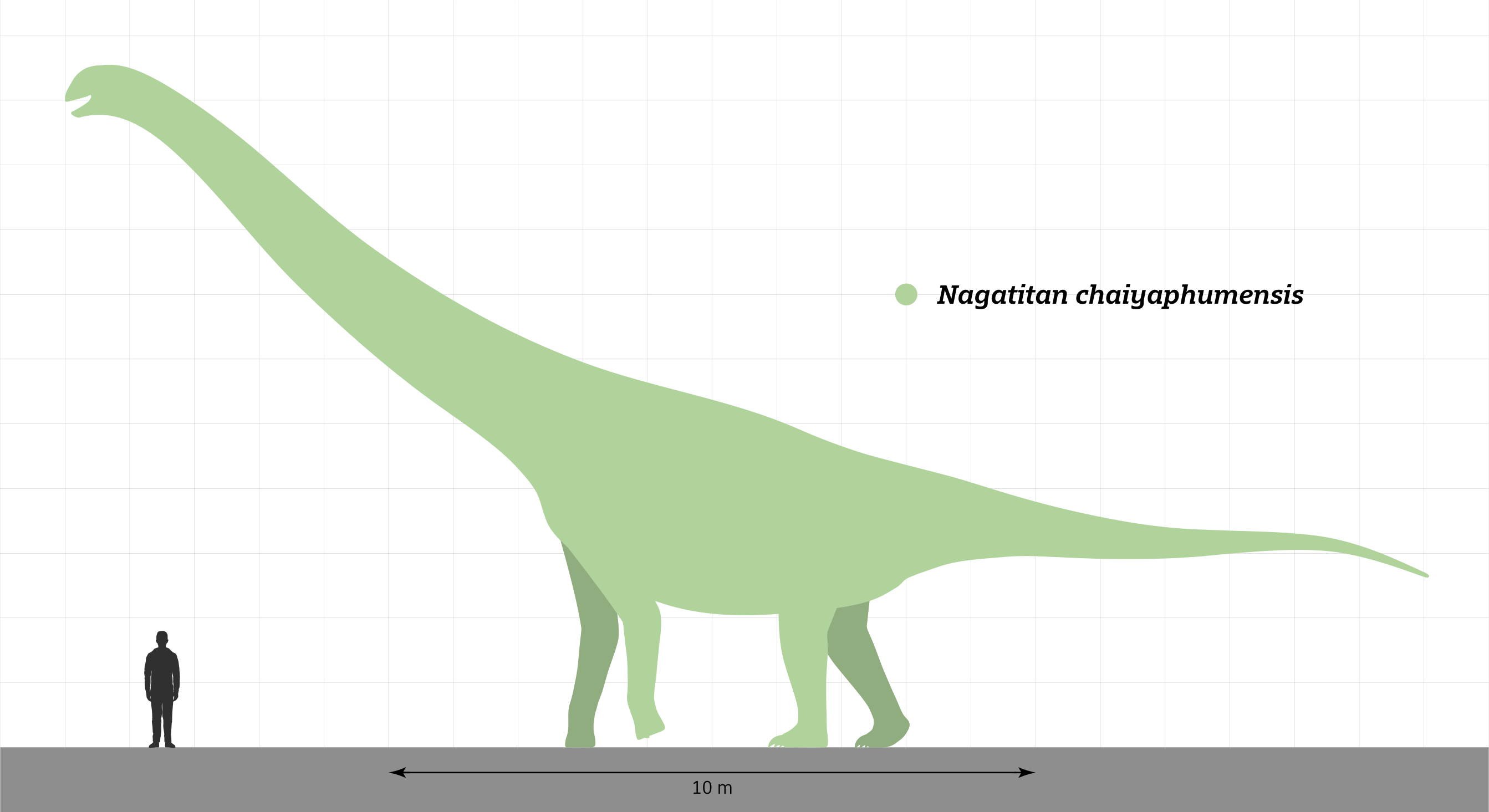
A gigantic Early Cretaceous sauropod from Thailand, represented by an associated partial skeleton and estimated at about 27 metres and 27 tonnes.
Last updated 16 July 2026
Field guide
Nagatitan chaiyaphumensis is the first diagnostic sauropod named from Thailand's Khok Kruat Formation and the largest dinosaur yet described from Southeast Asia. Four back vertebrae, ribs, part of the sacrum and pelvis, a humerus and an almost complete femur document one individual. The describing study recovered it as a euhelopodid somphospondylan, but not as an exclusively Southeast Asian branch with Phuwiangosaurus and Tangvayosaurus. Its immense size is reconstructed from limb-bone dimensions rather than a complete skeleton.
Its fossils occur between approximately 113 and 100.5 million years ago. Values shown here are approximate and reflect the current curated seed dataset.
Form and function
The holotype includes four dorsal vertebrae with changing accessory joint shapes along the back, five dorsal ribs, four sacral vertebrae and associated ribs, a 1.78-metre right humerus, the right ilium, both pubes and a mostly complete right femur reconstructed at roughly 1.9–2 metres. Two unique vertebral features and a distinctive combination of ridges, fossae, limb proportions and pelvic anatomy diagnose the species. Its skull, neck, forefeet, hind feet and tail are unknown.
Evolutionary position
This simplified classification path shows one placement from Dinosauria to this species. Each step is clickable, and other analyses may support alternative relationships.
Open interactive positionScale
Simplified length comparison using preferred dataset estimates; body shape and posture are not represented.
Scientific record
Local resident Thanom Luangnan noticed fossils exposed by low water at the edge of a communal pond near Ban Pha Nang Sua in 2016. Field teams excavated material from 2016 to 2019 and returned in 2024 to recover the remaining bones. Thitiwoot Sethapanichsakul and five colleagues named Nagatitan chaiyaphumensis in May 2026. Naga refers to a serpent-like figure in Asian traditions, especially northeastern Thai culture, titan evokes a giant, and the species name honours Chaiyaphum Province.
Discovery credit: Thanom Luangnan.
Naming authors: Thitiwoot Sethapanichsakul, Sasa-On Khansubha, Sita Manitkoon and 3 coauthors.
Palaeoenvironment
The Ban Pha Nang Sua sediments record a meandering river system crossing a semi-arid landscape. Seasonal low water exposed the fossil bed in modern times. Freshwater sharks, bivalves and teeth from spinosaurid and allosauroid theropods occur in nearby layers, although they are not evidence of direct interaction with the Nagatitan individual.
Its column-like limbs and sauropod relationships support four-legged locomotion and high-volume plant feeding. Neck posture, preferred vegetation, group size, migration and reproductive behaviour cannot be tested from the preserved postcranial bones. The Naga-inspired name does not imply an aquatic lifestyle.
Worth knowing
Fossil distribution
Nong Bua Rawe District, Chaiyaphum Province, Thailand
Khok Kruat Formation
regional marker
Markers are deliberately approximate. They identify published fossil areas without exposing sensitive excavation coordinates.
Open interactive mapFossil specimen record
Sahatsakhan, Thailand
Permanent repository of the original associated vertebrae, ribs, pelvic and limb bones. The paper verifies curation at the museum; continuous display of every original element is not promised.
A research repository is not necessarily a public exhibit. Loan and display status can change, so check with the institution before visiting.
Media record
Evidence
Thitiwoot Sethapanichsakul, Sasa-On Khansubha, Sita Manitkoon and 3 coauthors · Scientific Reports 16 · 2026
Open sourceUniversity College London · 2026
Open source