Kaiparowits Plateau fossil region
Grand Staircase–Escalante National Monument, Utah, United States
Kaiparowits Formation
regional marker
Pronunciation: nah-SOO-toh-SER-ah-tops TIT-us-eye
A Utah centrosaurine with an oversized nose, remarkably long forward-curving brow horns and a comparatively simple rounded frill.
Last updated 23 July 2026
Field guide
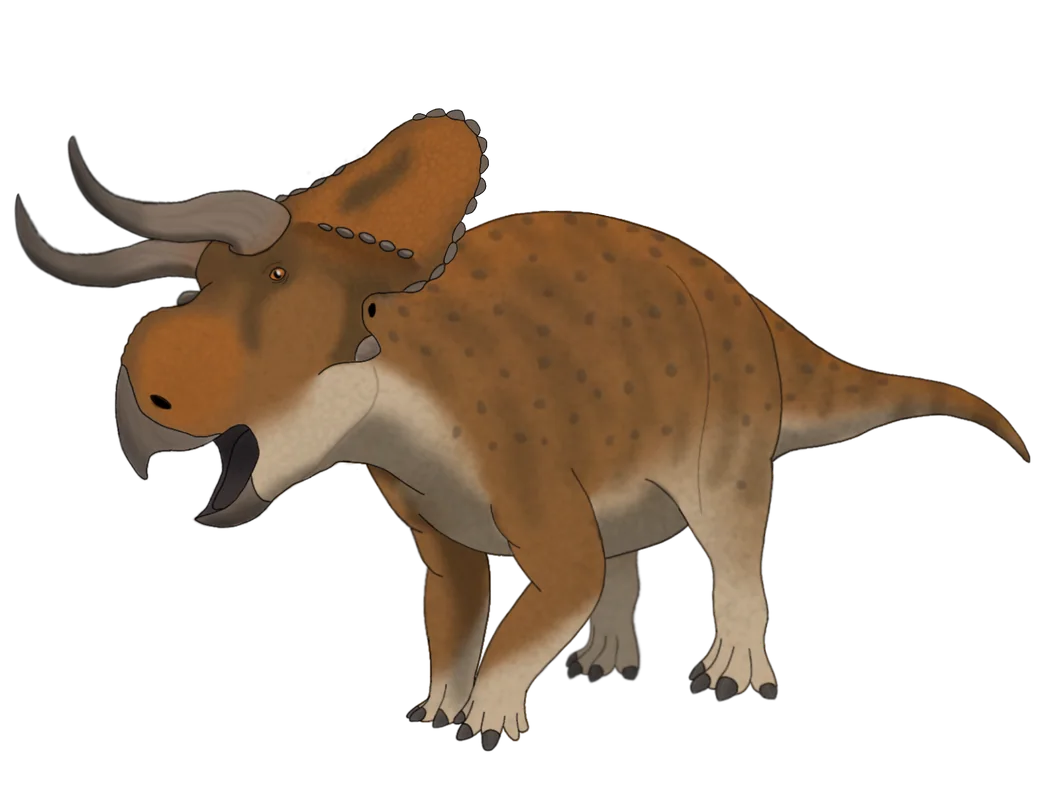
Nasutoceratops titusi was a large horned dinosaur from the Kaiparowits Formation of southern Utah. Its nearly complete skull combines features rarely seen together in centrosaurines: an enlarged, bulbous nasal region, a low blade-like nasal horn, exceptionally long brow horns that project outward and curve forward, and a short rounded frill with modest edge ornamentation. The holotype also preserves parts of the shoulder girdle and forelimbs, vertebrae and patches of skin impression. Nasutoceratops helped reveal a distinctive southern Laramidian radiation of centrosaurines during the Campanian.
Its fossils occur between approximately 76.4 and 75.5 million years ago. Values shown here are approximate and reflect the current curated seed dataset.
Form and function
The skull was short and deep, dominated by the expanded nasal bones and sweeping brow horns. Those horns extended laterally before curving forward, resembling the spread of cattle horns more than the short brow horns of most centrosaurines. The nasal horn was low and narrow, and the frill lacked the large spikes seen in Styracosaurus. A toothless beak cropped vegetation, while stacked replacement teeth formed dental batteries for slicing plant matter. Preserved skin impressions associated with the forelimb show polygonal scales, but they do not document the entire body's covering.
Evolutionary position
This simplified classification path shows one placement from Dinosauria to this species. Each step is clickable, and other analyses may support alternative relationships.
Open interactive positionScale
Simplified length comparison using preferred dataset estimates; body shape and posture are not represented.
Scientific record
University of Utah graduate student Eric Lund discovered the holotype UMNH VP 16800 in Grand Staircase–Escalante National Monument in 2006. Scott Sampson, Lund, Mark Loewen, Andrew Farke and Katherine Clayton formally named Nasutoceratops titusi in 2013. The genus combines Latin nasutus, large-nosed, with Greek ceratops, horned face. The species honours Alan Titus, the monument paleontologist who supported research in the region. The fossils are permanently housed at the Natural History Museum of Utah, where a reconstructed skull is displayed.
Naming authors: Scott D. Sampson, Eric K. Lund, Mark A. Loewen and 2 coauthors.
Palaeoenvironment
The Kaiparowits Formation records a humid, subtropical coastal plain threaded by large rivers and wetlands on southern Laramidia. Nasutoceratops lived alongside hadrosaurs, ankylosaurs, small ornithischians, tyrannosaurs and several other ceratopsids. Its fossils come from protected public land; the map therefore marks only the broad, publicly documented plateau rather than a quarry coordinate.
Nasutoceratops was a quadrupedal plant eater that cropped vegetation with its beak and processed it with dental batteries. Its spectacular horns were probably important visual signals and may also have been used in contests, but neither behaviour is directly preserved. The enlarged nose housed an expanded nasal cavity; proposals involving enhanced smell or sound remain uncertain. Several individuals are known, yet they do not demonstrate herding.
Worth knowing
Fossil distribution
Grand Staircase–Escalante National Monument, Utah, United States
Kaiparowits Formation
regional marker
Markers are deliberately approximate. They identify published fossil areas without exposing sensitive excavation coordinates.
Open interactive mapFossil specimen record
Salt Lake City, United States
NHMU permanently houses all definitive Nasutoceratops material, including holotype UMNH VP 16800, and displays a reconstructed skull.
A research repository is not necessarily a public exhibit. Loan and display status can change, so check with the institution before visiting.
Media record
Evidence
Scott D. Sampson, Eric K. Lund, Mark A. Loewen and 2 coauthors · Proceedings of the Royal Society B 280, 20131186 · 2013
Open sourceEric K. Lund, Patrick M. O'Connor, Mark A. Loewen, Zubair A. Jinnah · Journal of Vertebrate Paleontology 36(2), e1054936 · 2016
Open sourceNatural History Museum of Utah
Open source