Gadoufaoua fossil region
Ténéré Desert, Agadez Region, Niger
Elrhaz Formation
regional marker
Pronunciation: NYE-jer-SORE-us tah-KAY-tie
A small, short-necked sauropod with a broad downturned muzzle, extremely delicate skull and more than 500 continually replacing teeth.
Last updated 23 July 2026
Field guide
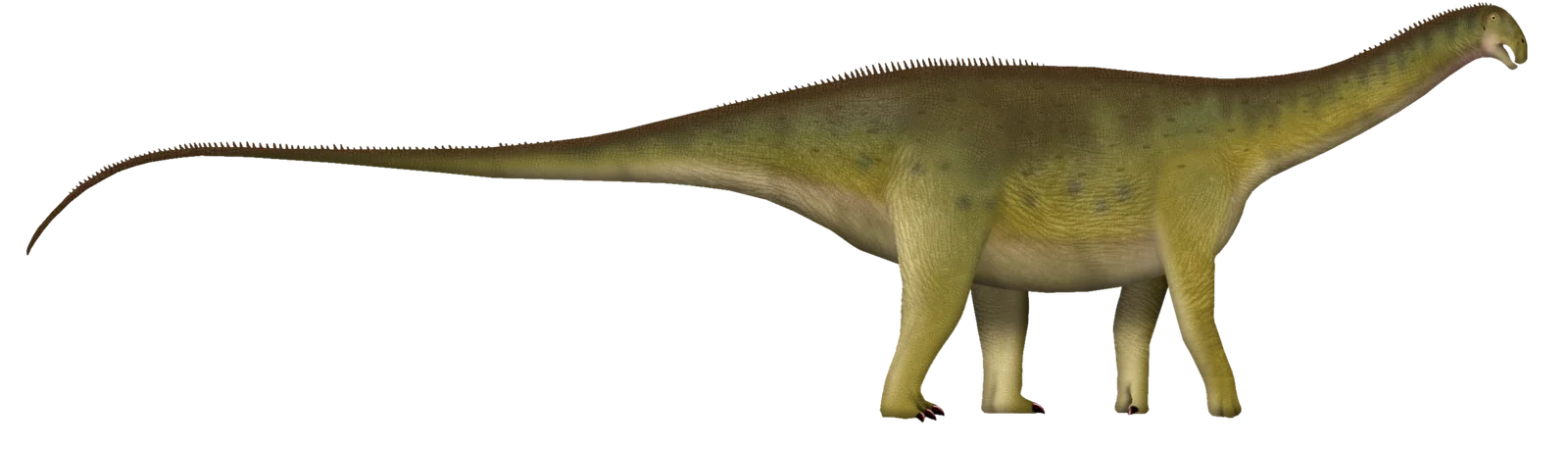
Nigersaurus taqueti was a highly specialized rebbachisaurid sauropod from the Early Cretaceous Elrhaz Formation of Niger. Its skull was lighter and more open than that of almost any other dinosaur, yet the front of its squared muzzle housed tightly packed dental batteries containing hundreds of replacement teeth. All active teeth were concentrated across the front edge of the jaws. CT scans helped researchers reconstruct the fragile skull and inner ear, showing an animal adapted for repeatedly cropping vegetation close to ground level. At about nine metres long, Nigersaurus was modest in size for a sauropod.
Its fossils occur between approximately 115 and 105 million years ago. Values shown here are approximate and reflect the current curated seed dataset.
Form and function
The broad muzzle was wider than the back of the skull and carried all tooth positions along its front margin. Each narrow working tooth was backed by a column of replacements; across the jaws the animal held more than five hundred active and replacement teeth. Individual teeth were replaced roughly monthly. Large openings and paper-thin struts made the skull exceptionally light. The neck contained only thirteen vertebrae and remained short for a sauropod. Air-filled spaces occupied much of the presacral vertebrae, and the limbs were relatively slender.
Evolutionary position
This simplified classification path shows one placement from Dinosauria to this species. Each step is clickable, and other analyses may support alternative relationships.
Open interactive positionScale
Simplified length comparison using preferred dataset estimates; body shape and posture are not represented.
Scientific record
Philippe Taquet's expeditions recovered the first recognizable material from Gadoufaoua in the 1960s and 1970s, but the fragile bones were initially difficult to interpret. Paul Sereno and ten colleagues named Nigersaurus taqueti in 1999 from material including holotype MNN GAD512. Expeditions in 1997 and 2000 recovered more skull and skeletal remains. In 2007, Sereno and colleagues published a detailed digital reconstruction based on CT scanning. The genus honours the Republic of Niger and the species honours Taquet.
Naming authors: Paul C. Sereno, Allison L. Beck, Didier B. Dutheil and 8 coauthors.
Palaeoenvironment
The Elrhaz Formation at Gadoufaoua represents river channels and vegetated floodplains in what is now the Ténéré Desert. Nigersaurus lived alongside the sauropod Jobaria, the herbivores Ouranosaurus and Lurdusaurus, the spinosaurid Suchomimus, crocodyliforms, turtles and fish. The modern desert landscape should not be mistaken for its Cretaceous environment.
Nigersaurus was a quadrupedal herbivore specialized for cropping low vegetation. Its broad muzzle could gather many small plants at once, while rapid tooth replacement compensated for heavy wear. Inner-ear orientation and muzzle anatomy support habitual low browsing, but they do not prove that the neck was permanently held downward. No direct evidence establishes herding, daily feeding schedule or preferred plant species.
Worth knowing
Fossil distribution
Ténéré Desert, Agadez Region, Niger
Elrhaz Formation
regional marker
Markers are deliberately approximate. They identify published fossil areas without exposing sensitive excavation coordinates.
Open interactive mapFossil specimen record
Niamey, Niger
The national collection houses holotype MNN GAD512 and other original Nigersaurus material from Gadoufaoua.
A research repository is not necessarily a public exhibit. Loan and display status can change, so check with the institution before visiting.
Media record
Evidence
Paul C. Sereno, Allison L. Beck, Didier B. Dutheil and 8 coauthors · Science 286(5443), 1342–1347 · 1999
Open sourcePaul C. Sereno, Jeffrey A. Wilson, Lawrence M. Witmer and 4 coauthors · PLOS ONE 2(11), e1230 · 2007
Open sourceDigital Morphology, University of Texas at Austin
Open source