Drumheller–Horseshoe Canyon fossil region
Alberta, Canada
Horseshoe Canyon Formation
regional marker
Pronunciation: or-NITH-oh-MY-mus ed-mon-TON-ih-kus
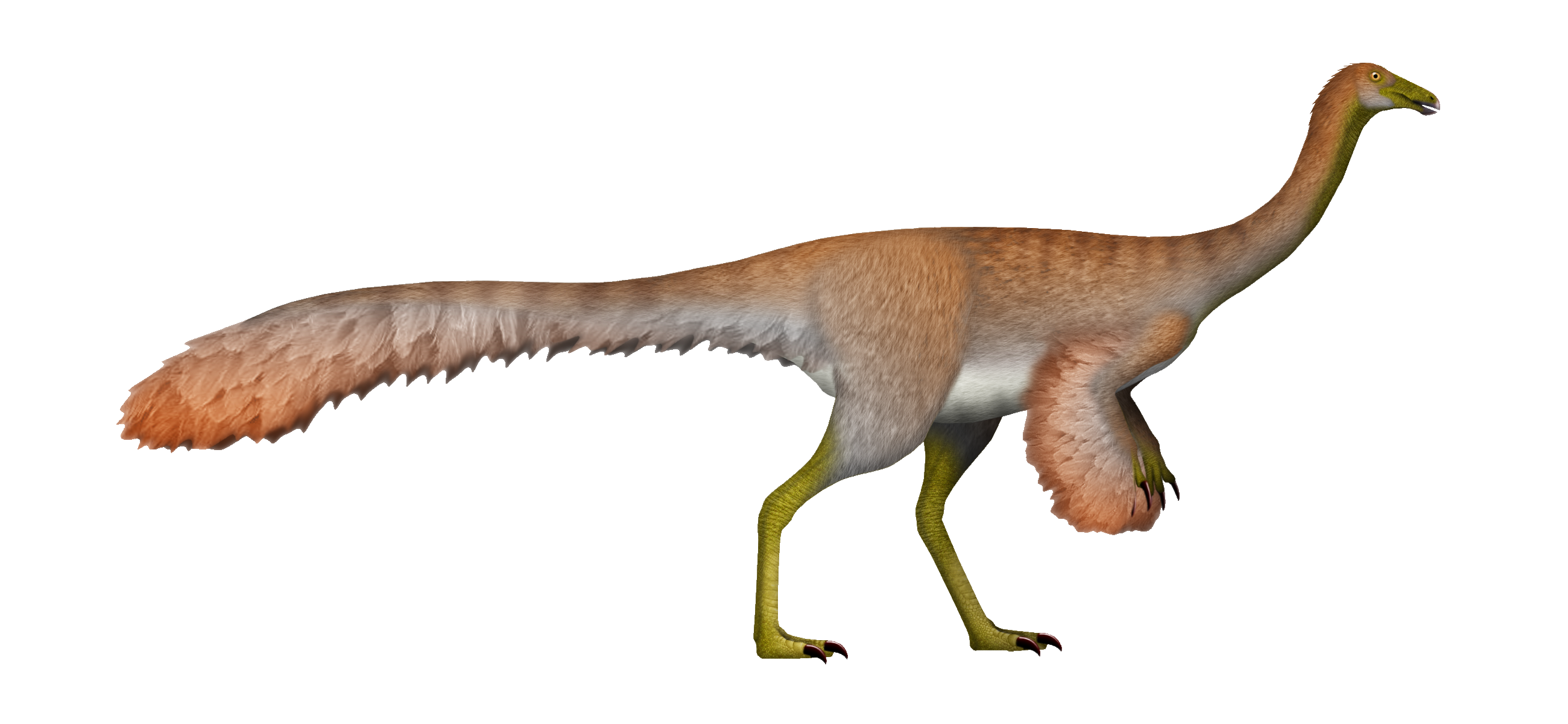
A long-legged Canadian ornithomimid known from complete skeletons and fossils preserving a shaggy coat and adult wing-like arm feathers.
Last updated 26 July 2026
Field guide
Ornithomimus edmontonicus was an ostrich-like theropod from the latest Cretaceous of Alberta. Its small toothless head, long neck, slender limbs and three-toed feet formed a lightweight body suited to rapid terrestrial movement. Fossils described in 2012 preserve filamentous body feathers in young and adult animals, while mature individuals carried longer, wing-like feathers on the forearms. These flightless structures may have served display or brooding.
Its fossils occur between approximately 72.5 and 66 million years ago. Values shown here are approximate and reflect the current curated seed dataset.
Form and function
The narrow skull ended in a toothless keratinous beak. Large eyes, a flexible neck, long arms with three slender fingers and extremely elongated hind limbs gave it an avian silhouette. Hollow bones reduced weight. Filamentous feathers covered much of the body, and adults developed pennibrachia—wing-like forearms that could not power flight.
Evolutionary position
This simplified classification path shows one placement from Dinosauria to this species. Each step is clickable, and other analyses may support alternative relationships.
Open interactive positionScale
Simplified length comparison using preferred dataset estimates; body shape and posture are not represented.
Scientific record
Charles M. Sternberg collected a nearly complete skeleton, CMN 8632, from the Horseshoe Canyon Formation in Alberta in 1914 and named Ornithomimus edmontonicus in 1933. Several specimens were later separated as Dromiceiomimus, but many researchers now regard that genus as indistinguishable from Ornithomimus. Alberta discoveries reported in 2012 provided the first feather evidence for ornithomimosaurs.
Discovery credit: Charles M. Sternberg.
Naming authors: Charles M. Sternberg.
Palaeoenvironment
Ornithomimus occupied coastal floodplains, river channels and wooded environments in Late Cretaceous Alberta. It shared these landscapes with hadrosaurs, ceratopsians, ankylosaurs and tyrannosaurids.
Its long legs indicate efficient running, although a precise top speed cannot be calculated. The toothless beak and generalized body plan are compatible with omnivory, but direct dietary evidence is limited. Adult-only arm fans may have been used for display, brooding or balance.
Worth knowing
Fossil distribution
Alberta, Canada
Horseshoe Canyon Formation
regional marker
Markers are deliberately approximate. They identify published fossil areas without exposing sensitive excavation coordinates.
Open interactive mapFossil specimen record
Ottawa, Canada
The museum houses holotype CMN 8632, a nearly complete skeleton collected by Charles M. Sternberg.
A research repository is not necessarily a public exhibit. Loan and display status can change, so check with the institution before visiting.
Media record
Evidence
Darla K. Zelenitsky, François Therrien, Gregory M. Erickson and 4 coauthors · Science 338(6106), 510–514 · 2012
Open sourceCanadian Museum of Nature
Open source