Hell Creek fossil region
Eastern Montana, United States
Hell Creek Formation
regional marker
Pronunciation: PAK-ee-sef-ah-loh-SORE-us why-oh-ming-EN-sis
The largest well-known dome-headed dinosaur, from the latest Cretaceous of the western United States. Adult skulls carry a massive rounded dome and a fringe of blunt nodes, but much of the body remains reconstructed from incomplete skeletons and close relatives.
Last updated 13 July 2026
Field guide
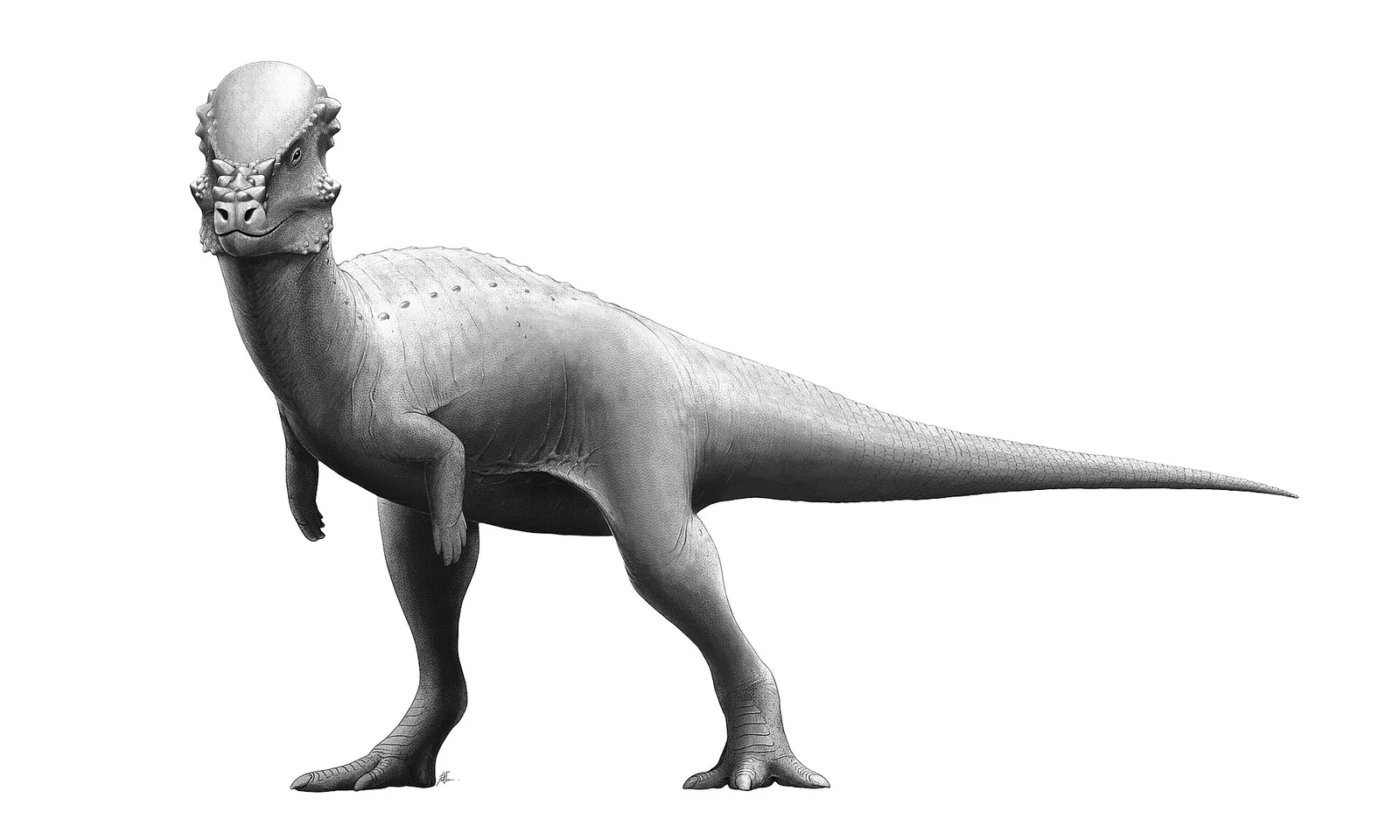
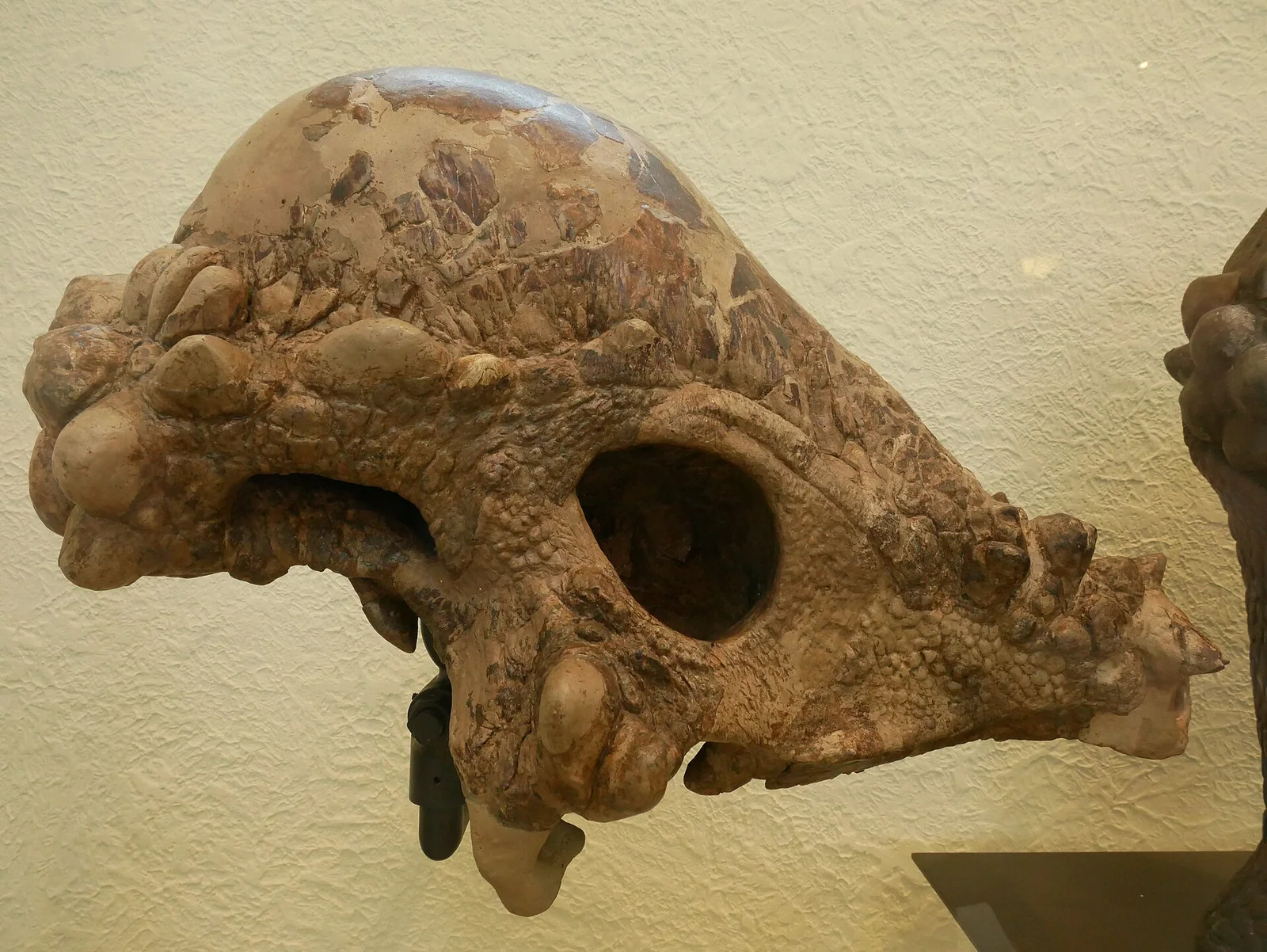
Pachycephalosaurus wyomingensis was a bipedal pachycephalosaurid from the Hell Creek and Lance formations near the end of the Cretaceous. Its adult skull roof expanded into an exceptionally thick dome built chiefly from fused frontal and parietal bones, surrounded by knobs and short spikes. The skull is much better represented than the rest of the skeleton, so full-body restorations remain composite. Histology and CT evidence led to an influential hypothesis that the flat-headed Dracorex and spike-fringed Stygimoloch are juvenile and subadult stages of Pachycephalosaurus. That model explains dramatic skull change during growth, but not every researcher treats the proposed synonymy as settled.
Its fossils occur between approximately 68 and 66 million years ago. Values shown here are approximate and reflect the current curated seed dataset.
Form and function
The adult frontals and parietals fused into a tall, solid cranial dome, while the rear and sides of the skull carried clusters of rounded nodes and shortened horn-like projections. Large eye sockets faced partly sideways, and a narrow beak ended the snout. Small leaf-shaped cheek teeth suit plant processing, but sharper, serrated teeth toward the front of the mouth complicate a strictly herbivorous reconstruction. The animal walked on long hind limbs and had a stiffening tail, short forelimbs and a relatively deep torso. Because no single universally accepted specimen preserves the whole body, many postcranial proportions are inferred from partial remains and other pachycephalosaurids.
Evolutionary position
This simplified classification path shows one placement from Dinosauria to this species. Each step is clickable, and other analyses may support alternative relationships.
Open interactive positionScale
Simplified length comparison using preferred dataset estimates; body shape and posture are not represented.
Scientific record
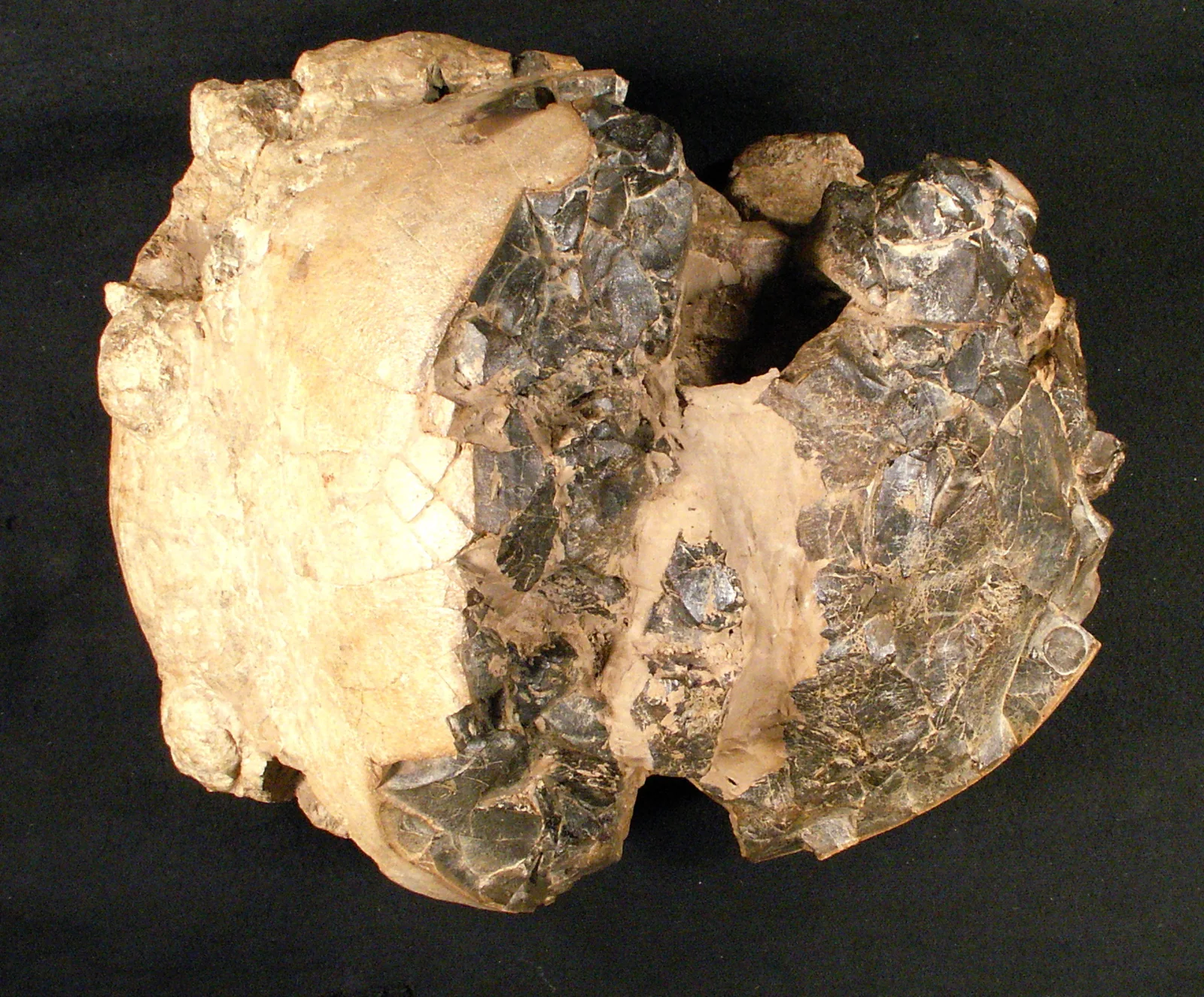
George F. Sternberg collected the partial domed skull USNM 12031 from the Lance Formation of Niobrara County, Wyoming, on 25 August 1930. Charles W. Gilmore named it Troodon wyomingensis in 1931, when dome-headed dinosaurs and the tooth-based Troodon were mistakenly grouped together. Barnum Brown and Erich Schlaikjer established Pachycephalosaurus in 1943 from the nearly complete adult skull AMNH 1696, naming it P. grangeri and transferring Gilmore’s older species into the genus. Later revision treated P. grangeri and P. reinheimeri as younger names for P. wyomingensis, leaving one generally recognized species.
Discovery credit: George F. Sternberg.
Naming authors: Charles W. Gilmore.
Palaeoenvironment
Pachycephalosaurus lived on the latest Maastrichtian coastal plain represented by the Hell Creek and Lance formations. Meandering rivers crossed wooded floodplains with ponds, wetlands and seasonally drier ground. Flowering plants, conifers, ferns and low vegetation supported a diverse herbivore fauna including Triceratops, Edmontosaurus, Thescelosaurus and Ankylosaurus. Tyrannosaurus occupied the role of largest predator. The known localities span parts of present-day Montana and Wyoming rather than one narrowly defined habitat patch.
Plants were probably the main food, based on the beak and cheek teeth, but the pointed front teeth leave occasional animal matter or a broader omnivorous diet possible; no gut contents decide the issue. The dome’s function remains one of dinosaur palaeobiology’s best-known debates. Finite-element models show that a dome could dissipate substantial low-speed impact forces, and healed cranial lesions cluster on the tops of many pachycephalosaurid domes. Histological work and the rounded impact surface have instead been used to question repeated high-speed head-on ramming. Display, pushing, flank strikes and lower-energy head contact are not mutually exclusive possibilities.
Worth knowing
Fossil distribution
Eastern Montana, United States
Hell Creek Formation
regional marker
Niobrara County, Wyoming, United States
Lance Formation
regional marker
Markers are deliberately approximate. They identify published fossil areas without exposing sensitive excavation coordinates.
Open interactive mapFossil specimen record
New York, United States
The real Pachycephalosaurus wyomingensis skull AMNH 1696 is currently listed among the hall’s accessible objects. Collected near Ekalaka, Montana, in 1940, it was originally the type of P. grangeri and now represents the most complete familiar adult skull of P. wyomingensis.
Washington, D.C., United States
Repository of holotype USNM 12031, the anterior part of a domed skull collected by George F. Sternberg from the Lance Formation in 1930. The current collection record verifies the specimen, locality and type status; continuous public display is not confirmed.
A research repository is not necessarily a public exhibit. Loan and display status can change, so check with the institution before visiting.
Media record
Evidence
Charles W. Gilmore · Proceedings of the United States National Museum · 1931
Open sourceBarnum Brown, Erich M. Schlaikjer · Bulletin of the American Museum of Natural History · 1943
Open sourceJohn R. Horner, Mark B. Goodwin · PLOS ONE · 2009
Open sourceEric Snively, Andrew Cox · Palaeontologia Electronica · 2008
Open sourceJoseph E. Peterson, Collin Dischler, Nicholas R. Longrich · PLOS ONE · 2013
Open sourceSmithsonian National Museum of Natural History
Open sourceAmerican Museum of Natural History
Open source