Little Bow River type region
Southern Alberta, Canada
Horseshoe Canyon Formation
regional marker
Pronunciation: PAK-ee-rye-noh-SORE-us kan-ah-DEN-sis
A large Canadian centrosaurine whose nose carried a broad roughened boss instead of a conventional horn, known from multiple partial skulls and regional bonebeds.
Last updated 16 July 2026
Field guide
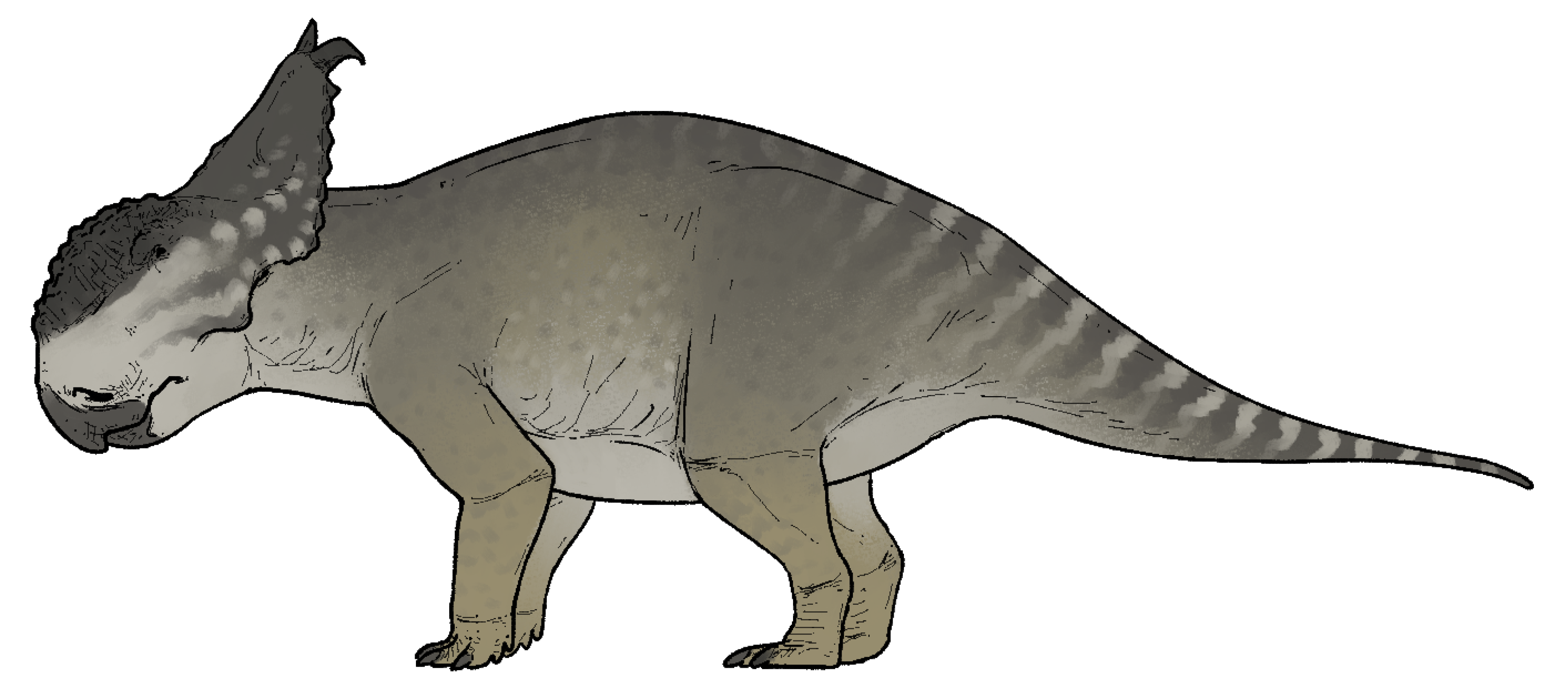
Pachyrhinosaurus canadensis was a robust horned dinosaur from southern Alberta near the end of the Cretaceous. Unlike Triceratops, it belonged to the short-frilled centrosaurine branch of ceratopsids. Mature skulls replaced the familiar nasal horn with a broad, roughened bony boss and carried additional bosses above the eyes. These surfaces supported keratin in life, but whether that covering formed pads, low domes or taller horn-like structures is unknown. P. canadensis is the type and geologically youngest named Canadian species of Pachyrhinosaurus; the famous Pipestone Creek mass-death assemblage belongs to the distinct species P. lakustai.
Its fossils occur between approximately 73.1 and 71.5 million years ago. Values shown here are approximate and reflect the current curated seed dataset.
Form and function
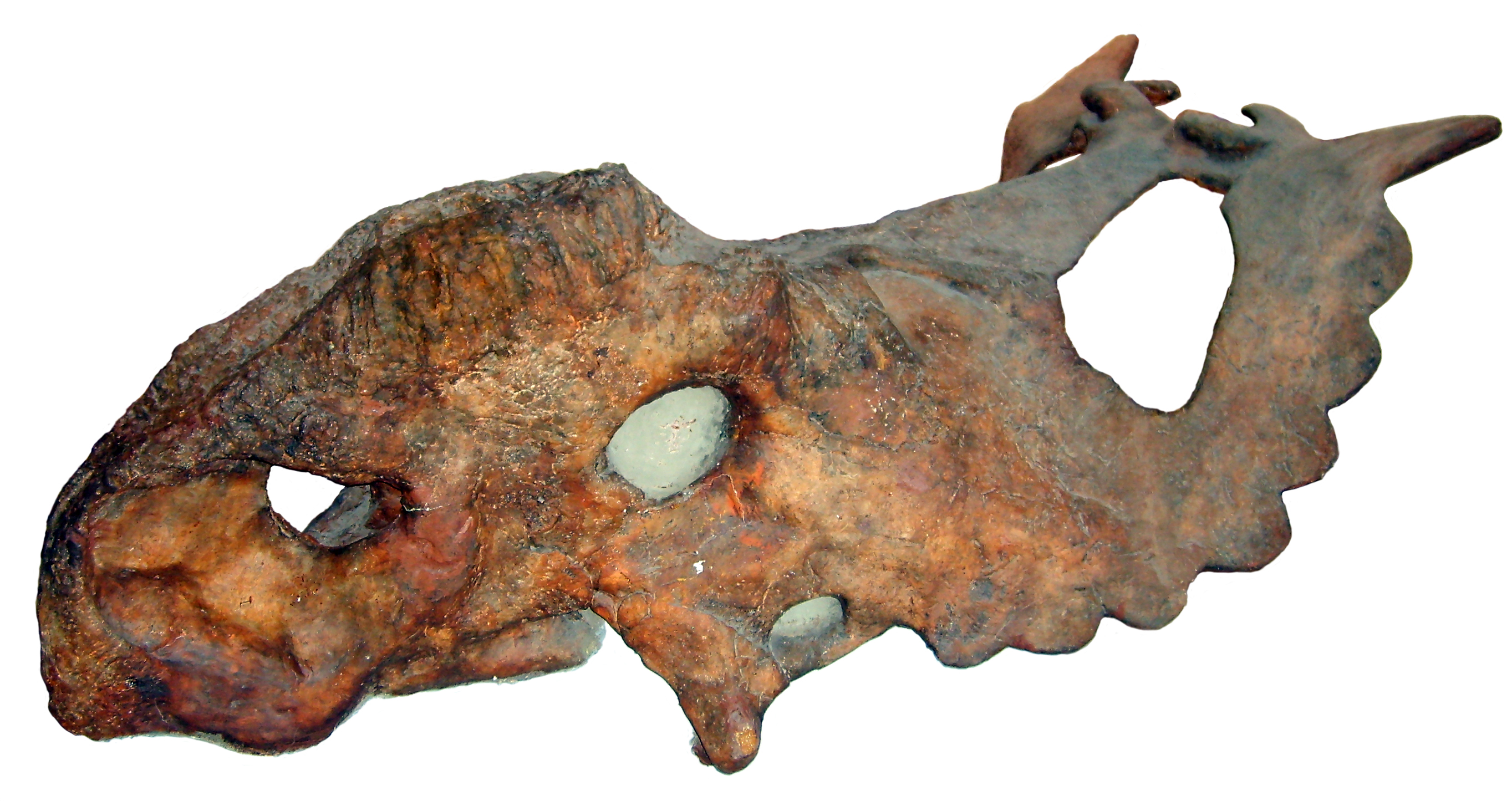
The skull was deep and heavily reinforced, with a parrot-like beak at the front and dense dental batteries farther back for slicing vegetation. A broad nasal boss occupied the snout, paired bosses rose above the eyes, and the short frill carried hooks and small marginal ornaments. The neck and torso were muscular, the forelimbs stout and slightly shorter than the hind limbs, and the hands and feet supported a graviportal four-legged stance. Skull ornament changed during growth, so juveniles did not look like scaled-down adults.
Evolutionary position
This simplified classification path shows one placement from Dinosauria to this species. Each step is clickable, and other analyses may support alternative relationships.
Open interactive positionScale
Simplified length comparison using preferred dataset estimates; body shape and posture are not represented.
Scientific record
Geologist J. S. Stewart reported a skull beside the Little Bow River east of Carmangay, while O. A. Erdman sent fragments from Scabby Butte to the National Museum of Canada in 1945. Charles M. Sternberg investigated both regions during the 1946 field season and collected additional skull material. In 1950 he named Pachyrhinosaurus canadensis from incomplete skull CMN 8867, with CMN 8866 among the key referred specimens. The fossils came from units historically called the Lower Edmonton and from the St. Mary River Formation; modern work places the main Horseshoe Canyon occurrence in a dated assemblage zone about 73.1–71.5 million years old.
Discovery credit: J. S. Stewart, O. A. Erdman, Charles M. Sternberg.
Naming authors: Charles M. Sternberg.
Palaeoenvironment
Pachyrhinosaurus canadensis inhabited coastal plains crossed by rivers near the retreating Western Interior Seaway. The lower Horseshoe Canyon Formation records a shift from warm, wet deltaic habitats toward cooler, seasonally wet and dry lowlands. Conifers, flowering plants, ferns and horsetails supplied vegetation, while hadrosaurs, armoured dinosaurs and tyrannosaurids occupied the wider ecosystem. The St. Mary River sites represent related inland floodplain settings farther south and west.
The beak cropped plants and dental batteries sliced them into manageable pieces. Multi-individual Pachyrhinosaurus sites containing animals of different ages suggest that at least some populations gathered, but several sites belong to other species and a bonebed does not reveal the duration or organisation of a herd. The nasal boss probably carried a keratinous covering and may have served for display or physical interaction. Direct head-butting is possible but not demonstrated, and the exact shape of the living structure is unknown.
Worth knowing
Fossil distribution
Southern Alberta, Canada
Horseshoe Canyon Formation
regional marker
Southern Alberta, Canada
St. Mary River Formation
regional marker
Markers are deliberately approximate. They identify published fossil areas without exposing sensitive excavation coordinates.
Open interactive mapFossil specimen record
Gatineau, Quebec, Canada
Research repository of the incomplete holotype skull and a principal referred skull used by Sternberg. The Natural Heritage Campus collections facility is not open to the public, so this entry does not imply current exhibition.
A research repository is not necessarily a public exhibit. Loan and display status can change, so check with the institution before visiting.
Media record
Evidence
Canadian Museum of Nature
Open sourceCharles M. Sternberg · National Museum of Canada Bulletin 118 · 1950
Open sourceDavid A. Eberth, Sandra L. Kamo · Canadian Journal of Earth Sciences 57(10) · 2020
Open sourceNatural History Museum, London
Open source