La Flecha ranch region
Chubut Province, Argentina
Cerro Barcino Formation
regional marker
Pronunciation: PAT-ah-go-TIE-tan my-OR-um
One of the largest and best-sampled giant titanosaurs, represented by more than 130 bones from at least six young adults buried during separate floods at one Patagonian quarry.
Last updated 14 July 2026
Field guide
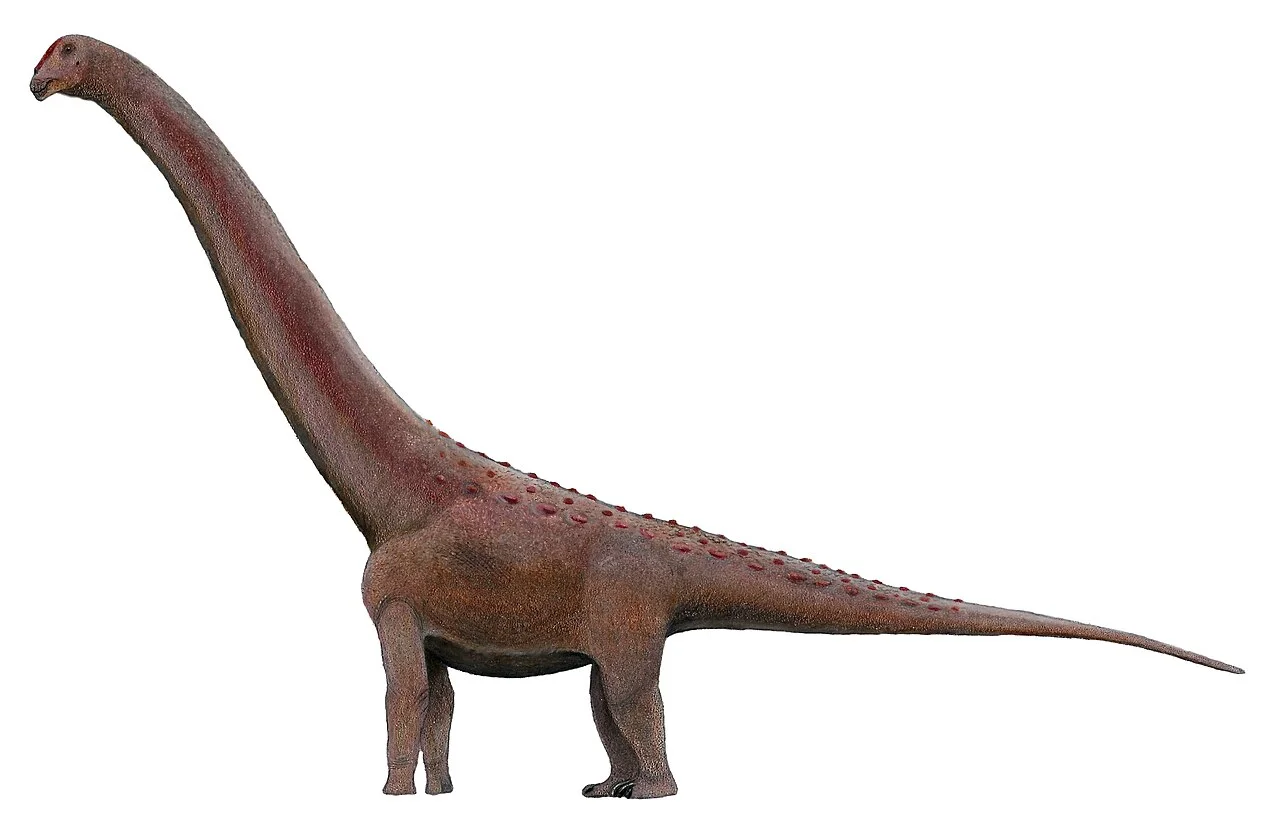
Patagotitan mayorum was a colossal titanosaur from the late Albian of Chubut Province, Argentina. Unlike most contenders for the largest dinosaur, it is represented by multiple individuals that collectively preserve much of the neck, trunk, tail and limb skeleton. This makes its proportions more defensible than those of Argentinosaurus, although no complete individual or skull is known. Current reconstructions commonly fall around 31-37.5 metres and 42.5-71.4 tonnes, with roughly 57 tonnes serving as a cautious central estimate.
Its fossils occur between approximately 101.8 and 101.4 million years ago. Values shown here are approximate and reflect the current curated seed dataset.
Form and function
Collectively the fossils include nine neck vertebral positions, nine of the probable ten dorsal positions, many tail vertebrae, ribs and chevrons, shoulder and chest bones, forelimb elements, pelvic bones and multiple femora. The neck vertebrae are extremely elongated and internally divided into many small air chambers. Thin but tall bony laminae strengthened the dorsal vertebrae, while an accessory hyposphene-hypantrum joint appears to have been retained only between the third and missing fourth dorsals. Broad anterior tail neural spines, an expanded scapular blade, distinctive humeral muscle scars and a straight distal femoral edge help diagnose the species.
Evolutionary position
This simplified classification path shows one placement from Dinosauria to this species. Each step is clickable, and other analyses may support alternative relationships.
Open interactive positionScale
Simplified length comparison using preferred dataset estimates; body shape and posture are not represented.
Scientific record
Ranch worker Aurelio Hernandez spotted the first giant bone at the Mayo family's La Flecha ranch in Chubut Province, and Oscar Mayo alerted palaeontologists at the Museo Paleontologico Egidio Feruglio. Excavations recovered more than 130 bones from at least six similar-sized individuals in three closely spaced flood deposits. Jose L. Carballido, Diego Pol and seven colleagues formally named Patagotitan mayorum in 2017. Patago refers to Patagonia, titan evokes the powerful beings of Greek mythology, and mayorum honours the Mayo family's hospitality during fieldwork.
Discovery credit: Aurelio Hernandez, Oscar Mayo, Museo Paleontologico Egidio Feruglio field team.
Naming authors: Jose L. Carballido, Diego Pol, Alejandro Otero and 6 coauthors.
Palaeoenvironment
The La Flecha quarry lay on a low-energy river floodplain represented by muddy sandstone and sandy mudstone of the Cerro Castano Member. Volcanic ash entered the basin, allowing a tuff beneath the fossil beds to be dated to about 101.62 million years ago. Repeated floods buried the Patagotitan remains without significant transport. The wider Cerro Barcino ecosystem included other sauropods, the large theropod Tyrannotitan, crocodyliforms, turtles and sphenodontians, with conifer and flowering-plant wood recorded in the formation.
All six known individuals were similar-sized young adults that died at the same place during at least three separate flooding events. The describing team interpreted this recurrence as site fidelity and possible social behaviour among giant titanosaurs. It is suggestive rather than proof of a permanent herd: the animals were not one simultaneous group death, and the quarry preserves no trackway showing how they moved together. Histology indicates the sampled individuals were still growing. Feeding mechanics and reproduction are reconstructed from sauropods generally because no Patagotitan skull, nest or egg has been identified.
Worth knowing
Fossil distribution
Chubut Province, Argentina
Cerro Barcino Formation
regional marker
Markers are deliberately approximate. They identify published fossil areas without exposing sensitive excavation coordinates.
Open interactive mapFossil specimen record
Trelew, Argentina
Repository of the holotype and referred specimens. MEF permanently displays a life-sized skeletal replica, an original femur and additional original fossils; a larger temporary selection was shown during July 2025.
Chicago, United States
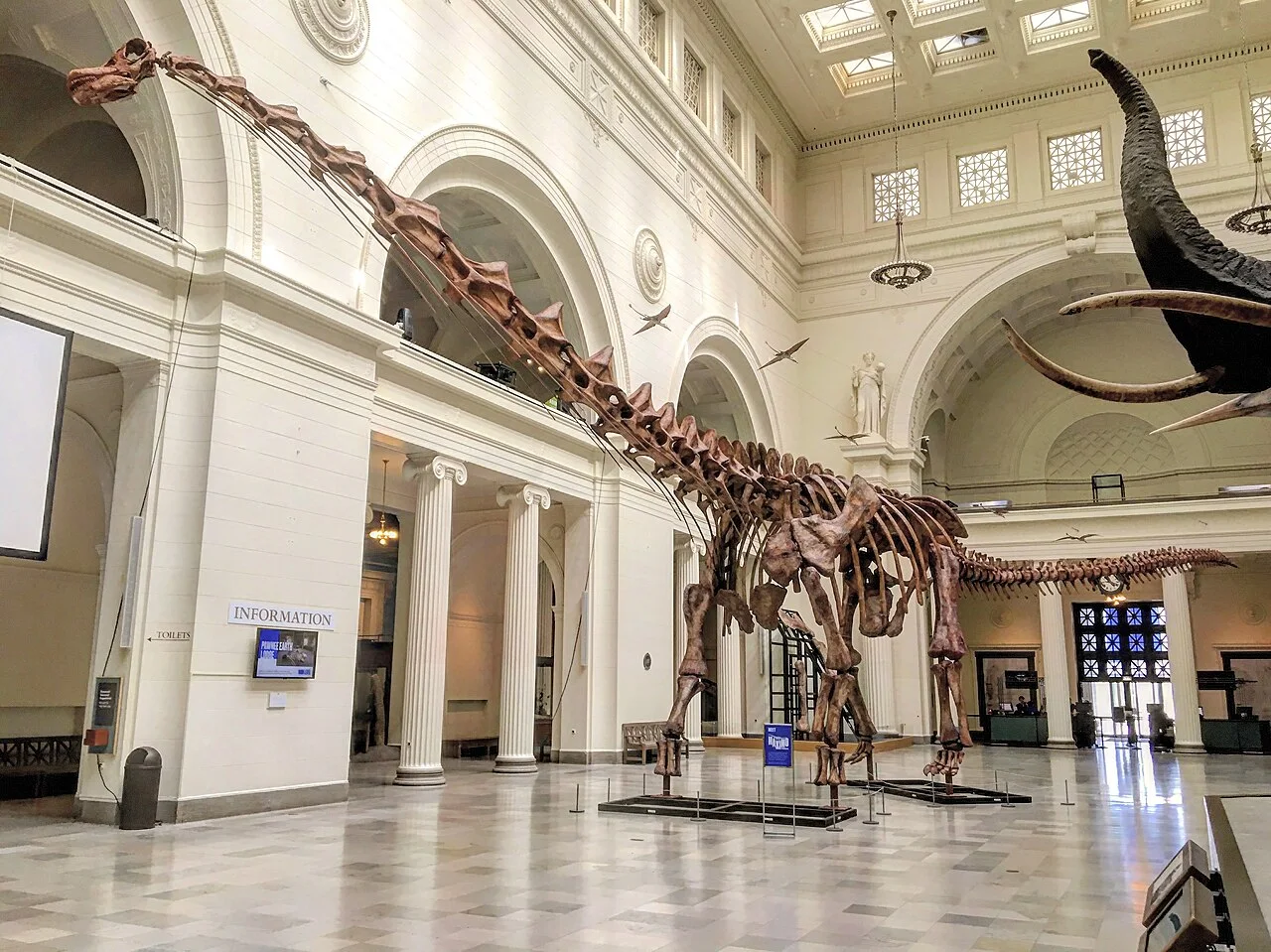
Permanent 37-metre skeletal cast based on the La Flecha fossils, extending across Stanley Field Hall. Maximo is a composite cast rather than one original skeleton; the original Patagotitan collection remains at MEF in Argentina.
A research repository is not necessarily a public exhibit. Loan and display status can change, so check with the institution before visiting.
Media record
Evidence
Jose L. Carballido, Diego Pol, Alejandro Otero and 6 coauthors · Proceedings of the Royal Society B 284 · 2017
Open sourceAlejandro Otero, Jose L. Carballido, Agustin Perez Moreno · Journal of Vertebrate Paleontology 40(4) · 2020
Open sourceJ. Marcelo Krause, Jahandar Ramezani, Aldo M. Umazano and 6 coauthors · Gondwana Research 80 · 2020
Open sourceNicolas E. Campione, David C. Evans · Biological Reviews 95(6) · 2020
Open sourceMuseo Paleontologico Egidio Feruglio · 2017
Open sourceMuseo Paleontologico Egidio Feruglio · 2025
Open sourceField Museum
Open sourceNatural History Museum, London
Open source