Trossingen bonebeds
Baden-Württemberg, Germany
Trossingen Formation
approximate site marker
Pronunciation: PLAT-ee-oh-SORE-us TROSS-ing-EN-sis
A large, obligately bipedal Late Triassic herbivore known from exceptionally complete European skeletons. Its holotype, growth record and healed injuries make it a cornerstone for understanding early sauropodomorphs.
Last updated 13 July 2026
Field guide
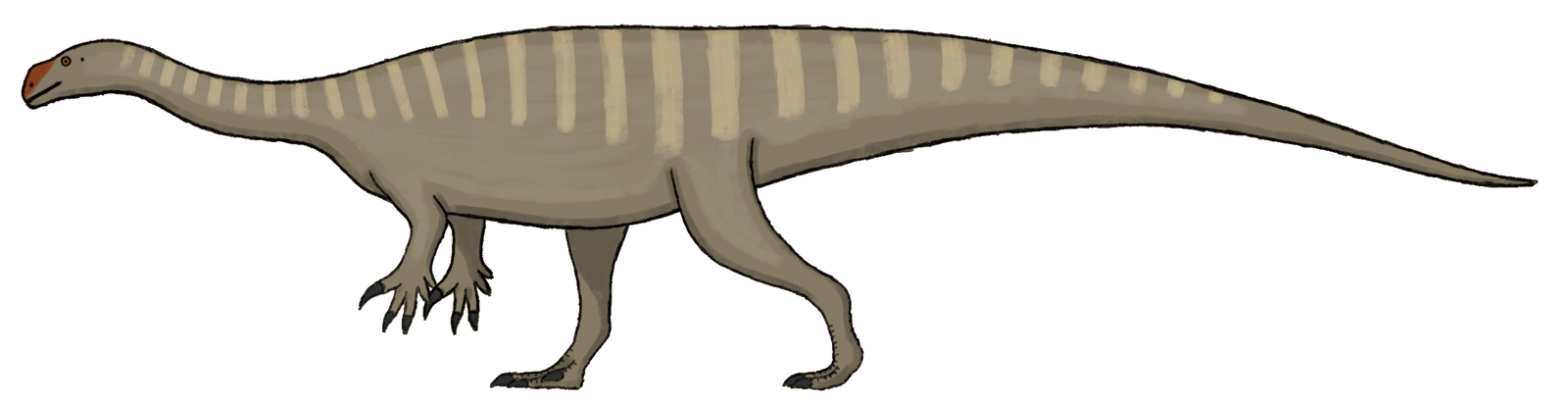
Plateosaurus trossingensis was an early sauropodomorph: a comparatively large, long-necked herbivorous dinosaur from before the age of giant quadrupedal sauropods. It carried a small skull on a flexible neck, a deep body above powerful hind limbs and a long muscular tail. The shorter forelimbs ended in mobile grasping hands with an enlarged inner claw. Digital skeletal studies indicate that the palms could not rotate into the flat, forward-facing position needed for ordinary quadrupedal walking, making Plateosaurus an obligate biped despite many older four-footed reconstructions.
Its fossils occur between approximately 214 and 204 million years ago. Values shown here are approximate and reflect the current curated seed dataset.
Form and function
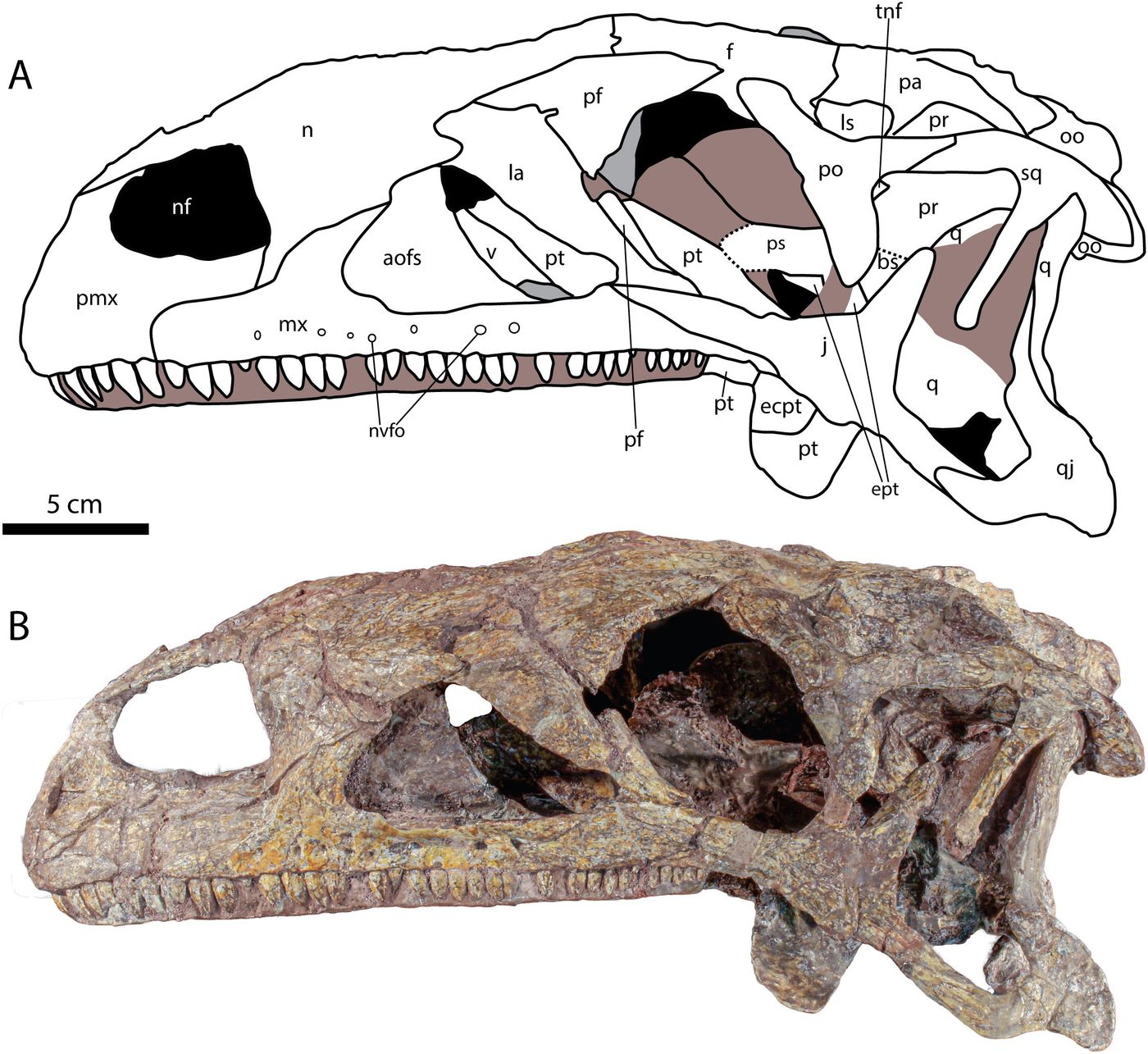
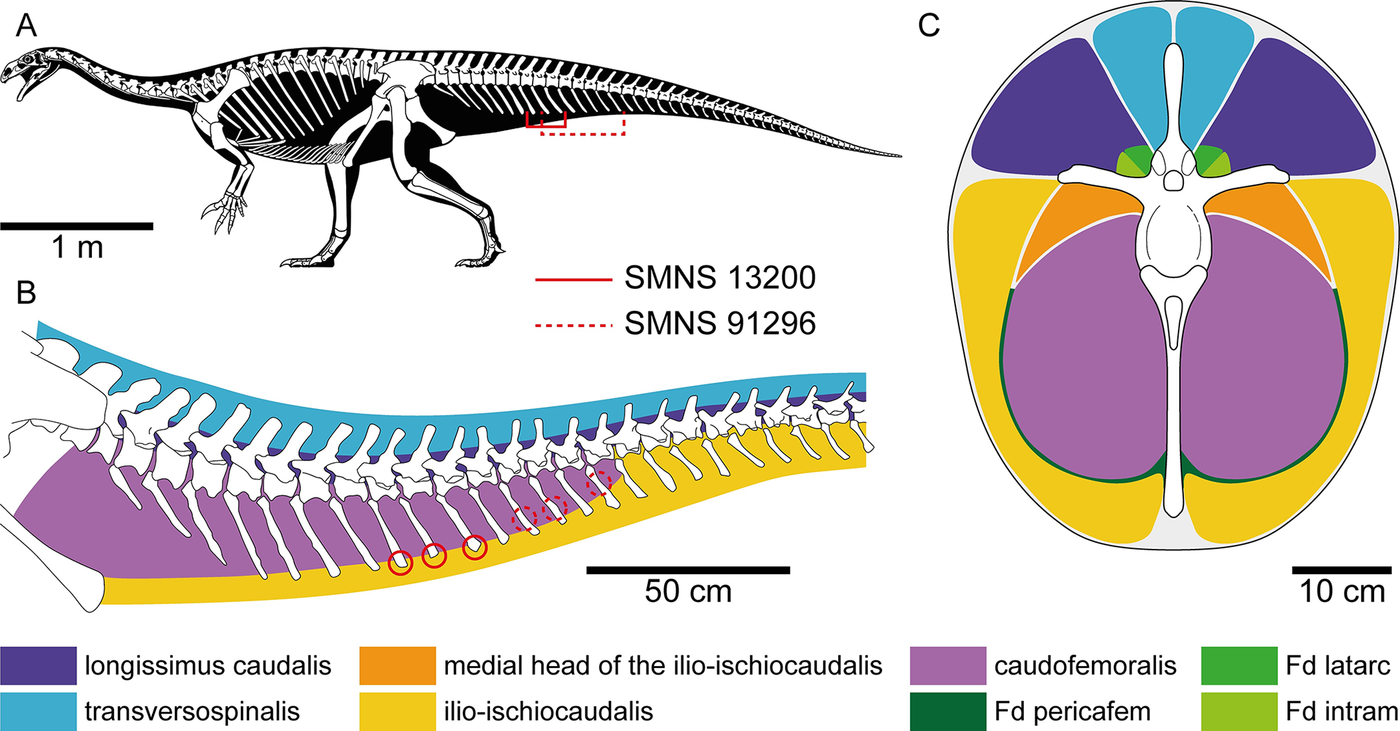
Holotype SMNS 13200 preserves almost the entire skeleton, including a largely articulated skull about 34 centimetres long. The jaw carried numerous small, coarsely serrated leaf-shaped teeth suited to cropping plant material. Five-fingered hands remained free for grasping, with a large thumb claw whose exact function is unknown. Robust hind limbs supported the body, and powerful tail muscles helped balance and propel the animal. Some parts of the holotype were restored in plaster during early preparation, but the 2024 redescription explicitly distinguishes restoration from original bone.
Evolutionary position
This simplified classification path shows one placement from Dinosauria to this species. Each step is clickable, and other analyses may support alternative relationships.
Open interactive positionScale
Simplified length comparison using preferred dataset estimates; body shape and posture are not represented.
Scientific record
Eberhard Fraas recovered the almost complete skeleton SMNS 13200 from the lower bonebed at Trossingen in 1912 and named Plateosaurus trossingensis in 1913. Friedrich von Huene produced its first full anatomical description in 1926. The genus Plateosaurus had originally been named by Hermann von Meyer in 1837 for fragmentary P. engelhardti material, creating a long-running nomenclatural problem. In 2019 the International Commission on Zoological Nomenclature designated P. trossingensis as the genus’s type species, tying the name Plateosaurus to diagnostic material. A modern, specimen-based redescription of SMNS 13200 followed in 2024.
Discovery credit: Eberhard Fraas.
Naming authors: Eberhard Fraas.
Palaeoenvironment
The Trossingen Formation records broad, seasonally wet and dry lowlands crossed by shallow drainage systems. Mudstone bonebeds accumulated over multiple events rather than one instantaneous catastrophe. Plateosaurus browsed among seed ferns, conifers and other Triassic vegetation alongside smaller reptiles and archosaurs. Swiss finds from Frick come from a semi-arid basin with flood-prone mud flats that could become dangerous natural traps.
Plateosaurus was primarily a terrestrial browser that cropped vegetation with its serrated teeth while the hands remained available to pull branches or manipulate food. The enlarged thumb claw may have helped in feeding or defence, but no direct trace selects one use. Bone histology shows unusually flexible growth: animals of similar age could differ greatly in size, and the age at which growth slowed varied between individuals. Healed tail injuries demonstrate that some animals survived substantial trauma; competing explanations include accidents in mud, tendon strain, social impacts and predator attacks.
Worth knowing
Fossil distribution
Baden-Württemberg, Germany
Trossingen Formation
approximate site marker
Canton of Aargau, Switzerland
Klettgau Formation
regional marker
Markers are deliberately approximate. They identify published fossil areas without exposing sensitive excavation coordinates.
Open interactive mapFossil specimen record
Stuttgart, Germany
The museum houses holotype SMNS 13200 in its scientific collection and displays a full skeletal model based on it. The model and the original research specimen are clearly distinguished.
Zurich, Switzerland
Original, almost complete Frick skeleton excavated in 2018 and displayed in its burial pose beside a life-sized reconstruction. The exhibit incorporates the individual’s severe chronic right-shoulder pathology.
A research repository is not necessarily a public exhibit. Loan and display status can change, so check with the institution before visiting.
Media record
Evidence
Joep Schaeffer · Journal of Systematic Palaeontology · 2024
Open sourceInternational Commission on Zoological Nomenclature · Bulletin of Zoological Nomenclature · 2019
Open sourceHeinrich Mallison · Palaeontologia Electronica · 2010
Open sourceP. Martin Sander, Nicole Klein · Science · 2005
Open sourceJoep Schaeffer, Ewan Wolff, Florian Witzmann and 3 coauthors · PLOS ONE · 2024
Open sourceState Museum of Natural History Stuttgart · 2024
Open sourceUniversity of Zurich · 2025
Open source