Flaming Cliffs (Bayn Dzak)
Gobi Desert, Mongolia
Djadokhta Formation
approximate site marker
Pronunciation: PRO-toh-SER-ah-tops an-DROO-see
A sheep- to pig-sized, four-legged ceratopsian from Mongolia’s Late Cretaceous dune fields, known from abundant skulls and skeletons, a juvenile nest and the extraordinary ‘Fighting Dinosaurs’ fossil.
Last updated 13 July 2026
Field guide
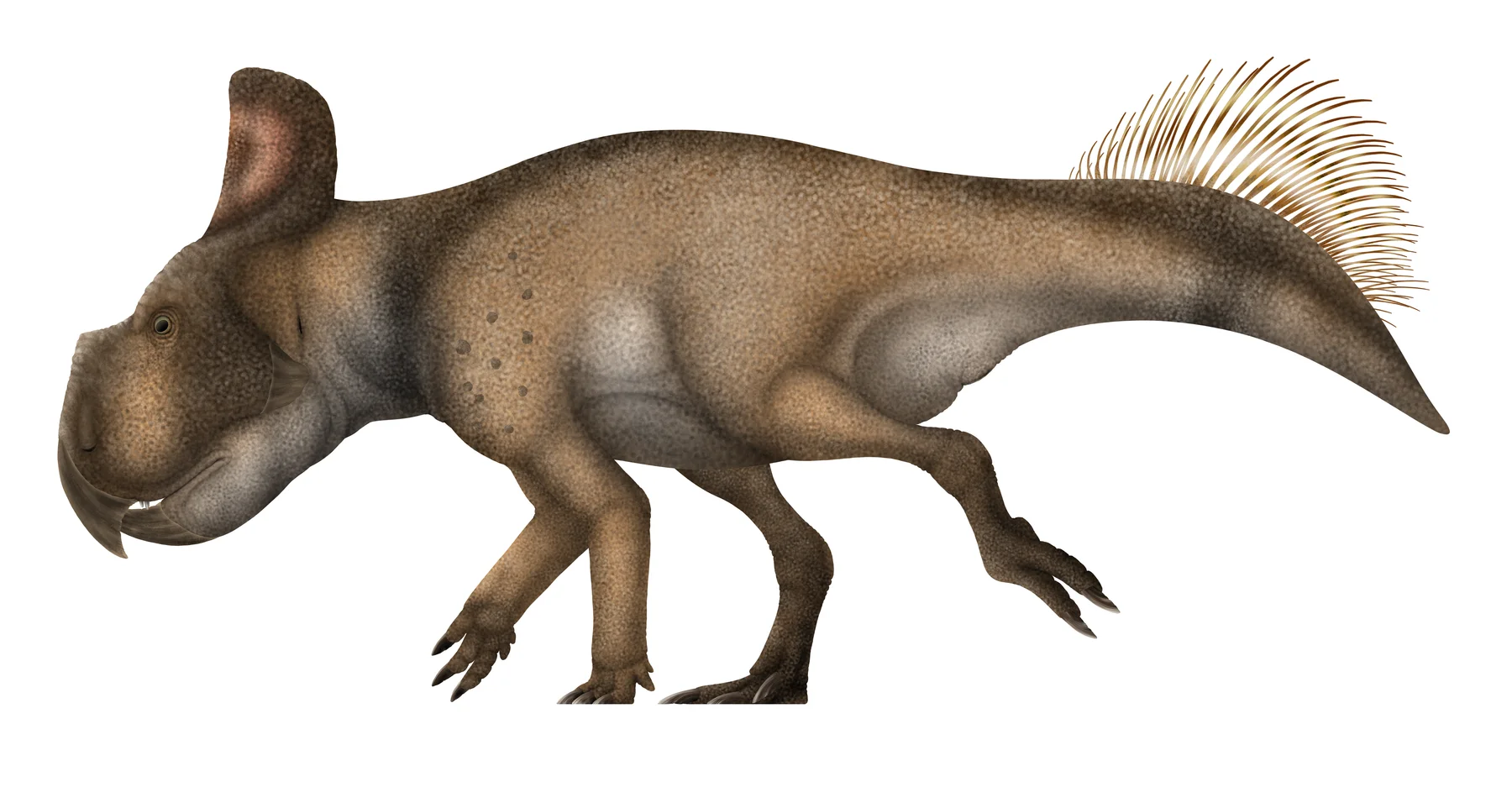
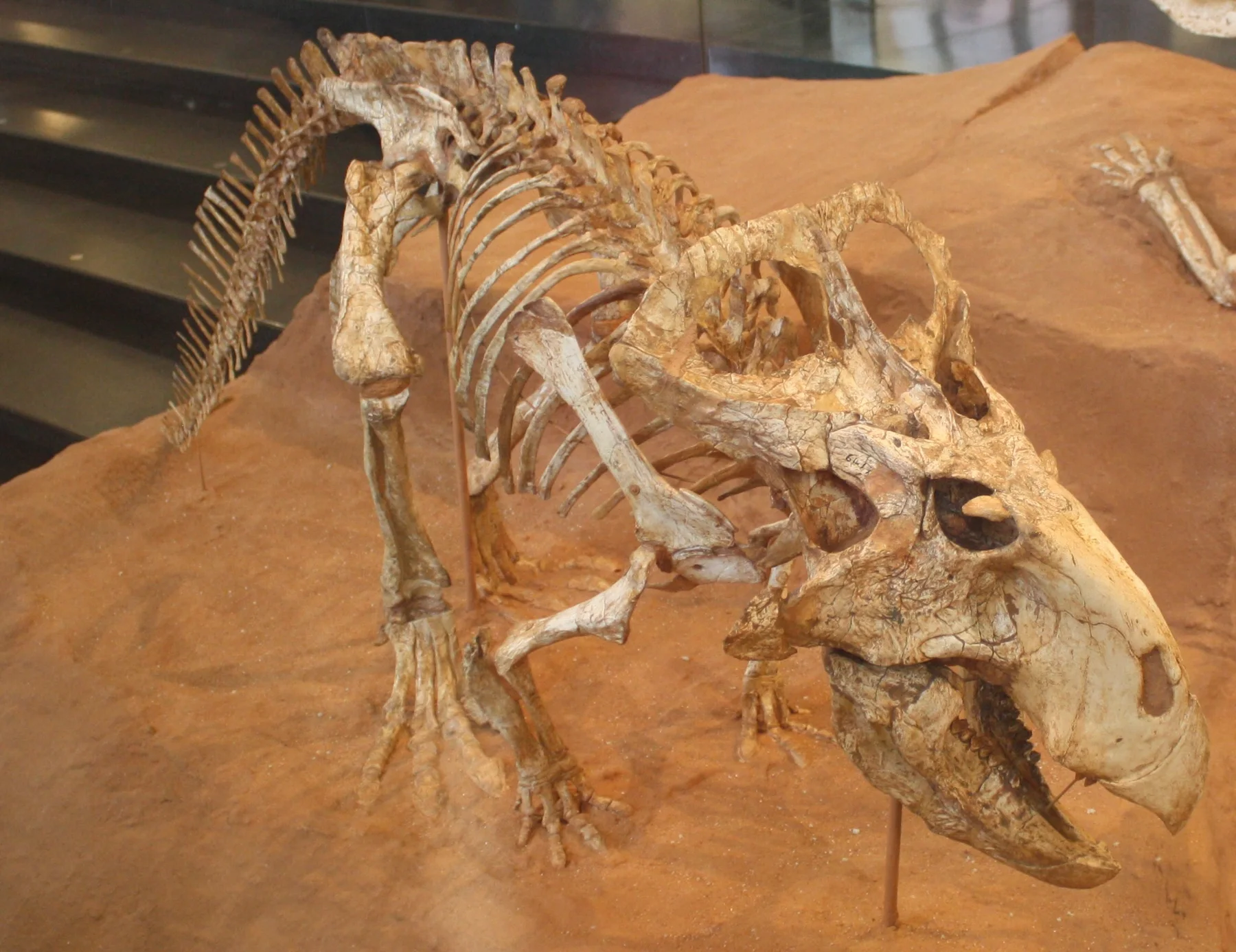
Protoceratops andrewsi was a small, stout neoceratopsian that lived in the Djadokhta dune fields of Late Cretaceous Mongolia. Its skull combined a deep beak, a modest nasal boss and a broad fenestrated frill, but lacked the long horns of later ceratopsids. Numerous skulls from small juveniles to large adults document dramatic growth: the snout deepened and the frill expanded disproportionately as the animal matured. The skeleton indicates mainly quadrupedal locomotion, with some capacity to rear. Exceptional fossils add rare behavioural context. Fifteen juveniles were preserved together in a bowl-shaped nest, and another individual died entangled with Velociraptor mongoliensis. Neither occurrence tells a complete life story, but together they make P. andrewsi one of the most behaviourally informative non-ceratopsid ceratopsians.
Its fossils occur between approximately 75 and 71 million years ago. Values shown here are approximate and reflect the current curated seed dataset.
Form and function
A narrow, down-curved rostral bone supported a keratinous beak at the front of the upper jaw, opposed by the predentary beak below. Behind it, closely packed cheek teeth formed slicing surfaces for vegetation. The skull broadened toward a parietal-squamosal frill pierced by two large openings that reduced its weight. Adults developed a low nasal boss rather than a long horn and prominent jugal projections at the cheeks. The neck and trunk were robust, the forelimbs weight-bearing and the hind limbs longer and more powerful. Mature shoulder, elbow and forearm anatomy is consistent with habitual quadrupedalism, while some retained features may have allowed occasional rearing on the hind legs.
Evolutionary position
This simplified classification path shows one placement from Dinosauria to this species. Each step is clickable, and other analyses may support alternative relationships.
Open interactive positionScale
Simplified length comparison using preferred dataset estimates; body shape and posture are not represented.
Scientific record
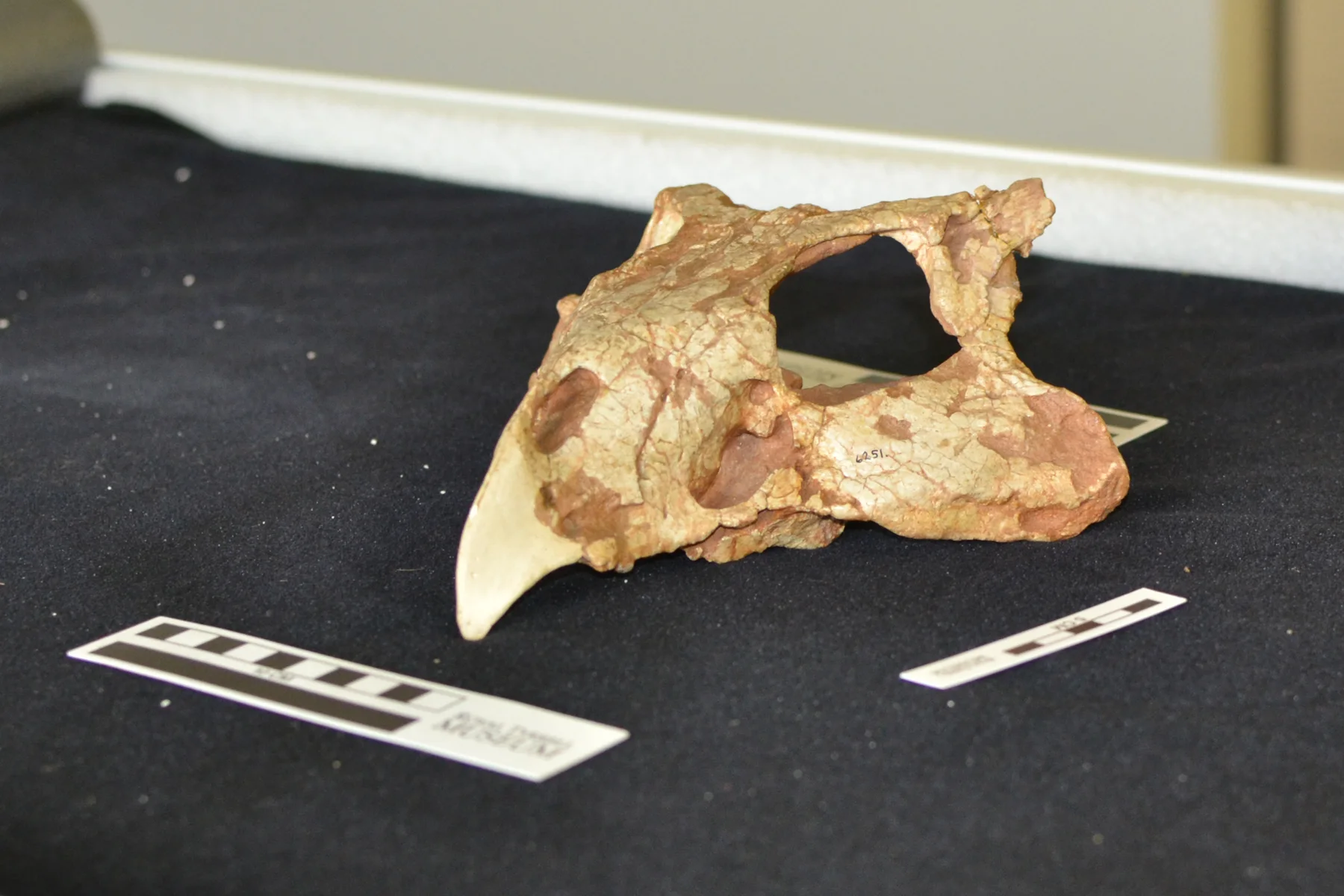
James Blaine Shackelford found the partial juvenile skull AMNH 6251 during the American Museum’s 1922 Central Asiatic Expedition in Mongolia. Walter W. Granger and William King Gregory named Protoceratops andrewsi in 1923, honouring expedition leader Roy Chapman Andrews. The following expeditions recovered many additional skulls and skeletons at the Flaming Cliffs, producing an unusually broad growth series. Eggs discovered there in 1923 were assigned to Protoceratops largely because it was the common dinosaur nearby. That attribution collapsed in 1994 when an embryo inside the same egg type proved to be an oviraptorid, a correction now incorporated into the museum’s own account.
Discovery credit: James Blaine Shackelford.
Naming authors: Walter W. Granger, William King Gregory.
Palaeoenvironment
Protoceratops lived among the wind-built dunes and sandy interdune areas recorded by the Djadokhta Formation. The climate was arid to semi-arid, but episodic moisture and patches of vegetation supported a diverse small-bodied fauna. Velociraptor, Oviraptor, Saurornithoides and the armored Pinacosaurus occupied the same broad formation, alongside lizards, mammals and other reptiles. Burial in collapsing or rapidly shifting sand helps explain the three-dimensional skeletons, nests and close associations for which the unit is famous, although no single death mechanism explains every specimen.
The beak and cheek-tooth wear establish herbivory, while the deep jaws supplied leverage for cropping and slicing plants. Adult limb anatomy indicates mainly four-legged travel; rearing to feed, display or defend is mechanically possible but is not directly recorded. The ‘Fighting Dinosaurs’ specimen MPC-D 100/25 preserves P. andrewsi locked against Velociraptor mongoliensis, providing exceptional evidence of a direct physical encounter even though the precise sequence of attack, defence and burial remains debated. A separate nest with fifteen similarly sized juveniles shows that young animals remained together after hatching. It is compatible with extended nest use, but without an adult it does not by itself prove parental care. Strong positive growth of the frill is consistent with a visual social or sexual signal, not proof of one exclusive function.
Worth knowing
Fossil distribution
Gobi Desert, Mongolia
Djadokhta Formation
approximate site marker
Markers are deliberately approximate. They identify published fossil areas without exposing sensitive excavation coordinates.
Open interactive mapFossil specimen record
New York, United States
The museum currently lists Protoceratops andrewsi among its dinosaur displays and shows original skeletons and a growth series from the Mongolian expeditions. Its current egg explainer also corrects the historical Protoceratops assignment: the nearby classic egg type is oviraptorid, not evidence for this species.
New York, United States
Repository of the original expedition series, including holotype skull AMNH 6251 and articulated skeletons such as AMNH 6416. The museum archive verifies catalogue numbers and historic displays; individual specimens may rotate between research and exhibition use.
A research repository is not necessarily a public exhibit. Loan and display status can change, so check with the institution before visiting.
Media record
Evidence
Rinchen Barsbold · Paleontological Journal · 2016
Open sourceAmerican Museum of Natural History
Open sourceMark A. Norell, James M. Clark, Demberelyin Dashzeveg and 6 coauthors · Science · 1994
Open sourceAmerican Museum of Natural History
Open sourceWalter W. Granger, William King Gregory · American Museum Novitates 72 · 1923
Open sourceDavid E. Fastovsky, David B. Weishampel, Mahito Watabe and 3 coauthors · Journal of Paleontology · 2011
Open sourceLeonardo Maiorino, Andrew A. Farke, Tassos Kotsakis, Paolo Piras · PLOS ONE · 2015
Open sourceAndrew Knapp, Robert J. Knell, David W. E. Hone · Proceedings of the Royal Society B · 2021
Open sourceJustyna Słowiak, Victor S. Tereshchenko, Łucja Fostowicz-Frelik · PeerJ · 2019
Open sourceAmerican Museum of Natural History Digital Collections
Open source