Öösh fossil region
Gobi Desert, Mongolia
Öösh Formation
regional marker
Pronunciation: sit-AK-oh-SORE-us mon-go-lee-EN-sis
A small, primarily bipedal Early Cretaceous ceratopsian from Mongolia with a deep skull, parrot-like beak, flared cheek bones and clusters of polished stones preserved inside some skeletons.
Last updated 13 July 2026
Field guide
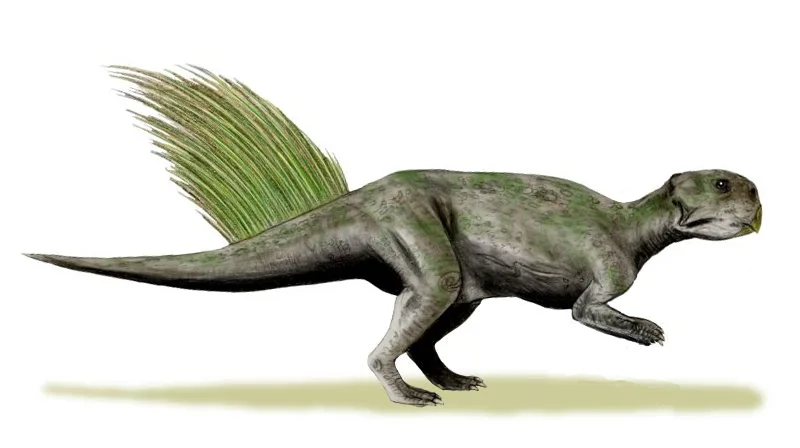
Psittacosaurus mongoliensis was an early member of Ceratopsia, the lineage that later produced Protoceratops and the giant horned dinosaurs. It lacked the long frill and facial horns of those later relatives, but already possessed the group’s distinctive rostral bone at the tip of the upper beak. A short trunk, long hind limbs, much shorter forelimbs and a balancing tail made the adult animal principally bipedal. The name-bearing skeleton AMNH 6254 came from the Öösh locality in Mongolia and remains central to the species. Other referred skeletons preserve growth stages and concentrated masses of rounded stones. The famous Psittacosaurus specimen with skin, countershading and tail bristles belongs to an uncertain species from China and cannot safely supply those features to P. mongoliensis.
Its fossils occur between approximately 110 and 100 million years ago. Values shown here are approximate and reflect the current curated seed dataset.
Form and function
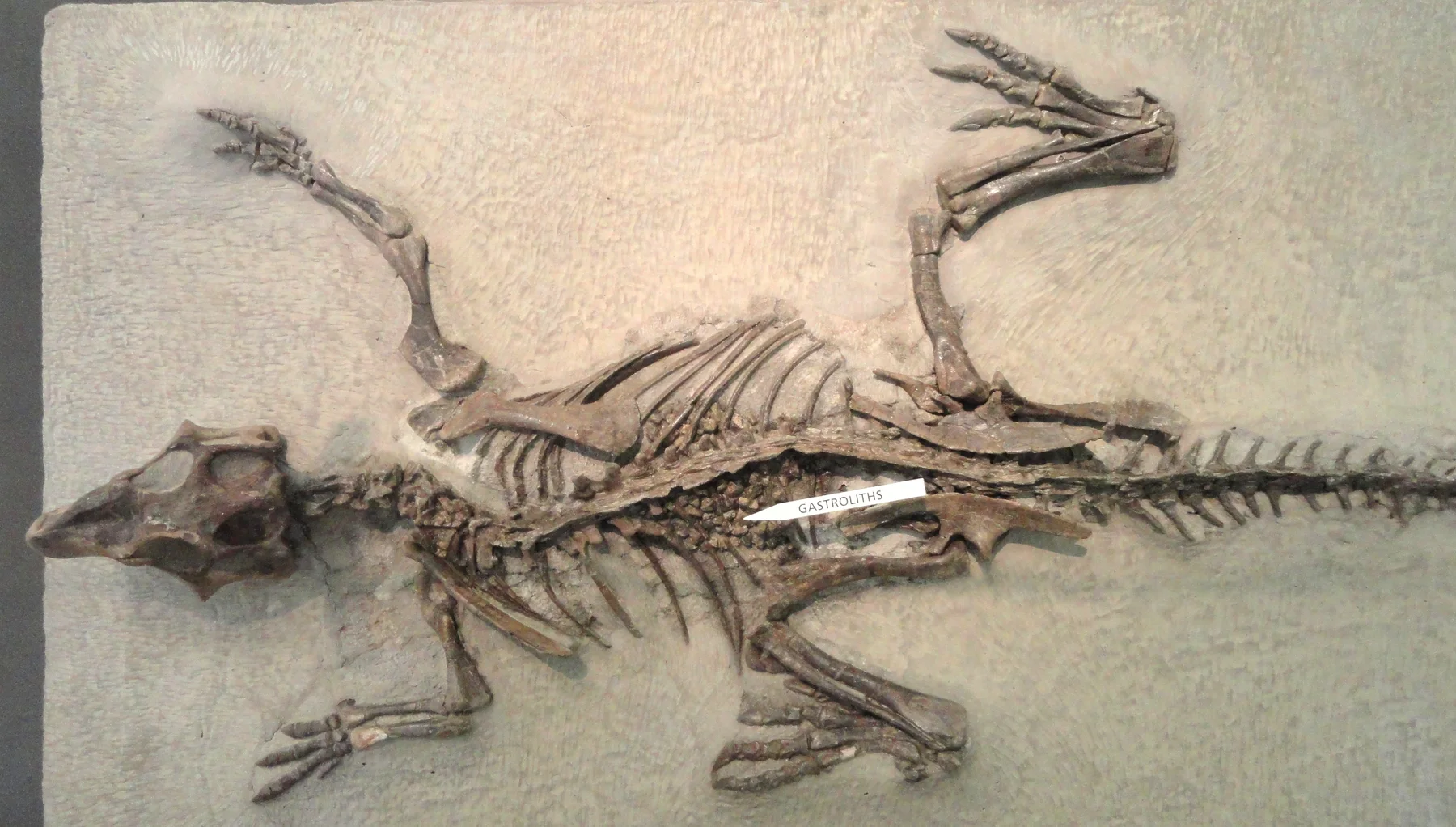
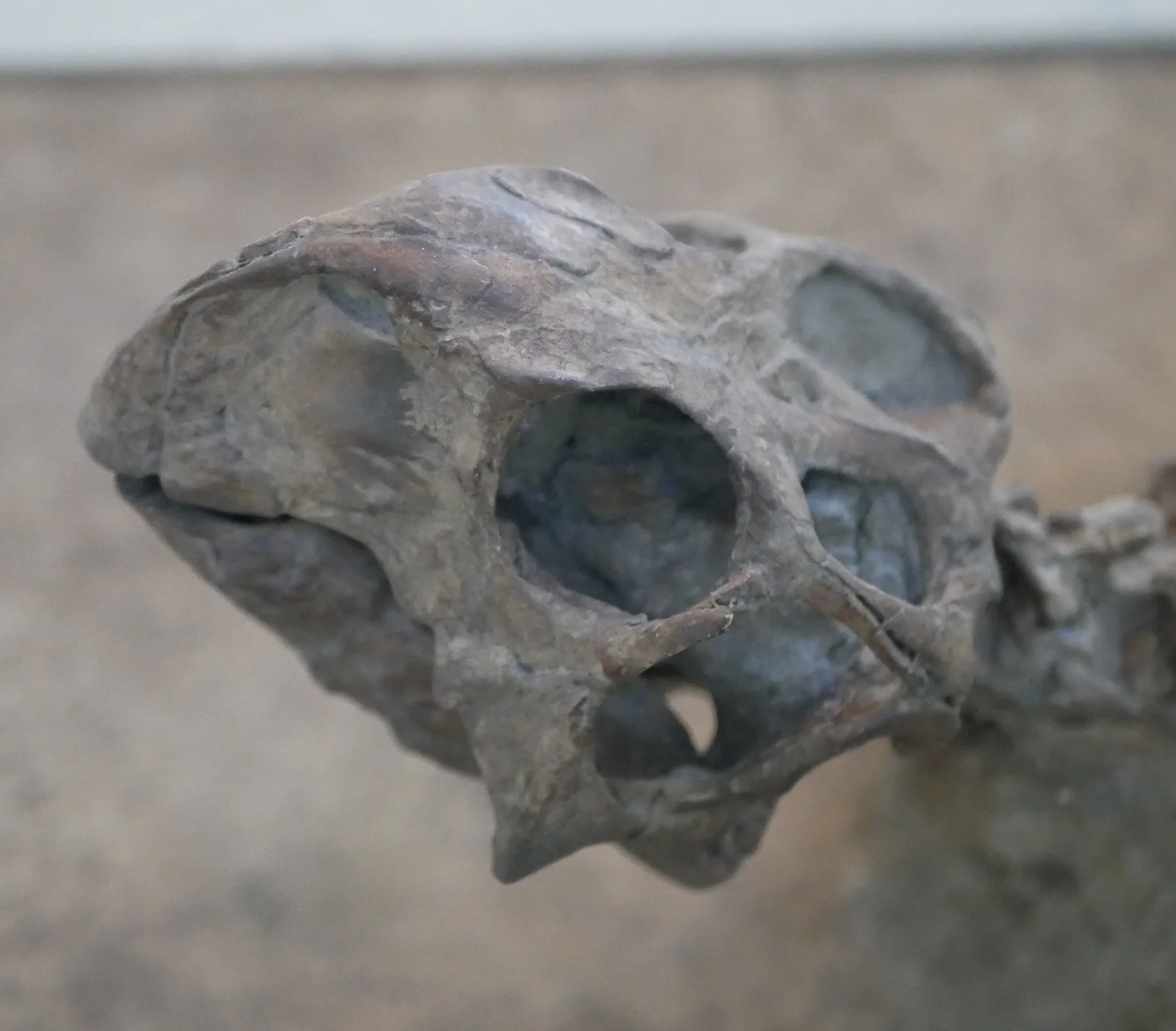
The skull was high and short, with a strongly curved rostral bone forming the core of a keratin-covered upper beak. Large eye sockets and outwardly expanded jugal bones gave the head a broad, angular outline, but there was no enlarged neck frill. Teeth were confined behind the beak; oblique wear facets show that the jaws processed vegetation rather than merely clipping it. Each hand had four digits, a reduction from the five-fingered condition of many early ornithischians. The hind limbs were substantially longer and more robust than the forelimbs, supporting habitual bipedal locomotion. Several referred P. mongoliensis skeletons contain tightly associated polished stones interpreted as gastroliths, although exactly how much grinding occurred in the gut remains debated.
Evolutionary position
This simplified classification path shows one placement from Dinosauria to this species. Each step is clickable, and other analyses may support alternative relationships.
Open interactive positionScale
Simplified length comparison using preferred dataset estimates; body shape and posture are not represented.
Scientific record
During the American Museum of Natural History’s 1922 Central Asiatic Expedition, a Mongolian driver recorded as Wong found the ‘Red Mesa skeleton’ at Öösh in the Artsa Bogdo Basin. The specimen, AMNH 6254, includes a skull and much of an articulated skeleton. Henry Fairfield Osborn introduced Psittacosaurus mongoliensis in 1923 and provided a fuller description in 1924. In the same work he named another expedition skeleton Protiguanodon mongoliense; later study placed that animal within Psittacosaurus and generally treated the name as a synonym of P. mongoliensis. Additional Mongolian specimens, including juveniles and histologically sampled long bones, have made the species important for studying early ceratopsian growth.
Discovery credit: Wong (Central Asiatic Expedition driver).
Naming authors: Henry Fairfield Osborn.
Palaeoenvironment
The Öösh locality lay in an inland Early Cretaceous basin in what is now southern Mongolia. Its terrestrial sediments preserve an ecosystem much less densely sampled than the younger Gobi dune fields. The available rocks and fauna are compatible with a seasonally dry landscape crossed by local water sources, but the precise mix of dunes, floodplains and vegetated ground is not securely resolved. The formation’s age has also been assigned differently in the literature, so this profile uses a cautious Aptian–Albian interval rather than presenting one exact date as settled.
The beak and worn cheek teeth identify Psittacosaurus mongoliensis as a plant eater capable of cropping and processing relatively tough vegetation. Concentrated stone masses inside referred skeletons are consistent with additional food processing in a muscular gut, but they do not reveal a preferred plant. Adult limb proportions support habitual movement on two legs; the forelimbs could still brace or manipulate objects without making the animal a regular quadruped. Long-bone histology records an S-shaped growth curve and maximum growth faster than living reptiles and marsupials but slower than most birds and placental mammals. No species-specific nest, trackway or mass association demonstrates parental care, herd structure or migration.
Worth knowing
Fossil distribution
Gobi Desert, Mongolia
Öösh Formation
regional marker
Markers are deliberately approximate. They identify published fossil areas without exposing sensitive excavation coordinates.
Open interactive mapFossil specimen record
New York, United States
The current hall page lists a Psittacosaurus model on Floor 4. It is an educational reconstruction rather than the name-bearing fossil and should be read alongside the hall’s real skeletal material.
New York, United States
Repository of holotype AMNH 6254, the skull and partial articulated skeleton collected at Öösh in 1922. The museum’s catalogue-linked archive verifies the specimen number, locality and repository; continuous public display of the original is not promised.
A research repository is not necessarily a public exhibit. Loan and display status can change, so check with the institution before visiting.
Media record
Evidence
Henry Fairfield Osborn · American Museum Novitates 95 · 1923
Open sourcePaul C. Sereno · New Perspectives on Horned Dinosaurs · 2010
Open sourceGregory M. Erickson, Tatyana A. Tumanova · Zoological Journal of the Linnean Society · 2000
Open sourceAmerican Museum of Natural History
Open sourceAmerican Museum of Natural History Digital Collections
Open source